

Think living in part of your rental lets you skip rental taxes? Think again.
House hacking creates a mixed-use tax situation where every dollar, expense, and tax benefit must be split between personal and rental use.
This post walks you through the essentials: how to report rental income on Schedule E, how to prorate shared expenses, how depreciation must be calculated (and why you can’t just skip it), and what happens at sale with recapture and the home-sale exclusion.
Read on to learn the simple screens and common red flags.
Core Tax Rules Landlords Must Know When House Hacking
House hacking creates a mixed-use tax situation. The IRS doesn’t let you pick one treatment and run with it. When you live in a property while renting out parts of it, you’re splitting every dollar of income, every expense, every tax benefit between rental and personal use. There’s no shortcut election. You allocate based on a reasonable method (usually bedrooms or square footage) and stick with it across every line on your return.
Rental income and rental deductions go on Schedule E, not your personal itemized Schedule A. That rental portion generates its own income statement: depreciation, repair costs, utilities, net profit or loss. The personal portion’s mortgage interest and property tax might qualify for Schedule A deductions if you itemize, but those hit the $10,000 SALT cap and standard-deduction thresholds. If your rental portion shows a loss, you can’t just offset W-2 income without checking passive-loss rules first.
Your allocation method sets the baseline for everything else. Own a 10-bedroom house and occupy two bedrooms yourself? You’d allocate 80 percent to rental use (10 bedrooms, 2 personal, so 80% rental). Prefer square footage? If your 4,000-square-foot home includes a 1,000-square-foot owner’s unit, your rental percentage is 75 percent (4,000 total sq ft, your unit 1,000 sq ft, so 75% rental). Document the method and the measurements that support it. Keep floor plans, photos, appraisal reports showing bedroom counts or square-footage breakdowns. Once you elect a method, apply it across income, expenses, and depreciation for the entire year.
Core tax consequences you’ll handle when house hacking:
- Income reporting requirement: All rent collected from tenants is taxable income, reported on Schedule E regardless of how you use the rest of the property.
- Expense allocation requirement: Every shared expense (mortgage interest, property tax, insurance, utilities, repairs to common areas) gets split using your documented rental-use percentage.
- Depreciation requirement: You must claim depreciation on the rental portion of the building. Failing to claim it still triggers recapture when you sell.
- Mixed-use documentation requirement: The IRS expects contemporaneous records proving how you calculated your rental percentage and how you allocated each expense.
- Primary residence interaction: Because you live in part of the property, sale of the property can trigger both capital-gains exclusion rules and depreciation recapture rules at the same time.
Rental Expense Deductions Under House Hacking Rules

Unit-specific repairs and expenses that benefit only the rental portion are fully deductible without proration. Replace a faucet in a tenant’s bathroom, repaint a rental bedroom, fix a broken window in unit 2? Those costs are 100 percent rental expenses (unit-specific repairs in unit #2 not occupied by you are 100% rental expenses for that unit). Shared expenses that benefit the entire property get allocated between rental and personal using your documented percentage. You pay $3,600 per year for water service that covers all units, and your rental-use percentage is 30 percent? You deduct $1,080 on Schedule E and treat the remaining $2,520 as a nondeductible personal expense.
Repairs and maintenance are deductible in the year incurred for the rental portion. Improvements get capitalized and depreciated. Patch a leaky pipe? That’s a repair. Replace the entire plumbing system? That’s an improvement added to basis and depreciated over 27.5 years. The de minimis safe harbor lets you expense items under $2,500 per invoice without capitalizing them, but you need an accounting policy in place to use it. Expenses incurred before a unit is placed in service for rental (before it’s advertised or available to rent) must be capitalized to basis rather than deducted as operating expenses. Once the unit is in service, ordinary repairs and maintenance become deductible.
Common house-hacking deductions landlords claim on Schedule E:
- Repairs to rental areas or shared systems, prorated if shared
- Utilities paid on behalf of tenants, or shared utilities times rental percentage
- Insurance premiums for the property times rental percentage
- HOA fees or condo fees times rental percentage
- Legal and accounting fees directly related to the rental activity
- Travel mileage for rental-related errands (IRS standard rate, documented trips)
Depreciation Rules for the Rental Portion of a House Hack
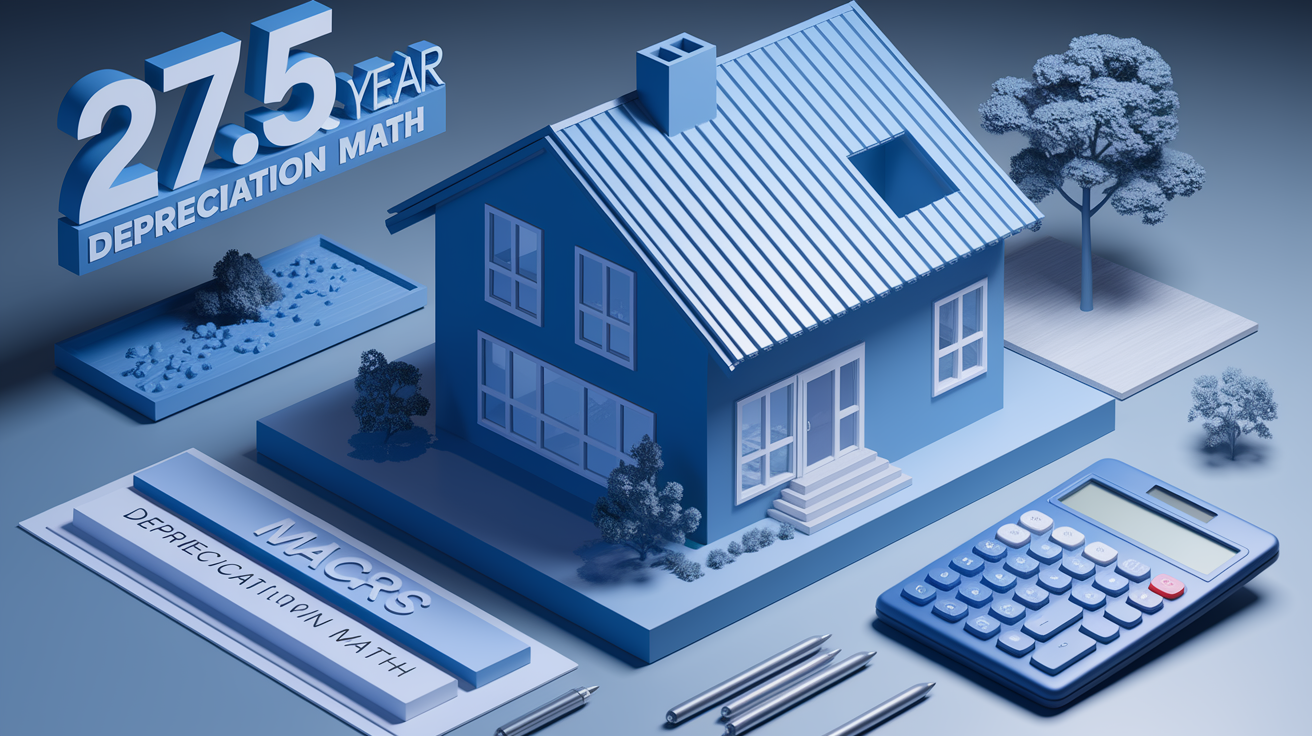
Depreciation is mandatory for the rental portion of your building. You can’t skip it and avoid recapture later. Residential rental property depreciates under MACRS over a 27.5-year recovery period. Land isn’t depreciable, so you allocate your total purchase basis between building and land before calculating depreciation. Use the county assessor’s allocation as a starting point. If the assessor values the building at $230,000 and the land at $50,000, your building represents 82 percent of the total assessed value. Apply that 82 percent to your total basis (including purchase price, closing costs, title fees, recording fees, and other capitalized acquisition costs) to determine the building’s basis.
Once you have the building basis, multiply it by your rental-use percentage to arrive at the depreciable basis for the rental portion. Your total basis is $610,000 and the building represents 81 percent? Your building basis is $494,100. You allocate 80 percent of the property to rental use? Your depreciable basis is $395,280 ($494,100 building × 80% = $395,280 depreciable basis for rental). Divide that amount by 27.5 to calculate annual depreciation: $395,280 ÷ 27.5 = $14,374 per year. That $14,374 deduction appears on Schedule E and reduces rental income, even though you didn’t spend any cash that year.
If you later convert your personal unit to rental (you move out and rent the entire property), you can begin depreciating the portion that was previously personal. You don’t create a new asset. You recalculate depreciation using the original basis and the new rental-use percentage from the date of conversion forward. Keep permanent records of your original basis allocation, assessor valuations, and depreciation schedules. Those records will determine gain, recapture, and excluded amounts when you sell.
| Component | Example Value | Tax Treatment |
|---|---|---|
| Total basis (purchase + closing costs) | $610,000 | Starting point for all allocations |
| Building basis (81% per assessor) | $494,100 | Depreciable; land $115,900 is not |
| Rental-use % (80% of property rented) | 80% | Applied to building to find depreciable basis |
| Depreciable rental basis | $395,280 | Divided by 27.5 years = $14,374 annual depreciation |
Schedule E Reporting for House Hack Landlords

Schedule E is where you report all rental income and rental expenses for the portion of your property you rent out. Line 3 asks for rents received. Enter the total rent collected from tenants during the year. Don’t reduce that number by any expenses. Expenses come later on separate lines. Collected $54,000 in rent? You report $54,000 as gross rents, even if your net income is negative after expenses and depreciation.
Mortgage interest and property taxes require special handling. The rental portion of those items is deductible on Schedule E under “Mortgage interest” and “Taxes” lines. The personal portion may be deductible on Schedule A if you itemize, subject to the $10,000 cap on state and local taxes. Your annual property tax is $8,000 and 75 percent of your property is rental? You’d deduct $6,000 on Schedule E and potentially claim $2,000 on Schedule A (along with state income taxes, if any, up to the $10,000 total SALT cap). Keep a separate worksheet showing how you split each shared expense between rental and personal. Attach it to your own records even though you don’t file it with the return.
How to fill out Schedule E for your house hack:
- Report gross rents received on line 3. Don’t net out any expenses yet.
- Enter advertising, auto/travel, cleaning/maintenance, insurance, legal/professional fees, mortgage interest (rental portion), repairs, utilities, and other expenses on the appropriate lines, using your rental-use percentage for shared items.
- Claim depreciation on line 18. Use Form 4562 in the first year you claim depreciation or when you place new property in service.
- Calculate the net rental income or loss. If you have a loss, note it because passive-loss limits may apply.
- Carry the net amount to page 1 of Form 1040, where it combines with other income. Unused passive losses carry forward to future years.
Capital Gains and Depreciation Recapture When Selling a House Hack
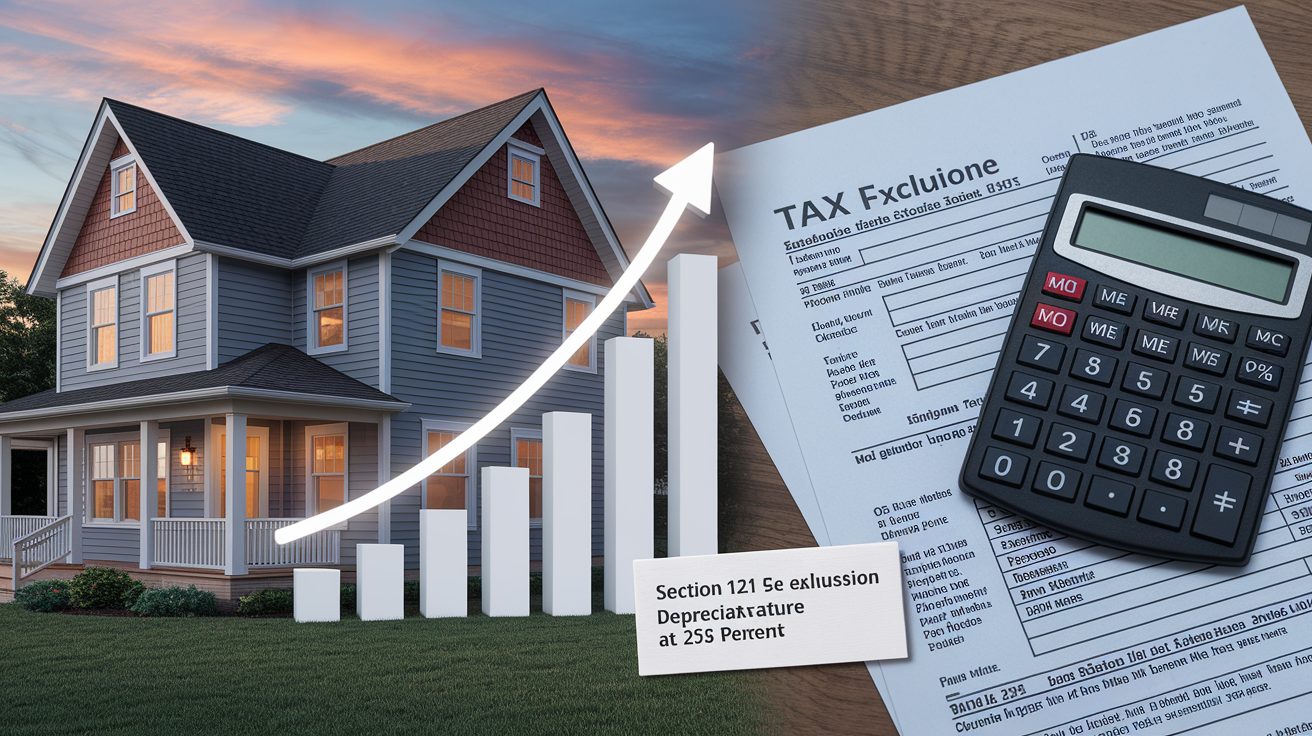
Selling a house-hacked property triggers two separate tax calculations: the primary-residence exclusion under Section 121 and depreciation recapture under Section 1250. If you meet the ownership and use tests (you owned and lived in the home as your principal residence for at least two of the five years before the sale), you can exclude up to $250,000 of gain if you’re single or $500,000 if you’re married filing jointly. That exclusion applies only to the gain attributable to the personal-use portion and to periods when the property qualified as your principal residence. Rental periods and nonqualified use reduce the excluded amount on a prorated basis.
Depreciation claimed on the rental portion can’t be excluded and must be recaptured when you sell. Depreciation recapture is taxed as unrecaptured Section 1250 gain, with a maximum federal rate of 25 percent. You claimed $14,374 of depreciation each year for five years? You’ve taken $71,870 of total depreciation. When you sell, that $71,870 is taxed at recapture rates regardless of how much total gain you have or how much you exclude under the primary-residence rules. The recapture amount is calculated first, then the remaining gain is allocated between excludable (personal, qualified-use) and nonexcludable (rental, nonqualified-use) portions.
To calculate your taxable gain, start with the sale price and subtract selling costs (agent commission, closing fees) to get the amount realized. Subtract your adjusted basis (original basis plus improvements minus depreciation taken) to find total gain. Next, allocate that gain between the rental and personal portions based on time and use. Apply the $250,000 or $500,000 exclusion to the personal, qualified-use portion. Finally, add back the depreciation recapture amount as a separate taxable item. The math gets complicated quickly, especially if you converted the property from full personal to partial rental or vice versa during ownership.
Example calculation for a house-hack sale:
- Purchase price $300,000, improvements $40,000, total basis before depreciation $340,000.
- Depreciation claimed over 5 years: $35,000.
- Adjusted basis at sale: $305,000.
- Sale price $500,000, selling costs $30,000, amount realized $470,000.
- Total gain: $470,000 minus $305,000 = $165,000.
- Rental portion was 40% for 3 of the 5 years. Allocate gain and apply nonqualified-use fraction to determine excludable vs. nonexcludable gain.
- Assume $100,000 of gain qualifies for exclusion. Single filer excludes $100,000 fully.
- Remaining $65,000 of gain is taxable. $35,000 is depreciation recapture taxed at up to 25%, and the remaining $30,000 is long-term capital gain taxed at 0%, 15%, or 20% depending on income.
Passive Activity Loss Limits for House-Hacking Landlords

Rental activities are generally treated as passive under IRS rules. Rental losses can offset only passive income unless you qualify for an exception. The most common exception for small landlords is the $25,000 special allowance for active participation. Your modified adjusted gross income is less than $100,000? You own more than 10 percent of the property? You actively participate in management decisions (approving tenants, selecting contractors, setting rent)? You can deduct up to $25,000 of rental losses against your ordinary income like W-2 wages or business income.
The special allowance phases out between $100,000 and $150,000 of AGI. For every dollar of AGI above $100,000, you lose 50 cents of the allowance. At an AGI of $125,000, your allowed loss is $12,500 (AGI $125,000, so allowed loss = $12,500). If your AGI exceeds $150,000, the special allowance drops to zero and your rental losses are fully passive, suspended until you have passive income or sell the property. Unused passive losses carry forward indefinitely and can be used in future years when you generate passive income or when you dispose of the property in a taxable transaction.
Eligibility requirements for the $25,000 active-participation allowance:
- Modified AGI must be $150,000 or less. Full allowance available below $100,000.
- You must own more than 10 percent of the property by value. Joint ownership counts.
- You must actively participate in management, making decisions, not just receiving rent checks.
- The allowance applies per taxpayer, not per property. Multiple rentals share the same $25,000 cap.
Practical House-Hacking Tax Scenarios and Numeric Examples

Renting Individual Bedrooms
You own a single-family home with four bedrooms and rent out two bedrooms to individual tenants. You allocate 50 percent of the property to rental use under the bedroom method. Gross rents might total $1,800 per month ($900 per room), or $21,600 annually. Shared expenses like mortgage interest, property tax, and utilities are split 50/50 between rental and personal. Your annual mortgage interest is $12,000? You deduct $6,000 on Schedule E and potentially claim the other $6,000 on Schedule A if you itemize. A bedroom-specific repair (replacing carpet in one rental bedroom) is 100 percent deductible because it benefits only the rental portion.
Building basis for depreciation uses the same 50 percent allocation. Your total basis is $400,000 and the building represents 85 percent ($340,000)? Your depreciable rental basis is $170,000. Annual depreciation is $170,000 ÷ 27.5 = $6,182. If you later convert a third bedroom to rental, you recalculate using 75 percent rental allocation from that date forward and begin depreciating the additional basis attributable to the newly converted room.
Renting a Basement or ADU
A basement apartment or accessory dwelling unit (ADU) is often measured by square footage rather than bedrooms. Your main house is 2,000 square feet and the basement unit is 800 square feet? Your total is 2,800 square feet and your rental percentage is 800 ÷ 2,800 = 29 percent (29% rental). Apply that percentage to all shared costs. Annual utilities are $4,800? You deduct $1,392 on Schedule E ($4,800 × 29%). If you install a separate utility meter for the basement, the entire basement utility bill becomes a direct rental expense and you deduct 100 percent of it.
Improvements made solely to the basement (finishing walls, adding a bathroom, installing a kitchenette) are capitalized and added to the building basis allocated to the rental portion. Those costs are then depreciated over 27.5 years. A new water heater that serves both the main house and the basement is a shared improvement. Capitalize the cost and allocate depreciation using the 29 percent rental fraction.
Short-Term vs. Long-Term Rentals
Short-term rentals (Airbnb, VRBO) of a bedroom or basement may trigger different tax rules if you provide substantial services like cleaning, meals, or concierge assistance. The average guest stay is seven days or less and you provide regular cleaning or maid service? The IRS may treat the activity as a business rather than a passive rental. That changes passive-loss treatment and can subject net income to self-employment tax. Long-term rentals (leases of 30 days or more with minimal services) are treated as traditional rental real estate and remain passive activities under normal passive-loss rules.
A long-term bedroom rental of $900 per month generates $10,800 annually, reported on Schedule E with expenses allocated by the bedroom or square-footage method. A short-term rental of the same bedroom at $100 per night with 15 nights booked per month generates $18,000 annually but may require Schedule C reporting if services are substantial. Document the nature and frequency of services provided, average length of stay, and whether guests have exclusive use of the space to determine the correct reporting method.
Documentation and Audit-Proofing Your House Hack
The IRS expects contemporaneous records that prove your rental-use percentage, expense allocation, and basis calculations. Start with your closing statement from the purchase, which shows the purchase price, prorated property taxes, title fees, recording fees, and other costs that become part of your basis. Obtain the county assessor’s valuation or a professional appraisal showing the split between building and land. Keep floor plans, photos, or room counts that support your chosen allocation method (bedrooms or square footage) and write a brief memo explaining the method and the measurements.
Every rental expense requires a receipt, invoice, or bank statement showing the amount, date, payee, and purpose. A $42.08 receipt from Home Depot dated June 15 for a repair in unit 2 is deductible if it’s a repair and you can show it was for the rental portion (keep receipts and contemporaneous documentation to support allocations). If you allocate shared utilities, keep copies of the bills and a worksheet showing the calculation (total bill × rental %). For capital improvements, retain contracts, invoices, and before-and-after photos so you can prove the cost and the placed-in-service date for depreciation purposes.
Must-keep house-hacking records for audit readiness:
- Closing statement and settlement documents from purchase
- County assessor valuations or appraisal showing building vs. land allocation
- Floor plans, square-footage measurements, or bedroom counts proving rental-use percentage
- Receipts, invoices, and canceled checks for all repairs, improvements, and operating expenses
- Depreciation schedules and Form 4562 filings for each year, retained permanently even after sale
Final Words
You’re in the action now: you know to separate rental and personal use, prorate income and expenses, and report rental activity on Schedule E. Depreciation, mortgage interest splits, and repair vs improvement rules matter. Selling? Expect depreciation recapture and limits on the primary-residence exclusion. Also watch passive loss rules and keep tight records.
Keep a simple checklist: allocations, receipts, depreciation schedule, leases, and utility bills. Remember: the tax implications of house hacking for landlords are manageable with good records and a plan. You got this.
FAQ
Q: What is the 50% rule in rental property?
A: The 50% rule in rental property is a quick screening guideline: expect about half your gross rent to cover operating expenses (repairs, taxes, insurance, vacancy), excluding mortgage and depreciation.
Q: What is the most overlooked tax break?
A: The most overlooked tax break is depreciation on rental property, a noncash deduction that lowers taxable income; track basis, allocate land versus building, and claim it each year.
Q: What is the tax loophole for rental property?
A: The tax loophole for rental property often refers to accelerated depreciation and cost segregation, which legally shift deductions earlier and speed write-offs for building components with proper studies and records.
Q: How to legally avoid paying taxes on rental income?
A: To legally reduce taxes on rental income, use allowable deductions, depreciation, passive-loss rules, 1031 exchanges, and cost segregation where eligible, and keep clear records while consulting a tax advisor.