
Think bigger units always win? Not always.
A fourplex often cuts your housing cost the most because you collect three rents. But it costs more and needs more hands-on work. Duplexes need less cash up front and feel more like a normal house. Triplexes sit in the middle.
This post walks through the money, the lender rules, and the daily tradeoffs so you can pick the right house hack for your budget and how much management you want. Short answer: fourplexes usually win on cash flow; duplexes win when pricing or simplicity matters.
Overview of Multifamily Options for House Hacking
A duplex is two units sharing a wall or stacked on top of each other, usually mirror images of one another. Triplexes have three separate units. You’ll often see two side by side on the ground floor with one above, or all three in a row. Fourplexes hold four units, typically two stacked on each side or arranged in a quad.
Prices go up with unit count. Duplexes in the same area usually cost 20–30% less than triplexes. Fourplexes run another 15–25% higher than triplexes. Rental income follows that pattern. Live in one unit of a fourplex and you’re collecting three rent checks. A triplex gets you two. A duplex gets you one.
You can use FHA, conventional, or VA loans for any of these because they all fall under the 1–4 unit residential threshold. That’s the house hacking sweet spot. Low down payment while you live in one unit and rent out the rest.
Quick comparison:
- Upfront cost: Duplexes need the smallest down payment in actual dollars. Fourplexes need the most cash to close, even at the same percentage.
- Rental income: Fourplexes bring in the most monthly rent. Triplexes sit in the middle. Duplexes generate the least.
- Owner-occupancy reality: Duplex means one tenant. Triplex means two. Fourplex means three tenants while you’re living there.
- FHA access: All three qualify for 3.5% down FHA loans if you occupy one unit and pass the lender’s self-sufficiency test when required.
- ROI: Fourplexes often win on cash-on-cash return when rent-to-price ratios work in your favor. But duplexes can outperform in markets where fourplex prices jump too high or you catch a motivated duplex seller.
Which one wins depends on your market’s pricing and your monthly savings target. Some markets keep per-unit rents fairly flat across property types but fourplex prices spike hard. In those places, a duplex might deliver better ROI because you’re not paying a premium for tiny rent bumps. Other markets have strong per-unit rent and reasonable fourplex pricing. The fourplex usually crushes it on monthly cash flow and overall return, even with the higher price and extra management work.
Detailed Comparison of Duplex, Triplex, and Fourplex Features

Tenant turnover risk spreads out differently. Lose your single tenant in a duplex house hack and your rental income goes to zero until you fill the spot. A triplex splits that risk between two tenants. One vacancy still leaves you collecting half your rent. A fourplex spreads turnover across three tenants, so one move-out only cuts your income by about a third. That buffer matters during slow leasing seasons or in areas where tenant quality bounces around.
Utility setup and cost exposure shift as buildings get bigger. Duplexes often have completely separate heating, electrical, and water systems. Tenants pay their own bills. You don’t subsidize someone who cranks the heat to 75 in January. Triplexes and fourplexes, especially older ones, are less likely to have totally separated utilities. Shared boilers or single water meters are common. When tenants don’t pay utilities directly, your operating costs climb and you lose control over waste. That compresses monthly cash flow even when rents look solid.
Privacy and lifestyle tradeoffs get bigger as unit count climbs. A duplex feels almost like a single-family home because you share one wall or floor with one neighbor. A triplex puts you next to two separate households. More noise, more parking friction, more schedules clashing with yours. A fourplex turns your home into a small apartment building where you’re both a resident and the landlord. Some house hackers love that. Others burn out fast.
Market availability and competition vary by property type. Duplexes usually make up the biggest chunk of 2–4 unit inventory in most markets. More listings mean more chances to find a motivated seller. Triplexes sit in the middle with fewer options but still decent supply. Fourplexes are often the scarcest. That smaller pool attracts more experienced investors who understand income properties and will pay closer to market value. Less room for negotiation or below-market deals.
Financing Options for 2–4 Unit House Hacks
Owner-occupied financing treats duplexes, triplexes, and fourplexes as residential mortgages, not commercial loans. That opens up low down payment programs that disappear once you hit five units. FHA loans let you put down 3.5% on anything up to four units as long as you live in one. Some lenders apply a self-sufficiency test for triplexes and fourplexes. They’ll want projected rental income to cover a minimum percentage of the mortgage payment. But that bar is usually reasonable if market rents are decent.
Conventional loans typically ask for 5% down on 2–4 unit owner-occupied properties. Slightly higher than FHA but often cheaper mortgage insurance long term. You can use projected rental income from the non-owner units to help qualify. That boosts your buying power compared to a single-family purchase where only your job income counts. VA loans offer zero down for eligible veterans and active-duty service members, covering up to fourplexes with the same live-in requirement.
The financing structure stays the same across unit counts. Loan terms, interest rate, program eligibility don’t really change whether you’re buying a duplex or a fourplex. The difference is in total loan size and monthly payments, not the programs.
| Loan Type | Down Payment | Unit Limit | Key Requirement |
|---|---|---|---|
| FHA | 3.5% | Up to 4 units | Occupy one unit; may require self-sufficiency test for 3–4 units |
| Conventional | 5% | Up to 4 units | Occupy one unit; rental income can help qualify |
| VA | 0% | Up to 4 units | Eligible veteran/service member; occupy one unit |
| Conventional (Investment) | 15–25% | Up to 4 units | No occupancy requirement; used if not owner-occupying |
ROI and Cash Flow Examples for Duplex, Triplex, and Fourplex
Running the numbers side by side shows how unit count affects your monthly reality. Say duplexes in your market go for around $285,000, triplexes around $375,000, and fourplexes around $465,000. You’re putting 5% down, locking a 6.75% rate, and using standard reserves of 5% for maintenance and 5% for vacancy on each rented unit.
For the duplex, your loan is $270,750. Principal and interest run $1,756 per month. Add $285 for property taxes, $165 for insurance, and reserves of $60 for maintenance and $60 for vacancy on the one rental unit. Total monthly cost is $2,326. Rent one unit at $1,200 and your net housing cost drops to $1,126.
For the triplex, the loan is $356,250 with a monthly payment of $2,311. Taxes jump to $375, insurance to $210, and reserves to $100 each for maintenance and vacancy across two rental units. Total monthly cost is $3,096. Rent two units at $1,150 each for $2,300 total. Your net housing cost falls to $796.
For the fourplex, the loan is $441,750 with a payment of $2,866. Taxes climb to $465, insurance to $255, and reserves to $143 each for three rental units. Total cost is $3,872. Rent three units at $1,100 each for $3,300 total. Your net housing cost is $572.
Breaking those into ROI terms means comparing your annual out-of-pocket housing cost against your cash investment. The duplex needs $14,250 down, the triplex $18,750, and the fourplex $23,250. Your annual net housing cost is $13,512 for the duplex, $9,552 for the triplex, and $6,864 for the fourplex. You’re living for roughly $1,126, $796, or $572 per month. The extra cash you put into larger properties buys down your housing expense faster.
| Property Type | Total Monthly Rent | Est. Monthly Expenses | Net Housing Cost | Cash Invested |
|---|---|---|---|---|
| Duplex | $1,200 | $2,326 | $1,126 | $14,250 |
| Triplex | $2,300 | $3,096 | $796 | $18,750 |
| Fourplex | $3,300 | $3,872 | $572 | $23,250 |
Management Complexity Across Unit Types
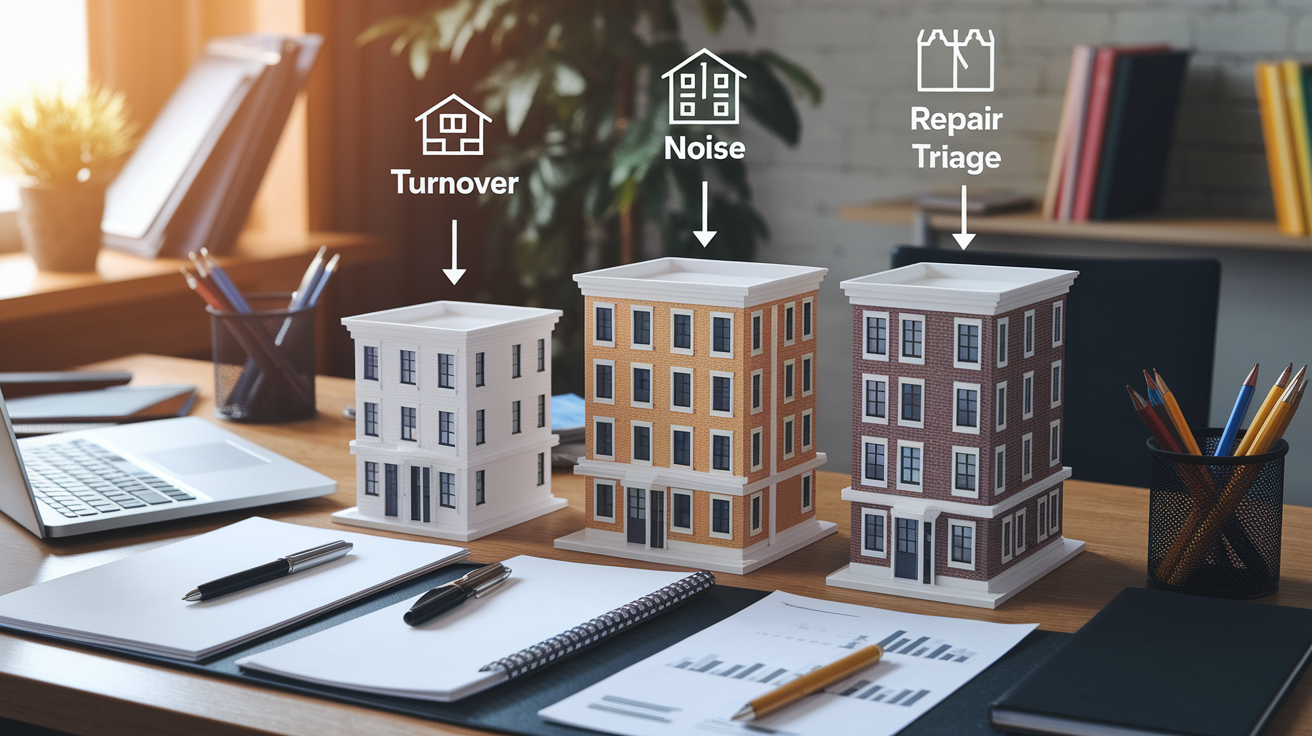
More units means more tenants. Each tenant brings another lease, another batch of maintenance requests, another move-in and move-out, another personality to deal with. A duplex house hack means managing one tenant while you live next door or upstairs. A triplex doubles that to two. A fourplex triples it to three. The time you spend screening applicants, answering repair calls, coordinating turnovers, and chasing late rent scales roughly with tenant count. Expect to invest more hours per month as you move up.
Repair frequency and coordination get messier with more units. More appliances, more plumbing, more HVAC systems, more wear on shared spaces like driveways or porches. Even if each unit costs the same percentage to maintain, the absolute number of repair visits climbs. A duplex might average one maintenance call per month. A fourplex could easily hit three or four. You’ll also face more scheduling chaos when multiple tenants need attention the same week. And living onsite means you’re always visible and reachable. That can be great or exhausting depending on your boundaries.
Common problems that get worse with unit count:
- Turnover coordination: More units mean higher odds at least one is vacant at any time. You’re juggling showings, cleaning, and re-leasing while other tenants are still living there.
- Noise and conflict: More tenants means more lifestyle clashes, loud neighbors, parking disputes. You’re the landlord and the neighbor, so you get to mediate.
- Repair triage: When multiple units need fixes at once, you’re deciding what’s urgent and what can wait. More decisions, more fatigue.
- Communication volume: More tenants means more texts, emails, phone calls. Especially during the first few months or when things break.
Recommendations by Investor Profile

If you’re new to real estate and this is your first time being a landlord, a duplex is usually the best starting point. Lower purchase price keeps your risk contained. Managing one tenant lets you build skills without drowning. The smaller property is easier to handle if you need to bail or sell. You’ll spend less time dealing with tenant drama and more time learning how rent collection, maintenance, and screening actually work.
A triplex fits investors who’ve done some property management or who can handle moderate complexity for stronger monthly cash flow. Two rental units give you real income diversification compared to a duplex. The extra management work is noticeable but not crushing. If your market shows reasonable triplex premiums and solid per-unit rents, the triplex often hits the best balance of affordability, income, and scale without the full operational weight of a fourplex.
Fourplexes make sense for people chasing maximum income who are ready to run a small apartment building while living in it. If you can afford the bigger down payment, manage three tenant relationships, and handle the maintenance load, a fourplex can push your net housing cost close to zero or into positive territory. The tradeoff is more money up front, more landlord hours, and less privacy day to day.
Quick recommendations:
- Beginner or tight budget: Go duplex. Lowest cash needed, simplest management, best place to learn without high stakes.
- Some experience and want better income with manageable risk: Go triplex. Better monthly savings than a duplex, tenant count is doable, strong ROI if pricing and rents line up.
- Experienced or income-focused and willing to trade time for cash flow: Go fourplex. Maximum rental income, best shot at living free or cash-flow positive, but you need to be comfortable with onsite property management and a bigger capital commitment.
Final Words
We defined duplex, triplex, and fourplex, then compared cost, rental income, FHA and other financing, and typical ROI. You got quick math examples and a look at how more units change management and tenant risk.
The post walks through tradeoffs—cash flow vs complexity, financing limits, and where each property type often fits different goals.
Use this triplex vs duplex vs fourplex house hacking comparison to choose the setup that matches your budget and time. Start with a clear plan and you can build steady income.
FAQ
Q: What is the 1% rule for duplexes?
A: The 1% rule for duplexes is a quick cash-flow screen: total monthly rent should be at least 1% of the purchase price to suggest the property may cover expenses and mortgage.
Q: Can you house hack with a duplex?
A: You can house hack with a duplex by living in one unit and renting the other, which lowers your net housing cost and can qualify for FHA financing when owner-occupying up to four units.
Q: Is it better to buy duplex or triplex?
A: Whether a duplex or triplex is better depends on goals: duplexes are simpler with more privacy, while triplexes usually offer higher rental income and diversification but more management and financing complexity.
Q: What are the six types of houses?
A: The six common house types are detached single-family, semi-detached, townhouse, duplex, triplex/fourplex (multifamily), and apartment building, each differing by shared walls, ownership, and density.