

Think a house hack always looks like free rent and fast returns?
Not usually.
Cash-on-cash return is the right first check, but only if you do it the right way.
Annualize your cash flow, count down payment, closing costs, initial repairs, and reserves.
Treat your own unit deliberately: use market rent, reduced income, or imputed rent depending on the question.
Pressure-test debt service and vacancy.
This post gives a step-by-step method and quick screens so you can tell in minutes whether a house hack actually pencils or just looks good on a listing.
Step-by-Step Method for Computing Cash-on-Cash Return in House Hack Deals

Cash-on-cash return measures your levered, before-tax operating yield. The formula is straightforward: CoC = (Annual pre-tax cash flow ÷ Total cash invested) × 100.
Your annual pre-tax cash flow equals rental income minus operating expenses and debt service for the year. Total cash invested bundles your down payment, closing costs, initial repairs, and any reserves you set aside at closing.
Here’s the order that works:
- Estimate Gross Rental Income: Multiply monthly rent by 12 for each unit. If you’re living in one, use the assumed market rent for that space.
- Sum Operating Expenses: Property taxes, insurance, maintenance, utilities you pay, property management, HOA dues, reserves.
- Calculate Annual Debt Service: Add up your mortgage principal and interest payments for the year.
- Compute Net Cash Flow: Take gross rental income, subtract operating expenses and debt service.
- Compute Total Cash Invested: Down payment + closing costs + initial repairs + upfront reserves.
- Divide and Multiply: Net cash flow ÷ total cash invested × 100.
House hack CoC gets trickier because you’re treating your own unit differently. You can count it as if you’re renting it at market rate, exclude its rent and lower your revenue, or add a line for imputed rent savings (what you’d otherwise pay to live somewhere else). Each method answers a different question.
Always annualize. If you’re comparing one month’s cash flow to some other period’s investment, you’ll get the wrong return. Lenders and partners expect annual figures, so keep it consistent.
Understanding Rental Income and Owner-Occupied Adjustments in House Hack Cash-on-Cash Calculations
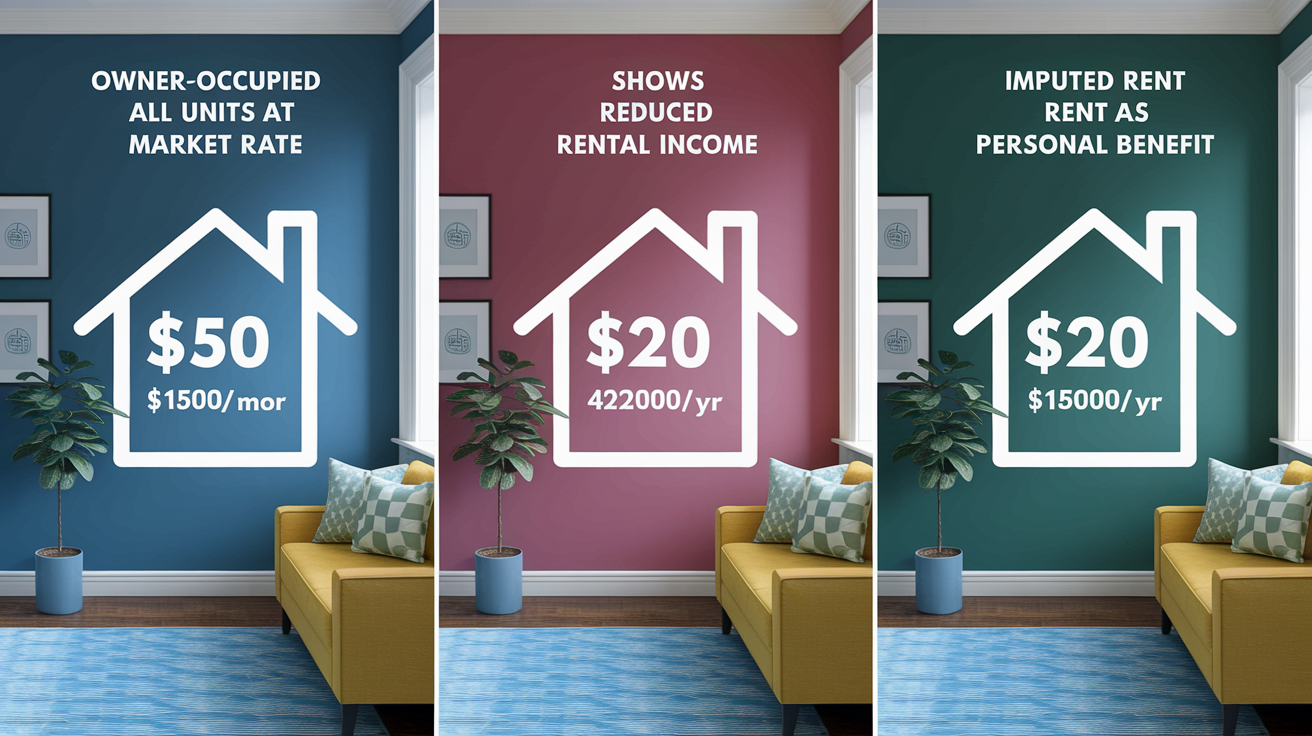
When you live in one unit, you’ve got three ways to model rental income. The first treats your unit as if it were rented at market rate (say, $1,500 per month or $18,000 per year) and adds that to your gross rental income. This is the pure investment view. It shows what the property would yield if you weren’t there.
The second adjusts for reduced rental income. If your other units only bring in $42,000 per year instead of $60,000 total, you use that $42,000 figure. You end up with a realistic first-year cash impact, which can be negative. The third brings in imputed rent: the $18,000 you save by living on-site counts as a personal benefit, added to your actual cash flow to calculate personal ROI. Imputed rent doesn’t go in formal CoC reports for lenders, but it’s useful for comparing whether buying beats renting somewhere else.
Here’s what shapes your rental income accuracy:
- Market comps: Pull rent data from active listings and recent leases in your neighborhood, filtered by bedroom count and condition.
- Vacancy assumption: Set aside 5 to 10 percent of gross rent. Higher if you’re dealing with student renters or short-term rooms that turn over frequently.
- Turnover cost: Roommate house hacks see more move-outs. Budget extra for cleaning, minor repairs, and lost days between tenants.
- Utilities-sharing arrangement: If tenants pay separately metered electric and you cover water and trash, allocate those costs to operating expenses, not rent.
- Imputed rent use cases: Use it to measure your personal cash benefit and compare total household economics. Keep it out of investor or lender CoC worksheets.
Use assumed market rent when you want a pure property yield. Use actual reduced income when you need the household budget reality. Use imputed rent when you’re deciding whether the house hack beats renting and investing elsewhere.
Calculating Operating Expenses and Debt Service for Accurate House Hack Cash-on-Cash Return

Operating expenses cover property taxes, homeowner’s insurance, routine maintenance, utilities you pay, HOA or condo fees, property management if you hire out, and reserves for big-ticket replacements. A typical range is 25 to 45 percent of effective gross income, depending on property age, location, and how much you self-manage. For a triplex where you cover landscaping and trash, you might land around 35 percent. For a single-family with a high HOA and aging mechanicals, 40 to 45 percent is realistic.
Reserves are both an expense line and an upfront investment item. Setting aside $200 per month per unit for roof, HVAC, and appliance replacement counts as an operating expense that reduces your annual cash flow. If you also fund an initial reserve account at closing (say, $3,000), that amount goes into total cash invested in the denominator. Don’t double-count.
Debt service is your annual mortgage principal and interest, not the full loan balance. For a $240,000 loan at 4.5 percent over 30 years, your monthly payment is about $1,216, or roughly $14,592 per year. If rates climb to 5.5 percent, that same loan costs you around $1,363 per month or $16,356 annually. That’s an extra $1,764 in annual debt service that drops your cash flow by the same amount. A single percentage point can swing CoC by two to four points, so lock your rate assumptions early and pressure-test your math at half-point increments. CoC is highly sensitive to leverage. Small changes in rate or down payment size ripple directly into the bottom line.
Worked Examples: Applying Cash-on-Cash Return Math to Real House Hack Deals

Here’s the baseline example: purchase price $500,000, down payment 20 percent ($100,000), closing costs $10,000, initial repairs $15,000. Total cash invested is $125,000. Gross annual rent from all units is $60,000. Annual operating expenses run $20,000, and annual debt service is $24,000. Net cash flow equals $60,000 minus ($20,000 + $24,000), or $16,000. Cash-on-cash return is $16,000 ÷ $125,000 × 100, which gives you 12.8 percent.
Now adjust that for owner occupancy. If you live in one unit and the other units generate only $42,000 per year, your cash flow becomes $42,000 minus ($20,000 + $24,000), or negative $2,000. CoC is negative $2,000 ÷ $125,000, or -1.6 percent. Realistic but discouraging on paper. This is the household budget view: you’re cash-flow negative in year one while you live there.
The imputed rent scenario treats your saved housing cost as income. If living on-site saves you $1,500 per month, that’s $18,000 per year. Add that to your negative $2,000 actual cash flow and you get $16,000 in personal net benefit. Personal ROI including imputed rent is $16,000 ÷ $125,000, or 12.8 percent (same as the full rental scenario). Use imputed rent to compare house hacking against renting elsewhere and investing the down payment differently. Don’t mix it into lender underwriting or partnership distributions.
| Scenario | Annual Cash Flow | Total Cash Invested | Resulting CoC |
|---|---|---|---|
| Baseline (all units rented) | $16,000 | $125,000 | 12.8% |
| Reduced income (owner-occupied) | −$2,000 | $125,000 | −1.6% |
| Imputed rent (personal ROI view) | $16,000 | $125,000 | 12.8% |
Reference: Evaluating Multifamily Properties: House Hacking and Cash-on-Cash Return
What Counts as a “Good” Cash-on-Cash Return for House Hacks?
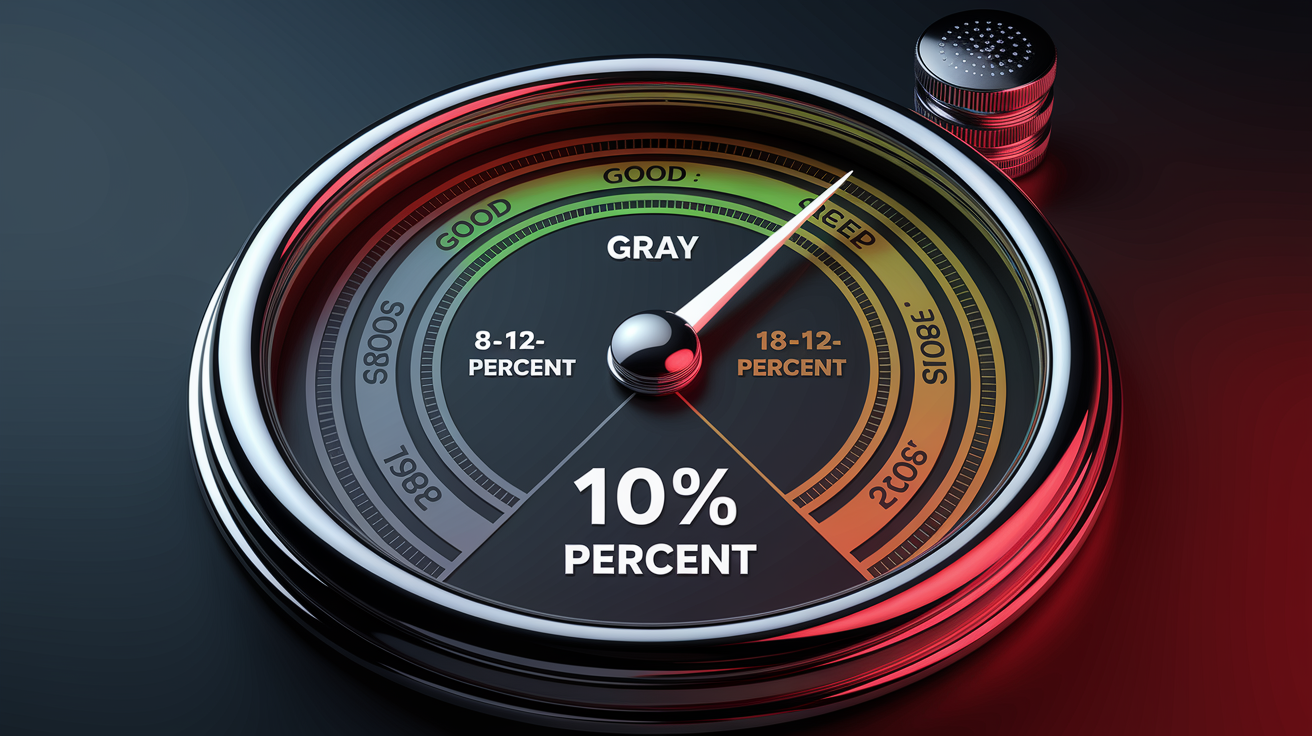
Traditional rental benchmarks fall into a few bands: 5 to 8 percent is common in stable urban markets where you’re banking on appreciation; 8 to 12 percent is the mid-tier sweet spot for balanced investors; 12 percent and up signals higher-risk markets or value-add opportunities. House hacks shift those ranges because owner-occupancy financing and imputed rent add value outside the CoC formula.
For house hacks, use these modified targets:
- 8 to 12 percent: Solid first-year return when you include market rent for your unit or realistic reduced income.
- 12 to 20 percent: Strong performance, typical when you room-rent or buy below market and rehab sweat equity into the deal.
- 20 percent and above: Exceptional, often driven by very low cash invested (FHA 3.5 percent down) or high rental density (renting by the room in a college market).
- Negative to 5 percent: Acceptable if imputed rent savings and principal paydown justify the low nominal CoC. Many first-time buyers accept this tradeoff to stop paying rent elsewhere.
Owner-occupancy benefits (mortgage interest deduction, principal build-up, zero rent payment) mean a 10 percent CoC on a house hack can deliver more total financial benefit than a 12 percent CoC on a hands-off turnkey rental. Context matters. If the local rental market is weak and vacancy runs high, even a 15 percent CoC might be riskier than an 8 percent return in a stable neighborhood with consistent tenant demand.
Comparing Cash-on-Cash Return to Other Evaluation Metrics in House Hack Investing

CoC measures one year’s operating cash yield on the money you put in up front. It’s levered (meaning it accounts for your mortgage) and it ignores what happens after year one. Internal rate of return (IRR) captures appreciation, principal paydown, tax benefits, and the time value of money over your entire hold period. If you plan to live in the house hack for three years, convert to a full rental, then sell in year seven, IRR will show the blended annualized return across all those phases. CoC only shows year-one cash.
Cap rate is net operating income divided by purchase price. It’s unleveraged, so it ignores your financing and treats the property as if you paid all cash. Cap rate is useful for comparing properties in the same market, but it won’t tell you whether your 20 percent down payment is working hard enough. Equity build-up from mortgage principal is real wealth creation, but it doesn’t show up in CoC because you’re not receiving that money as cash flow. It’s locked in the property until you sell or refinance.
A cautionary case study: one investor bought a baseball stadium property for $1.2 million with $900,000 debt and $300,000 equity, collecting $100,000 annual rent for five years. Average annual CoC was 18.3 percent. Looks stellar. But the exit value was only $900,000 after demolition costs, leaving a net loss of $25,000 and a levered IRR of -2.8 percent. High CoC can coexist with an overall loss if terminal value or costs turn unfavorable. (Reference: Using the Cash-on-Cash Return in Real Estate Investment Analysis) Use CoC to screen for immediate cash yield and compare financing structures, but always layer in exit scenarios, appreciation estimates, and tax impacts before you commit.
Common Mistakes When Calculating Cash-on-Cash Return in House Hacks

The most common error is omitting reserves from total cash invested. If you funded $5,000 into a repair reserve account at closing, that’s real cash out of pocket. It belongs in the denominator. Another frequent mistake is using gross rent instead of effective gross income. If you assume $3,000 per month in rent but don’t subtract 8 percent vacancy, you’re overstating cash flow by $240 per month or $2,880 per year.
Misallocating owner-occupied expenses is subtle but serious. If you pay the water bill for the whole triplex and live in one unit, don’t treat your share as zero. Allocate the full expense to operating costs, then recognize that your imputed rent benefit offsets part of it on the personal ROI side. Including imputed rent directly in formal CoC calculations will confuse lenders and partners. Keep it in a separate personal-benefit column.
Here are eight pitfalls to watch:
- Forgetting to include closing costs (title, escrow, lender fees) in total cash invested. Inflates CoC artificially.
- Excluding initial repairs or rehab from the denominator when you paid for them out of pocket before collecting rent.
- Using optimistic rent assumptions without pulling recent comps or accounting for condition differences.
- Ignoring vacancy entirely or using a 2 percent assumption in a market where turnover runs 10 percent.
- Double-counting rent savings by adding imputed rent to cash flow and also treating the owner unit as rented at market rate.
- Miscounting debt service by using only interest or forgetting mortgage insurance on FHA/VA loans.
- Skipping HOA dues or special assessments that hit every quarter but don’t appear on the tax bill.
- Relying solely on CoC and ignoring tax depreciation, appreciation potential, and principal paydown when those are significant parts of total return.
Accurate expense allocation is critical in house hacks because the owner-occupied portion changes how you split utilities, maintenance, and even property management. If you self-manage but would hire a manager once you move out, footnote that future expense so your year-two projections stay realistic.
Final Words
You now have a step-by-step method: the CoC formula, how to annualize rents, expense and debt details, plus worked examples with real numbers. Use the six quick calculation steps and adjust for owner-occupancy when estimating rents.
Mind the usual mistakes—omitting reserves, using gross rent, or misallocating owner costs—and compare CoC to IRR and cap rate so you know what each metric shows.
Focusing on calculating cash on cash return for house hack deals makes buy-or-pass choices clearer; do the math, keep assumptions conservative, and you’ll sleep better at night.
FAQ
Q: How to calculate cash-on-cash return for a property?
A: The cash-on-cash return for a property is calculated as (Annual pre-tax cash flow ÷ Total cash invested) × 100. Annual pre-tax cash flow = gross rental income − (operating expenses + annual debt service).
Q: What is the 3 3 3 rule in real estate?
A: The 3 3 3 rule in real estate varies by context; commonly it means holding a property three years, keeping three months of reserves, and assuming 3% for vacancy or growth—confirm the source before using it.
Q: What is a good cash-on-cash return for a property?
A: A good cash-on-cash return for a property depends on market and risk: roughly 5–8% in stable markets, 8–12% for mid-tier deals, and 12%+ for higher-risk or value-add investments.
Q: What is the 7% rule in real estate?
A: The 7% rule in real estate is a rough screening target meaning about a 7% annual cash yield (cash-on-cash). Treat it as a quick filter, then do full underwriting and sensitivity checks.