

Think the MLS is where investors find the best deals? Think again.
Wholesalers control much of the off-market inventory, about 73% of top opportunities never hit the MLS.
They can bring you properties 20–40% below market if you can move fast.
This post gives a clear playbook: how to show up credible, vet wholesalers, spot red flags, and close in a 7–14 day window.
Read on if you want steady, real off-market deal flow without wasting time.
Core Methods for Working With Wholesalers to Access Off-Market Deals

Wholesalers control inventory most investors never see. Off-market deals often sell 20–40% below market value, and MLS buyers miss roughly 73% of top opportunities simply because those properties never hit the MLS. Wholesalers connect motivated sellers with cash buyers, bringing you properties that haven’t been shopped around, bid up, or picked over.
The trade? Speed. Wholesalers need buyers who can decide within 24–48 hours and close within 7–14 days. Move that fast and you get first access to the best inventory.
Assignment fees usually run $10,000 to $50,000 depending on deal size and local market. That’s the wholesaler’s compensation for finding the seller, negotiating the contract, and packaging the opportunity. For you, that fee is the cost of off-market access and saved time. Not a markup to avoid.
The wholesaler assigns their purchase contract to you. You step into their position as buyer and close directly with the seller. Some wholesalers use a double closing where they buy from the seller and immediately resell to you the same day. Either way, same result: you acquire property well below market without competing against the public.
Before wholesalers take you seriously, you need three things ready. Proof of funds showing you can close quickly. Clear buying criteria so they know what you want. A track record (or at least willingness) of making fast decisions. Wholesalers burn time on buyers who can’t perform, so credibility is your currency. Show up prepared and you’ll get better deals first.
Six initial steps to start working with wholesalers:
- Prepare a one-page buyer profile specifying your target markets, price range, property types, acceptable condition, and closing capabilities.
- Secure proof of funds (bank statement, hard money commitment letter, or proof of private capital covering at least the purchase price plus estimated repairs).
- Join your local REIA to begin meeting wholesalers in person at monthly meetings.
- Create a simple vetting questionnaire asking wholesalers for recent deal addresses, closing history, and buyer references.
- Set internal underwriting rules including your maximum repair budget, pass rate discipline (plan to say no to 90–95% of opportunities), and a decision window of 24–48 hours.
- Build a list of expedited due diligence vendors (inspector, contractor, and title company who can accommodate compressed timelines when you need to close in 7–14 days).
Building a Strong Wholesaler Network for Off-Market Deals

Finding one or two wholesalers is easy. Building a consistent pipeline of quality wholesalers who send you vetted deals every week requires intentional networking and follow-through. REIA memberships typically cost $100–$500 per year, and active participants can expect to meet 5–20 new contacts per month at meetings and mixers. Facebook groups focused on local real estate investing often produce 2–10 leads per week if you engage regularly and post your buying criteria. Building relationships with 10–15 probate or estate attorneys can unlock another referral pipeline. Attorneys managing estates often know sellers who need to liquidate property quickly and quietly.
Multi-channel sourcing matters. You can’t rely on one networking event or one Facebook group to feed consistent deal flow. Wholesalers themselves are prospecting constantly, and they prioritize buyers who are easy to work with and close reliably.
Show up once at a REIA and disappear? You’ll be forgotten. Show up at every meeting, follow up promptly, and close when you say you will? Wholesalers start bringing deals to you before they blast them to their entire buyer list.
Five specific channels for finding wholesalers:
- Attend local REIAs and investor meetups monthly. Introduce yourself to wholesalers, exchange contact info, and clarify what you’re buying.
- Join online Facebook groups and wholesaling forums for your target markets. Scan posts daily and reach out to active wholesalers.
- Search for “we buy houses” signs and Craigslist ads in your area. Those signs often belong to wholesalers looking for both sellers and buyers.
- Ask investor-friendly real estate agents for referrals to wholesalers they know who operate off-market.
- Use driving for dollars apps like DealMachine to identify distressed properties, then research who owns them or who markets to those lists. You’ll often find wholesalers working the same neighborhoods.
Networking Behaviors That Attract Top Wholesalers
Wholesalers want buyers who make their lives easier. That means reliability, fast communication, and clarity.
When you receive a deal, respond within a few hours, even if your answer is no. When you say you’ll close in 14 days, close in 14 days or earlier. Top wholesalers keep mental lists of buyers who perform and buyers who flake, and they send their best inventory to performers first.
Make it easy for wholesalers to understand what you want by giving them written criteria: property types, zip codes, price range, acceptable condition level, and your typical closing window. The clearer you are, the less time they waste sending deals you’ll never buy. And the more trust you build.
Over time, that trust converts into priority access and exclusive short windows before a deal goes wide to the wholesaler’s full list.
Vetting Wholesalers and Red Flags to Avoid in Off-Market Deals
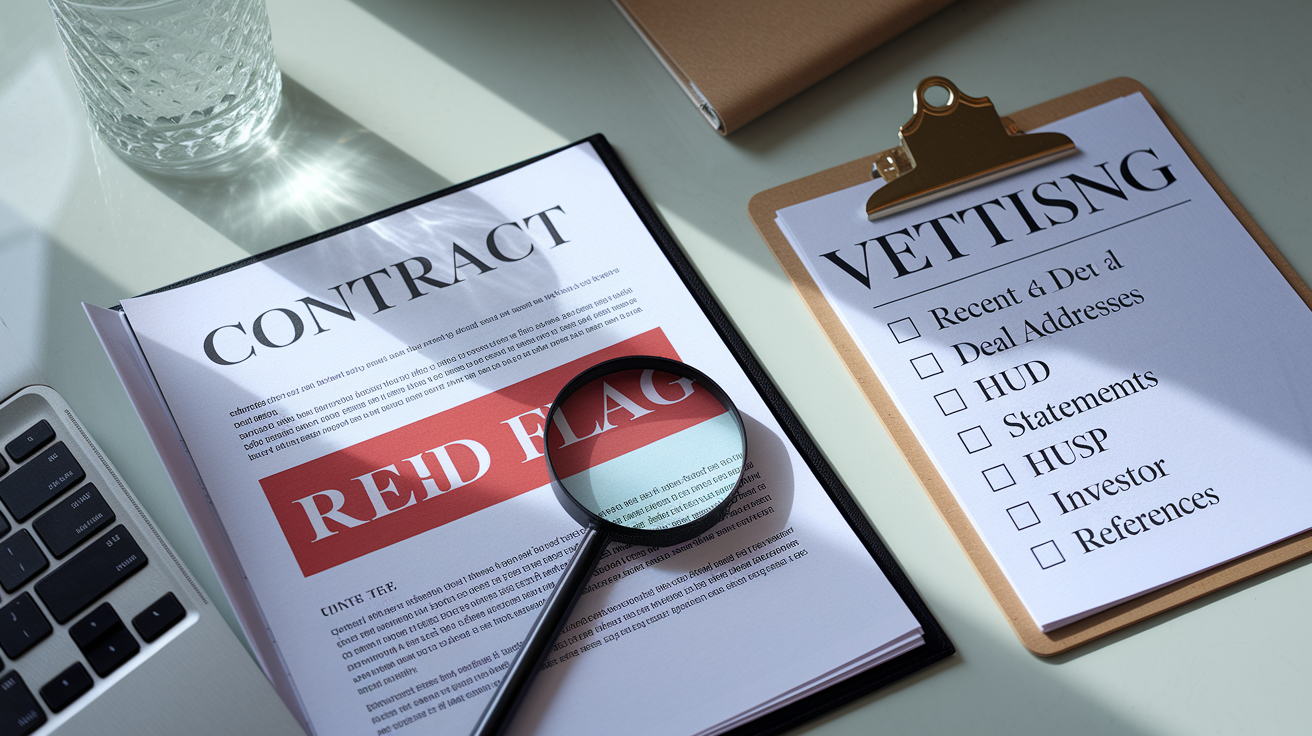
Not all wholesalers are created equal. Some are experienced professionals who bring you solid deals with clean documentation. Others are brand new, learning on the fly, and occasionally overpromising or underdelivering on property condition, value, or timelines. Your job is to separate the reliable operators from the rest before you commit capital or credibility.
Seven vetting requirements to apply to every new wholesaler:
- Request 3–5 recent deal addresses and ask to see redacted closing statements or HUD-1s proving they’ve actually closed transactions.
- Confirm they conduct on-site property inspections rather than relying solely on public records, exterior drive-bys, or seller photos.
- Ask for at least two investor references (other buyers who’ve closed deals with them) and actually call those references.
- Verify what systems they use for property analysis, title review, and repair estimates. Organized wholesalers use standardized deal packets.
- Check whether your state requires wholesalers to hold a real estate license and confirm they’re compliant if licensing applies.
- Ask about their typical assignment fee range and transaction volume per month to gauge experience and market positioning.
- Request transparency on deal sourcing: how they find properties, what marketing they run, and how long they’ve been wholesaling.
After you’ve collected that information, look for consistency. If a wholesaler can’t or won’t provide documentation, references, or proof of recent closings, walk away. Refusal to offer transparency is the single biggest red flag.
Wholesalers who rely solely on exterior photos without ever visiting the property are gambling with your money. Exterior condition can look fine while the interior is destroyed. You don’t want to discover that after you’ve signed an assignment.
| Red Flag | Why It Matters |
|---|---|
| Refuses to show property address or provide proof of contract | May not actually control the deal or may be shopping terms without seller consent |
| Pushes unrealistically high ARV with no comps or just Zillow estimates | Inflated value means you overpay and kill your margin when you sell or refinance |
| Will not share names of title company or closing agent | Legitimate deals always involve a reputable title company. Evasiveness here signals deeper issues |
| Demands upfront fees before providing deal details or documentation | Credible wholesalers earn fees at closing, not before you’ve seen the property or contract |
Communication Systems for Working Efficiently With Wholesalers

Efficient communication separates investors who see every deal from those who get ghosted. Wholesalers are juggling dozens of buyers and multiple deals at once, so they prioritize the buyers who respond quickly, ask smart questions, and follow a predictable process.
Take three days to reply to a deal email? The property is already under contract with someone else.
The standard follow up cadence looks like this: respond to the initial deal within 24 hours, follow up at the 7 day mark if you haven’t heard back, then check in weekly for four weeks, and shift to monthly after that if the relationship is warm but no deals have closed yet. This rhythm keeps you top of mind without being annoying.
Wholesalers respond fastest to buyers with clear criteria, proof of funds already in hand, and the ability to give rapid feedback (yes, no, or “send me more like this”).
Core communication touchpoints to maintain with wholesalers:
- Initial response acknowledging the deal and requesting any missing documentation (comps, repair estimate, title snapshot, photos).
- Quick decision communicated within 24–48 hours. Either a pass with brief reasoning or a request to move forward with exclusivity or inspection.
- Regular check-ins even when you’re not actively buying, so you stay on their radar for future inventory.
- Post-closing follow up thanking them and sharing the outcome. This cements your reputation and often unlocks the next deal.
Sample Questions for First-Call Conversations
When you talk to a wholesaler for the first time about a specific deal, you’re gathering information and simultaneously signaling that you’re a serious buyer who knows what to ask.
- What is the exact property address, and do you have the seller under contract or an option?
- What is your estimated ARV, and can you share the comps you used to arrive at that number?
- What is the scope of repairs, estimated cost, and have you or a contractor walked the interior?
- What is your assignment fee, and is there any flexibility depending on how quickly I can close?
- What title company are you using, and have you run a preliminary title search for liens or clouds?
Evaluating Off-Market Deals Provided by Wholesalers

Speed is the price of admission to off-market deals, but speed without discipline is a fast way to lose money. Wholesalers expect decisions within 24–48 hours, so you need a rapid screening process that separates plausible deals from obvious passes. The goal isn’t to analyze every detail in the first hour. It’s to identify fatal flaws fast and then dive deeper only on deals that survive the initial screen.
Your first filter is location and exit strategy. If the property is outside your target area or doesn’t fit your business model (flip, rental, wholesale assignment), pass immediately.
Next, run a quick ARV and repair sanity check. The 70% rule is a starting point. Max purchase equals ARV times 0.70, minus estimated repairs, minus your desired profit. For example, if ARV is $200,000 and repairs are $20,000, your max purchase is around $120,000 to preserve a 30% margin. If the wholesaler is asking $135,000 plus a $15,000 assignment fee, the deal doesn’t work unless you can verify a higher ARV or lower repair cost.
Successful investors pass on 90–95% of deals, so expect to say no often and quickly.
Six steps for evaluating a wholesale deal:
- Confirm the ARV using recent sold comps (not active listings) within half a mile, similar size, similar condition, sold within the last 90 days.
- Estimate repair costs using a line item scope if possible, or at minimum a contractor’s rough walk through. Add a 20–30% contingency buffer over the contractor’s estimate.
- Check for title risks including liens, back taxes, code violations, or clouds that could delay closing or add unexpected costs.
- Calculate your minimum profit threshold (typically $15,000–$40,000 for flips or $5,000–$15,000 for quick assignment flips) and verify the numbers support it.
- Stress test your assumptions by modeling a 10% lower ARV and 20% higher repair cost to see if the deal still works.
- Identify your exit strategy and confirm there’s a backup plan. If you’re flipping, could you rent it if the market softens? If wholesaling, do you have end buyers ready?
Conservative underwriting matters more with wholesalers than with MLS deals because information asymmetry is higher. The wholesaler may not have spent much time in the property, the seller’s disclosure may be incomplete, and you often can’t get a full inspection before signing. Budget renovation contingencies at 20–30% above the contractor’s estimate to cover surprises. Model multiple exit scenarios so you’re not stuck if Plan A doesn’t work.
And remember: the best deal you ever do is the bad deal you don’t do. If the numbers are tight or the risks are unclear, pass and wait for the next one.
Negotiating Assignment Fees and Contract Structures

Assignment fees commonly range from $10,000 to $50,000, and the fee should reflect the difficulty of sourcing the deal, the spread available, and local market norms. You’re not trying to eliminate the wholesaler’s fee. You’re negotiating fair compensation while preserving your own margin.
The wholesaler’s value is access and speed, so if they brought you a deal you couldn’t find yourself and the math still works, paying a reasonable assignment fee is smart business.
Closings are often required within 7–14 days, and earnest money deposits typically range from $500 to $5,000 depending on deal size. Many wholesalers will offer a 24–72 hour exclusivity window where you have the right to inspect and finalize your decision before the deal goes to their broader buyer list. That exclusivity is valuable. Use it to lock in deals that meet your criteria, and honor the timeline so you keep access to future exclusives.
Negotiation levers to improve terms:
- Emphasize your ability to close quickly and with certainty. Wholesalers value reliable buyers over buyers chasing the lowest price.
- Offer to cover certain shared costs like title work or preliminary inspections in exchange for a reduced assignment fee.
- Request a short option or exclusive review period in writing so you can complete due diligence without competition.
- Demonstrate proof of funds and recent closing history to show you’re not wasting their time.
- Structure the assignment fee as a percentage of your net profit instead of a flat fee on larger or riskier deals to align incentives.
| Assignment | Double Closing |
|---|---|
| Wholesaler assigns contract to you. You close directly with seller. Seller sees your name and purchase price | Wholesaler buys from seller, then immediately sells to you. Seller may not know final sale price |
| Lower closing costs. Faster. Assignment fee is explicit and visible | Higher closing costs (two sets of fees). More privacy. Useful when fee is large or seller relationship is sensitive |
| Requires assignability clause in original contract. Not allowed in some states or with some lenders | Requires transactional funding or cash for first closing. Legal in most states but check local rules |
Funding Requirements for Off-Market Purchases From Wholesalers
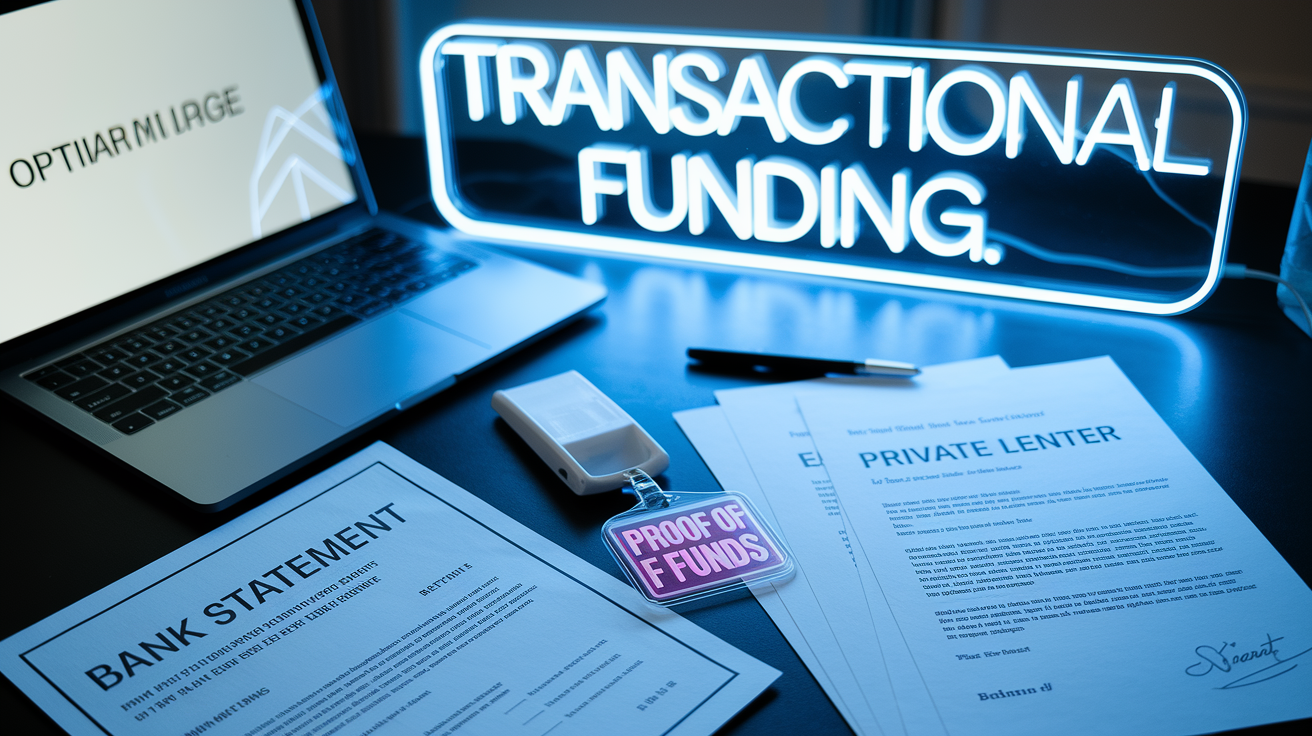
Wholesalers expect proof of funds covering the purchase price, estimated repairs, and the assignment fee. Cash ready buyers get priority access because they close faster and with more certainty than buyers dependent on traditional financing. Hard money down payments typically range from 10% to 30% of the purchase price, and hard money lenders usually fund based on the after repair value, not the purchase price. That means you can often finance most of the purchase and some of the rehab, but you still need cash for the down payment, closing costs, and any funding gaps.
Private lenders offer another option. Individuals or small funds that lend based on the deal and your track record rather than rigid underwriting guidelines. Private money often closes faster than hard money and may offer more flexible terms, but rates and fees vary widely.
Transactional funding is designed specifically for double closings. A transactional funder will provide same day capital to buy from the seller and immediately sell to you, usually for a flat fee or a percentage of the purchase price. Transactional funding is expensive per hour but cheap compared to holding costs if you can close the same day.
Before you approach wholesalers, line up at least one funding source and get a pre-approval or commitment letter. That proof of funds can be a recent bank statement showing liquid cash, a letter from a hard money lender, or a line of credit from a portfolio lender. The proof needs to show you can cover the purchase price plus repairs plus assignment fee without scrambling.
Wholesalers won’t waste time on buyers who “think” they can get funding. They want to see the money or the lender commitment before they’ll give you exclusivity.
Four common funding types for wholesale purchases:
- Cash: fastest and simplest. No lender approval, no appraisal, no underwriting delays. Ideal for competitive or time-sensitive deals.
- Hard money: asset-based loans funding 70–90% of purchase price and often a portion of rehab. Fast approval but higher rates (8–12%) and points (2–5%).
- Private money: individual or small fund lenders. Terms negotiated case by case. Often faster than hard money with flexible structures.
- Transactional funding: same day short term loans for double closings. Expensive per transaction but eliminates the need to hold the property overnight.
Improving Deal Flow and Scaling Relationships With Multiple Wholesalers

One wholesaler might send you one or two deals per month. To hit consistent volume (say, closing two to four deals per month), you need relationships with five to ten active wholesalers.
Managing that many relationships requires systems: a CRM or spreadsheet tracking each wholesaler’s name, contact info, typical deal flow, assignment fee range, deal quality, and your closing history with them. You should also track key performance indicators like how many deals each wholesaler sends per month, your conversion rate (deals closed divided by deals reviewed), and the average time from first contact to closing.
Top buyers maintain those metrics because they reveal which wholesalers are worth prioritizing. If a wholesaler sends ten deals per month but they’re all overpriced or misrepresented, that’s noise, not signal. If another wholesaler sends two deals per month but both are solid and you close one, that’s a high value relationship worth nurturing.
The ideal benchmark is receiving two or more vetted deals per month from each high quality wholesaler. When you hit that level, you have consistent deal flow without chasing every lead.
Six KPIs investors should measure when working with multiple wholesalers:
- Number of deals received per wholesaler per month.
- Conversion rate: deals closed divided by deals presented.
- Average assignment fee per deal and per wholesaler.
- Time from first contact to signed contract.
- Post-closing issues or surprises (title problems, undisclosed repairs, ARV misses).
- Repeat business: how many deals you’ve closed with the same wholesaler over time.
Becoming a Preferred Buyer
Credibility is built through fast decisions, clean closings, and reliability. When you tell a wholesaler you’ll review a deal by end of day, do it. When you commit to close in ten days, close in ten or fewer. When you pass on a deal, give brief feedback so the wholesaler learns what you want and stops sending mismatches.
Over time, those behaviors elevate you from “another buyer on the list” to “preferred buyer who gets first look.” Preferred buyers see deals before they’re marketed broadly, they get longer exclusivity windows, and they often negotiate better assignment fees because wholesalers know the deal will close. That status isn’t granted. It’s earned through consistent performance and clear communication over multiple transactions.
Final Words
You’re on the phone, opening deal packets, checking comps, and deciding fast. That’s the rhythm this post teaches: set up proof of funds, clear buying criteria, vet wholesalers, and run quick underwriting.
From networking and communication templates to negotiating assignment fees and funding options, the steps add up to a repeatable process. Keep your vetting checklist, communication cadence, and conservative repair buffers.
If you want to know how to work with wholesalers to find off-market deals, start small, track results, and be reliable, fast responses get the best offers. Do the basics consistently, and your pipeline will grow.
FAQ
Q: How to find off-market deals for wholesaling?
A: Finding off-market deals for wholesaling means combining direct outreach and networks: targeted mail or door knocks, driving for dollars, MLS pocket listings, REIA meetups, wholesalers and probate contacts, plus consistent follow-up.
Q: What is the 70% rule in wholesaling?
A: The 70% rule in wholesaling is a quick buy-price cap: max purchase = ARV × 70% − estimated repairs, leaving room for investor profit, assignment fees, and unexpected costs.
Q: What is the 3 3 3 rule in real estate?
A: The 3-3-3 rule in real estate is a tenant follow-up schedule: check in at 3 days, 3 weeks, and 3 months after move-in to catch issues, document condition, and build tenant rapport.
Q: What is the 7% rule in real estate?
A: The 7% rule in real estate is a loose rule of thumb estimating annual expenses or reserve needs around 7% of property value or gross rents; use it only as a starting point and verify locally.