

Property auctions are where investors either pick up real bargains or lose their deposit in minutes.
But most people treat them like regular listings and get burned.
This guide strips down the auction process step by step, shows the formats and funding tactics that actually work, and points out the legal traps that ruin deals.
You’ll get a quick 10‑minute screening method, practical bidding strategies, and a checklist for closing fast.
Read on if you want to bid with a plan, not hope.
How Property Auctions Work: The Complete Step‑by‑Step Process

Property auctions run on a tight timeline. It starts weeks before the gavel drops and ends with a binding contract hours after you win. You’ll usually find the auction catalog first, a public list of properties up for sale with legal descriptions, parcel numbers, dates, and sometimes opening bids. After that, time matters more than almost anything else.
Bidding wraps up fast. Traditional deals let you negotiate for days or weeks. Auctions close in minutes. Knowing the workflow before you show up keeps you from missing things like registration or deposit deadlines.
Here’s how it goes:
- Catalog release – Properties go public 30 to 90 days out, giving you time to check titles, liens, and condition.
- Pre‑auction inspection period – Some auctions let you visit the site or attend open houses, though interiors and pro inspections aren’t always on the table.
- Bidder registration – You register 24 to 48 hours ahead for in‑person sales, up to a week early for online, submitting ID and proof of funds.
- Deposit preparation – Most want a certified check or wire for 10 to 20 percent of what you expect to pay.
- Bidding begins – At the scheduled time, the auctioneer presents each property, takes bids, and the top bidder wins when the hammer falls.
- Contract signing and deposit payment – Winners sign a purchase contract right there and hand over the deposit. Don’t pay, don’t get the property.
- Balance payment and closing – You pay the rest within a fixed window, often 24 hours to 30 days depending on terms and location.
Big difference from regular sales: when the auctioneer says “sold,” you own a binding deal. Walk away or miss closing, you lose the deposit and might get sued for the gap if it resells lower. That’s why your funding needs to be ready before you raise your hand.
Types of Property Auctions Investors Should Know
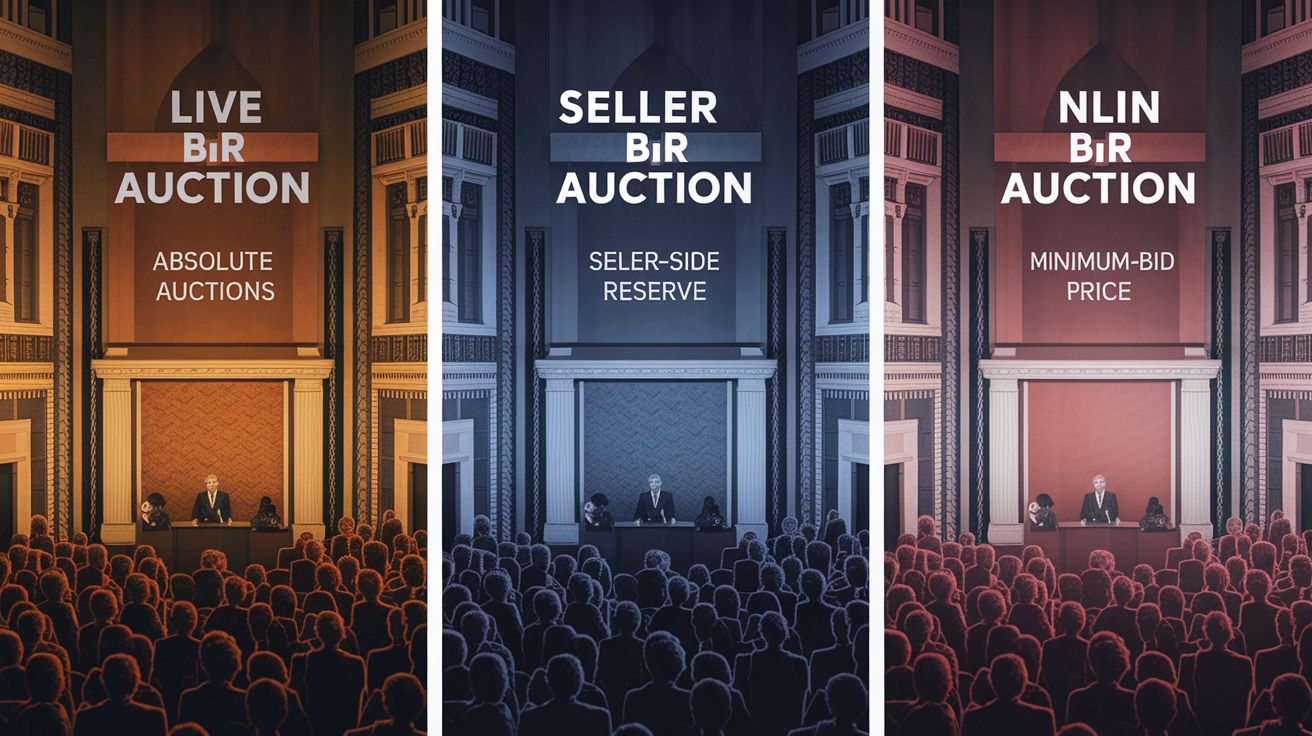
Auction formats change based on who’s selling, what they’re selling, and local habits. The three main types are absolute, reserve, and minimum‑bid. An absolute auction sells to the top bidder no matter how low the price goes. These pull the biggest crowds because buyers know there’s no hidden floor. A reserve auction lets the seller turn down any bid below a secret reserve, protecting them but annoying buyers who researched only to see “reserve not met.” Minimum‑bid auctions set a public starting price. The property has to sell at or above that number, so buyers know the seller’s floor going in.
Delivery format shapes your experience too. Live onsite auctions happen at the property or courthouse. You see your competition and feel the room. Online‑only auctions run on platforms for days or weeks. You bid from anywhere but lose the face‑to‑face pressure and drama. Hybrid auctions mix both: bidding opens online, then shifts to a live close where internet and in‑person bidders compete together.
Each format comes with tradeoffs:
• Absolute auctions – Better shot at deep discounts. Competition runs hot. No safety net for the seller means serious marketing and realistic pricing.
• Reserve auctions – Seller keeps control. Bidding can stall if the reserve’s too high. You risk spending time on properties that never clear reserve.
• Minimum‑bid auctions – Clear starting point. Cuts out extreme lowballs. Common for REO and tax‑deed sales where the county or lender wants a floor.
• Online vs live – Online offers convenience and wider buyer pools. Live lets you read the room and shift tactics based on who’s there.
Match your approach to the format. Chasing maximum discount and comfortable with uncertainty? Absolute auctions reward aggressive homework and bold bidding. Want predictable floors and clear rules? Minimum‑bid or online auctions give you structure and fewer surprises.
Essential Pre‑Auction Research for Investors

Auction catalogs get you started, but they’re rarely the whole story. Most listings show a street address, parcel number, legal description, maybe a photo. They leave out things like interior condition, tenant status, code violations, or senior liens. You fill those gaps before auction day.
Start with the parcel number. Pull county records to see ownership history, square footage, last sale price, mortgages, and liens. Cross‑check that with local MLS history on Zillow or Redfin for prior listings, interior shots, and days on market. If it was listed six months back at $200,000 and now heads to auction, something shifted. Could be foreclosure, estate settlement, or a flip gone wrong.
Next, check the neighborhood and comparable sales. Run a CMA using recent closed sales within half a mile that match bedrooms, square footage, and condition. That tells you the ceiling if you rehab to retail. Then back out repair costs, holding costs, financing costs, and your profit to get your maximum allowable offer. If comps show $180,000 after repair and you guess $40,000 rehab plus $10,000 carry plus $20,000 profit, your MAO is $110,000. That’s your hard limit.
Watch for red flags. Properties with multiple ownership changes in short windows often mean title trouble or structural nightmares that scared off earlier buyers. Long vacancy, boarded windows, or overgrown yards on Google Street View suggest deferred maintenance and maybe vandalism. If the catalog says “sold as‑is, no interior access,” assume worst case for HVAC, plumbing, electrical, and foundation unless you can verify otherwise through a drive‑by or neighbor chat.
Financing and Budget Planning for Auction Purchases
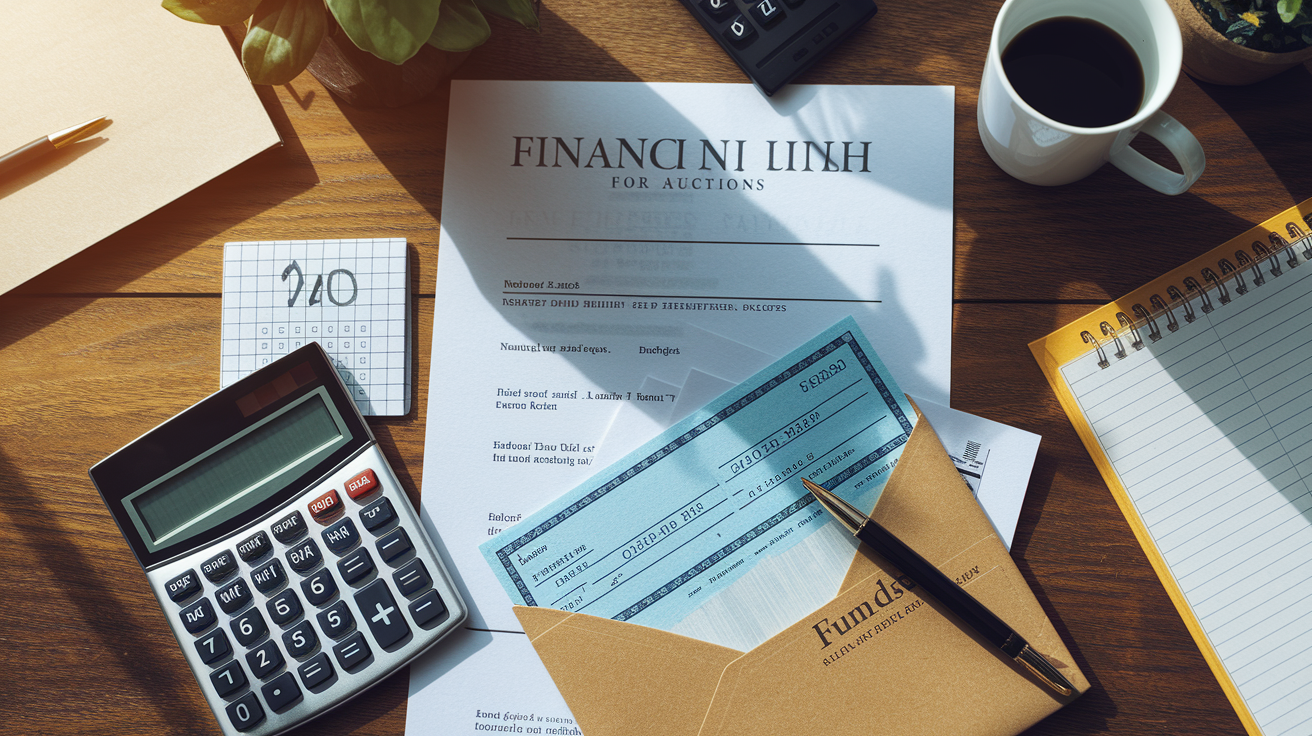
Most auctions want proof you can close fast. That means showing cash reserves or pre‑approved financing before you bid. If you’re using conventional, confirm your lender can close inside the auction’s payment window. Many residential lenders need 30 to 45 days, which works for some auctions but not courthouse sales wanting payment in 24 to 72 hours.
Hard‑money lenders and private capital show up often in auctions because they fund faster. A hard‑money loan can close in 48 to 72 hours if the deal’s solid, letting you hit tight deadlines. You’ll pay higher interest, 10 to 12 percent annually, plus origination points of 2 to 4 percent. The swap is speed and flexibility. Hard money works for distressed properties conventional lenders won’t touch.
Paying cash means liquidity planning matters. For a $100,000 auction buy, you typically need $10,000 to $20,000 in deposit funds on auction day, then the remaining $80,000 to $90,000 within the payment window. One smart move: carry multiple cashier’s checks in different amounts. One $25,000, two $10,000, four $5,000, and ten $1,000 checks let you hit the exact deposit and get change if needed.
Common upfront and closing costs to plan for:
• Auction deposit – Usually 10 to 20 percent of the winning bid, due right away or within 24 hours via wire or certified funds.
• Auction house or admin fee – Some charge a buyer’s premium of 5 to 10 percent on top of the hammer price.
• Title search and title insurance – Budget $500 to $1,500 depending on complexity and state.
• Survey costs – Required some places. Expect $300 to $800 for a residential lot survey.
• Conveyancing or closing attorney fees – Often $800 to $2,000 for auction deals with tight timelines and lien issues.
Plan for worst‑case deposits. If you bid on multiple properties in one session, you might need separate deposits for each. Bring enough to cover every potential win, or you risk losing a winning bid because you ran out of certified funds.
Legal and Contract Considerations in Property Auctions

Auction contracts bind you the second the hammer drops. Unlike traditional sales where you negotiate terms, ask for repairs, or back out during due diligence, auction buyers take the property “as‑is, where‑is, with all faults.” That phrase shows up in nearly every auction contract. It means what it says. You inherit every defect, lien, code violation, and tenant or occupant.
Before bidding, run a title search or hire a title company to spot liens, unpaid taxes, easements, and encumbrances. Some liens survive the auction. Mechanic’s liens, HOA dues, or IRS tax liens can transfer to you depending on lien priority and state law. If the property has $15,000 in unpaid contractor liens and you buy it for $80,000, you might owe $95,000 total to clear title. A pre‑auction title search shows these risks so you can adjust your bid or skip it.
Watch for redemption rights on tax‑deed and foreclosure auctions. In some states, the prior owner has 6 to 12 months after the auction to “redeem” the property by paying your winning bid plus interest, basically undoing the sale. Other states don’t offer redemption, giving you immediate final ownership. Confirm your state’s rules with a real estate attorney before bidding, because a redemption‑period property might sit vacant and un‑rehabbed for a year while you wait.
Contract clauses you’ll see include non‑refundable deposits, tight closing deadlines, and waivers of inspection contingencies. If it says “buyer waives all inspections,” you can’t back out after finding foundation cracks or mold. If it says “time is of the essence,” missing the payment deadline by even one day can trigger default and forfeiture. Read the auction terms and conditions, often 10 to 20 pages of fine print, or hire an attorney to review before you register. You can’t negotiate. You can only understand your obligations before the auctioneer starts.
Common legal traps: buying properties with undisclosed co‑owners (estate disputes), purchasing tax‑deed properties with surviving federal liens, or not budgeting for eviction costs when tenants or squatters occupy post‑sale. Title insurance protects you from some risks, but only if you buy a policy and only for covered defects. Many auction buyers skip title insurance to save $1,000, then spend $20,000 in legal fees clearing a cloud on title.
Effective Bidding Strategies for Auction Success

Set your max bid before the auction starts, write it down, and treat it like a ceiling you won’t cross. Emotional bidding, raising your hand “just one more time” because you already put in research hours, kills more deals than anything else. If your MAO is $110,000 and bidding hits $111,000, you stop. Walk. The next deal’s always coming.
Watch the competition. At live auctions, experienced investors often stand quietly in back, watching who bids early and who waits. Early bidders signal strong interest, which can push prices. Waiting till the last moment can save you from unnecessary raises, but it also risks losing if someone else hits your max before you jump in. Online auctions reward patience differently. Last‑minute “sniping” works on timed platforms, but some sites use auto‑extend rules that reset the clock with each new bid.
Here’s a six‑step playbook:
- Calculate your walk‑away number before you arrive – Factor in after‑repair value, estimated rehab (worst case), holding costs, financing costs, and profit. That’s your MAO.
- Register early and lock down proof of funds ahead – Don’t let admin delays shut you out.
- Arrive one hour early for live auctions – Watch the crowd, spot serious bidders vs. tire‑kickers, and catch pre‑auction rule changes.
- Start with the auctioneer’s opening bid or the first small bump – This sets the pace. Wait too long and aggressive openers can build momentum that drives prices higher.
- Use small, deliberate raises when you’re leading – Big jumps signal desperation. Small raises show discipline and might cool off competitors.
- Stop the instant you hit your ceiling – No exceptions, no “just $5,000 more,” no second‑guessing. Your numbers already include a margin for error.
For online auctions, set up alerts and check platform rules on bid steps, proxy bidding, and auto‑extend timers. Some investors use proxy bids (the system auto‑raises your bid up to your max), others prefer manual control to avoid showing their ceiling too early. Test the platform on a practice auction before you commit real money, because a missed click or misunderstood rule can cost you a property or lock you into an unintended bid.
Risk Mitigation for Property Auction Investors

Auction properties come with unknowns you can’t kill, but you can shrink your downside by planning for worst case. The biggest risk is hidden damage. Without interior access, you’re bidding blind on HVAC, plumbing, electrical panels, roof condition, and structure. Budget as if every major system needs replacement unless you have proof otherwise.
For example, if comps suggest $180,000 after repair and you estimate $30,000 in cosmetic rehab, add a 25 to 50 percent buffer for surprises. Foundation cracks, knob‑and‑tube wiring, or code violations that pop up during permit inspections. That pushes your rehab guess to $37,500 to $45,000, lowering your MAO and protecting your margin if the water heater dies the day you take over.
Title and lien risks need professional help. Hire a title company or real estate attorney to run a full title search before you bid. If the report shows a $10,000 mechanic’s lien, drop your bid by at least that much. Consider walking if the lien’s contested or unclear, because clearing it might need court filings and months of delay. Some investors build a standard “lien reserve” into every auction bid, setting aside $5,000 to $10,000 as a buffer for unexpected encumbrances.
Occupancy is another wild card. If tenants, squatters, or the former owner still live there, you’ll need to follow your state’s eviction process. That can take 30 to 90 days and cost $1,500 to $5,000 in legal fees and lost rent. Before bidding, drive by and look for signs of occupancy. Cars in the driveway, lights on, mail in the box. If occupied, assume eviction costs and timeline in your MAO, and budget for property security (lockboxes, cameras, boarding) until you get possession.
What Happens After Winning an Auction

The hammer falls, the auctioneer points at you, your heart races. Now the clock starts. Most auctions want your deposit within 24 hours via wire or certified check. Miss that window and you forfeit your winning bid. You might also face legal action if the property resells for less and the auctioneer sues you for the difference.
Once your deposit clears, you’ll get a contract or purchase agreement laying out the payment deadline for the remaining balance, typically 14 to 30 days from auction day. Use that time to lock financing, order title insurance, and schedule contractors for a walkthrough the moment you have legal access. Speed counts. Every day you hold the property costs you interest, insurance, utilities, and taxes. The faster you close, rehab, and either rent or flip, the better your return.
Here’s the post‑auction sequence:
- Wire or deliver deposit within 24 hours – Confirm wire instructions directly with the auction house (scammers send fake wire details sometimes). Bring certified checks if wiring’s not possible.
- Submit required docs – Provide photo ID, proof of funds, and any entity paperwork (LLC operating agreements, trust docs) they ask for.
- Order title search and title insurance right away – Even if you ran a preliminary search before bidding, update it post‑auction to catch last‑minute filings. Arrange title insurance at the same time to protect against hidden defects.
- Lock funding and close – Coordinate with your lender or arrange cash transfer. Attend closing (or set up remote signing) to get the deed and keys, then change locks, turn on utilities, and start repairs.
After closing, first priority is securing the property. If it’s vacant, install new locks, cover broken windows, and set up cameras or alarms to stop vandalism or squatting. If it’s occupied, serve proper legal notices and start eviction if tenants won’t leave. Then bring in contractors to check systems, pull permits, and start the rehab timeline you planned during homework.
Common Mistakes to Avoid at Property Auctions

The biggest mistake is bidding without a title search. You might win a $90,000 property only to find $40,000 in liens, turning your “deal” into a disaster. Title checks cost $300 to $500 and take a few days. Skip that and you’re gambling with five or six figures.
Another common error is low‑balling rehab costs. Investors see a cosmetic fixer, guess $20,000 for paint and flooring, then open walls to find mold, outdated wiring, or plumbing that breaks code. Always estimate worst case and add a buffer. If your contractor says $25,000, budget $31,000 to $37,500 to cover surprises.
Here are the five worst mistakes investors make at auctions:
• Bidding past your calculated max – Competitive pressure and attachment push bids beyond profit. Stick to your MAO no matter how badly you want it.
• Skipping the property inspection or drive‑by – Even without interior access, you can spot major red flags like settling, roof sag, or neighborhood decline from the curb.
• Not securing financing before auction day – Winning a bid with no funding plan leads to forfeited deposits and legal trouble. Pre‑qualify or line up cash first.
• Ignoring auction fees and closing costs – A 10 percent buyer’s premium, $2,000 in title fees, and $5,000 in surprise liens can erase your margin if you didn’t budget them.
• Not researching redemption periods on tax sales – Buying a tax‑deed property with a 12‑month redemption window means you can’t rehab or rent for a year, killing cash flow and forcing you to carry dead costs.
One subtle mistake: bringing the wrong payment. If you show up with personal checks or plan to wire after the auction, you might lose your winning bid. Confirm acceptable payment methods in the auction terms, and bring certified checks in flexible amounts so you can hit exact deposit numbers on the spot.
Property Auctions vs Traditional Real Estate Purchases

Auctions and traditional MLS buys serve different investor angles. Auctions reward speed, decisiveness, and risk tolerance with the shot at below‑market pricing. Traditional sales reward patience, thorough homework, and negotiation skill with lower legal risk and more financing options.
The core swap is time versus certainty. Auction closings happen in 30 to 45 days or less, letting you start rental income or flipping faster. Traditional closings stretch 45 to 60 days or longer, but you get inspection contingencies, appraisal protection, and the ability to walk if problems show up. Auctions attract fewer retail buyers because most can’t lock financing fast enough, cutting competition but also limiting your resale buyer pool if you flip quickly.
Here’s how the two compare across key factors:
| Factor | Auction Purchase | Traditional Purchase |
|---|---|---|
| Closing Timeline | 24 hours to 45 days, often fixed | 45 to 60+ days, flexible with extensions |
| Inspection Rights | Limited or none, sold “as‑is” with no recourse | Full inspection period, negotiate repairs or cancel |
| Financing Options | Cash or hard money preferred, conventional tough | Conventional, FHA, VA widely accepted |
| Price Discovery | Competitive bidding, potential deep discounts | Negotiated offers, seller can counter or reject |
| Legal Risk | Higher, liens and title defects transfer to buyer | Lower, title insurance and contingencies standard |
| Deposit & Commitment | Binding right away, non‑refundable deposit | Refundable earnest money during contingency period |
Use auctions when you have fast financing, strong homework skills, and the tolerance to handle unknown property conditions. Use traditional buys when you need time for inspections, want financing flexibility, or prefer negotiating price and terms instead of competing in real‑time bidding. Some investors blend both. They grab auction properties for deep‑value plays and use MLS for stable, low‑risk rentals that qualify for conventional loans.
Final Words
Start by running the quick pre-auction checks: catalog review, comps, a title search, and a site visit. Then follow the core auction steps—registration, bidding, hammer fall, deposit, and fast closing—so nothing takes you by surprise.
Pick the auction type that matches your strategy, secure financing or proof of funds, and read the contract for liens and deadlines. Keep a firm bidding ceiling and plan for repairs.
Use this property auctions guide for investors as a day-of checklist: prepare, limit downside, and bid with confidence.
FAQ
Q: How do property auctions work from start to finish?
A: Property auctions work from listing release through inspection, registration, bidding, hammer fall, deposit, and contract signing, with binding timelines and often immediate deposits.
Q: What are the main types of property auctions and how do they differ?
A: The main property auction types are absolute, reserve, and minimum‑bid; delivery formats include live onsite, online, and hybrid, each changing pricing, competition, and investor strategy.
Q: What should I research before attending an auction?
A: Before an auction you should review the auction catalog, comps, neighborhood trends, property condition, title and potential liens, and estimate repair costs and market rents.
Q: How do I prepare financing and budget for an auction purchase?
A: To prepare financing, get proof of funds or preapproval, plan for the immediate deposit and short close, and budget for purchase price, fees, taxes, and rehab reserves.
Q: What legal checks are essential before bidding at an auction?
A: Essential legal checks include a title search, lien and encumbrance searches, reading auction terms, verifying “as‑is” clauses, and getting an attorney to review the contract.
Q: What simple bidding strategies help win without overpaying?
A: Simple bidding strategies are set a hard ceiling, start with small increments, avoid emotional bids, observe competitors, and be ready to walk away when limits are reached.
Q: How can I reduce risks when buying at auction?
A: You can reduce auction risks by doing title and lien searches, ordering permitted inspections, keeping funding backups, holding repair reserves, and limiting bids to prechecked numbers.
Q: What happens immediately after winning an auction?
A: After winning, you must pay the required deposit, sign the binding sales contract, finalize financing and title work, and close within the auction’s short timeline.
Q: What common mistakes should investors avoid at auctions?
A: Common mistakes include bidding without research, skipping title or inspections, overlooking fees and rehab costs, emotional overbidding, and not having backup financing.
Q: When should I choose an auction over a traditional purchase?
A: Choose an auction when you need speed, accept buying as‑is, can close fast with funds prepared, and seek possible below‑market prices despite less negotiation flexibility.
Q: Are auction purchases legally binding and refundable?
A: Auction purchases are legally binding and usually nonrefundable; deposits are often required immediately and contract terms enforce strict closing deadlines and penalties.
Q: How do online and hybrid auctions change bidding and strategy?
A: Online and hybrid auctions change bidding by widening competition, enabling remote bids, requiring reliable internet and tech, and often speeding up decision and payment timelines.