
Think distressed rehabs are a shortcut to big profit? Think again.
They fail when underwriting is optimistic and unknowns pile up.
This post walks step-by-step through calculation methods for underwriting distressed rehab deals.
You’ll learn how to set a conservative ARV (after repair value), build realistic rehab budgets and contingencies, model carry and financing, and stress test scenarios so the deal still clears your minimum profit even if costs rise or timelines slip.
Read on to get a repeatable checklist that tells you when to buy, renegotiate, or walk.
Core Steps for Underwriting Distressed Rehab Deals From Start to Finish

Distressed rehab deals carry more risk than stabilized properties because you’re buying something that’s genuinely broken. Hidden structural damage, unknown permit history, deferred maintenance that compounds over decades. The numbers need more cushion because the unknowns pile up fast.
Initial numbers must be conservative. That means padding your ARV with a 5–10% discount compared to fully finished retail comps, adding renovation contingency buffers of 10–15%, and assuming timelines run 50–100% longer than the contractor promises. If you underwrite at the edge of what’s possible, any surprise pushes the deal underwater.
Four financial pillars matter most in distressed underwriting: income potential (what the property can rent or sell for after rehab), renovation scope (how much work and time the property needs), financing constraints (what terms you can secure and how debt service affects returns), and exit value (the ARV that determines your profit or refinance ceiling). Each pillar influences the others. A higher ARV justifies more renovation spend, but only if financing terms allow it and the timeline stays manageable.
These steps integrate to answer one question: does the deal work even when things go wrong? If your stress tested scenario still clears your minimum profit margin or DSCR threshold, you’ve found a viable opportunity. If not, you walk before you’re committed.
Full underwriting sequence:
- Initial property condition review. Walk the property, document visible defects, identify major systems that need replacement.
- Full repair scope and cost estimation. Translate condition findings into itemized scope of work with contractor bids and material costs.
- ARV calculation. Pull comparable sales, filter by location and condition, calculate average price per square foot.
- All in project cost calculation. Sum purchase price, renovation, carry costs, transaction fees, and contingency.
- Financing terms plus DSCR check. Model loan structure, calculate annual debt service, verify DSCR meets lender minimums if holding.
- Profit margin testing. Subtract all costs and desired profit from ARV to determine maximum allowable offer.
- Scenario stress testing. Rerun numbers with higher costs, longer timelines, and lower ARV to confirm deal viability.
Property Condition Analysis for Distressed Rehab Underwriting

Distressed condition directly affects ARV because buyers and appraisers discount properties with visible defects. A house with a sagging roofline or water stained ceilings won’t appraise at the same level as a renovated comp, even if square footage matches. Underwriting requires understanding not just what’s broken, but how much it costs to fix and whether the fix is even feasible within your budget and timeline.
Structural integrity checks and capital expenditure evaluation are essential because these items can’t be deferred or negotiated down. If the foundation is cracked, the roof needs replacement, or the electrical panel is a fire hazard, those repairs are mandatory. Skipping them means the property won’t pass inspection, won’t appraise, and won’t sell or rent. You can choose finishes, but you can’t choose whether to replace a failed septic system.
Verified inspection documentation protects you from committing to budgets based on guesswork. A contractor walking the property for 20 minutes will miss things. A licensed inspector with thermal imaging, moisture meters, and electrical testing will find hidden damage that changes your renovation estimate by $15,000 or $40,000. Get the inspection report before you finalize your offer or at least before your due diligence period expires.
Key defects to investigate:
Foundation cracks, settling, or water intrusion in crawl spaces and basements. Roof systems including decking, shingles, flashing, and estimated remaining useful life. HVAC age, functionality, and whether ductwork or refrigerant lines need replacement. Plumbing for galvanized pipe, polybutylene, slab leaks, or sewer line damage. Electrical panel capacity, knob and tube wiring, aluminum wiring, and grounding issues. Mold growth, water damage history, and asbestos indicators in older properties.
Creating a Renovation Scope and Estimating Rehab Costs Accurately

Translating inspection findings into actionable scope of work means turning a list of defects into a line item budget. You take the inspection report, break it into categories (structural, mechanical, cosmetic), assign costs to each item, and build a master spreadsheet that tracks hard costs, soft costs, and contingency. This scope becomes the contract document you hand to contractors and the budget you monitor during construction.
Collecting multiple contractor bids and cost benchmarks protects you from overpaying and from underestimating. Three bids on the same scope will often vary by 20–40%. One contractor may include permits and disposal, another may not. One may pad labor, another may lowball to win the job then hit you with change orders. Use the middle bid as your baseline, then cross check it against per square foot renovation benchmarks for your market and property type.
Contingency buffers protect the project against unknowns that always surface once walls are opened. You find rotten subfloor under the kitchen tile, outdated wiring that needs a full panel upgrade, or a permit issue that delays the schedule by six weeks. A 10–15% contingency on hard costs is standard. If your renovation estimate is $50,000, budget $55,000 to $57,500. If you don’t need it, great. If you do, you’re covered without scrambling for more capital.
| Cost Type | Examples | Notes |
|---|---|---|
| Hard Costs | Materials, labor, demolition, structural repairs, finishes | Directly tied to physical construction; get itemized contractor bids |
| Soft Costs | Permits, inspections, architect/engineer fees, insurance during rehab | Often overlooked; can add 5–10% to total project budget |
| Contingency | Hidden damage, change orders, unforeseen code compliance | Budget 10–15% of hard costs; release only when needed |
Calculating ARV and Using Comparable Sales for Rehab Underwriting
ARV is the most critical number for distressed deal underwriting because it sets the ceiling for everything else. If you overestimate ARV by $20,000, your maximum purchase price, renovation budget, and profit margin all collapse. If you underestimate it, you might walk away from a solid deal. Getting ARV right means the difference between a profitable exit and a loss.
Pulling and filtering comparable sales correctly requires discipline. You need properties in the same neighborhood (within half a mile for suburban, within a few blocks for urban), sold within the past 6–12 months, within ±20% of your subject property’s square footage, and in similar renovated condition. Don’t use a comp that’s 30% larger, across town, or sold 18 months ago during a different market cycle. Don’t use a distressed sale as a comp for your renovated ARV.
Overestimating ARV destroys rehab profits because every dollar of inflated ARV gives you false confidence to overpay, overspend, or underestimate risk. You think you can afford a $200,000 purchase price because ARV looks like $320,000, but the real ARV is $290,000. Now your profit margin just evaporated and you’re praying the property sells fast before carry costs eat what’s left.
Steps for calculating ARV using comps:
Pull at least three to five comparable sales that match location, size, age, and condition post renovation. Verify sale dates are recent (ideally within six months, maximum twelve months). Calculate price per square foot for each comp, then compute the average. Multiply the average price per square foot by your subject property’s finished square footage. Apply a 5–10% discount if your property has location, layout, or lot disadvantages compared to the comps.
Estimating All In Project Costs and Maximum Allowable Offer

Defining each cost category keeps your underwriting organized and prevents surprises. Renovation costs include hard costs, soft costs, and contingency as covered earlier. Carry costs are the monthly expenses you pay while the property sits: loan interest, property taxes, insurance, utilities if you’re keeping them on, HOA fees if applicable. Transaction costs include acquisition closing fees (title, escrow, inspections, appraisal) and disposition costs if flipping (realtor commissions at 5–6%, transfer taxes, seller closing fees). Add them all up and you have your all in project cost before profit.
The formula for flips breaks down like this: start with ARV, subtract selling costs (6–8% of ARV), subtract total renovation including contingency, subtract carry costs for the expected timeline, subtract your desired profit margin, and what’s left is the maximum price you can pay for the property. If that number is higher than the asking price, you have room to negotiate or pad your assumptions. If it’s lower, you either renegotiate the purchase price or walk.
Let’s say ARV is $280,000. Selling costs at 7% are $19,600. Renovation estimate with contingency is $55,000. Carry costs for six months (interest, taxes, insurance, utilities) total $9,000. You want a $40,000 profit (roughly 20% margin on your $200,000 all in cost). Maximum purchase price equals $280,000 minus $19,600 minus $55,000 minus $9,000 minus $40,000, which gives you $156,400. If the seller wants $165,000, the deal doesn’t work unless you can cut costs, raise ARV with better comps, or accept a lower profit.
Financing Terms and Loan Impact on Distressed Rehab Deals

Typical financing products for distressed rehabs include hard money loans (short term, asset based, higher rates around 8–12%, points of 2–4%), private money lenders (individual investors, flexible terms, often relationship based), bridge loans (six to eighteen months, moderate rates, used for acquisition and light rehab), and construction loans (fund renovation in draws, lender inspects progress before releasing funds). Each product has different LTV limits, interest structures, and approval timelines that directly affect deal feasibility.
Loan structure variables determine whether you can afford the debt service during the project and whether the exit refinance or sale covers your obligations. High interest rates inflate carry costs, making longer timelines riskier. Shorter loan terms force faster exits, which can push you to sell before the market window is ideal. Upfront points reduce your cash to close and lower your profit. Required reserves lock up capital that could go toward another deal.
Lender LTV limits directly influence maximum purchase price because they cap how much borrowed capital you can deploy. If a hard money lender offers 70% LTV on the ARV and 100% of rehab costs, you need to come up with 30% of the ARV in cash plus acquisition and carry costs. If ARV is $280,000, you can borrow $196,000 against the after repair value. If your all in cost is $220,000, you’re covering $24,000 out of pocket plus carry and closing. If LTV drops to 65%, your cash requirement jumps and the deal may no longer pencil.
Critical financing variables to model:
Interest rate and how it affects monthly carry cost over the full timeline. Loan term and whether it gives you enough runway for construction and marketing. Origination points and fees that reduce your net proceeds or increase cash to close. Lender required reserves or escrows that tie up liquidity during the project.
Profit Margin Modeling, Cash Flow Projections, and Deal Viability Tests

Distinguishing flip profit thresholds from hold cash flow requirements starts with understanding your exit strategy. Flips need a minimum profit margin (commonly 20% of total project costs or a flat dollar amount like $30,000+) to justify the risk, timeline, and effort. Rental holds need positive monthly cash flow after debt service, with a DSCR of 1.20x or higher to satisfy lender requirements and provide a cushion for vacancies, repairs, and rate adjustments.
Time in market metrics affect projected profits because every extra month adds carry costs and increases exposure to market shifts. If you plan for a four month renovation and six week sale cycle, but construction runs six months and the property sits for three months, your carry costs double. Interest, taxes, and insurance that were budgeted at $6,000 now hit $12,000, cutting directly into profit. Days on market and absorption rate data help you set realistic timelines.
Using DSCR and NOI to evaluate long term holds means modeling annual rental income, subtracting operating expenses (taxes, insurance, maintenance, property management, vacancy reserve), and dividing the resulting NOI by annual debt service. If NOI is $18,000 and annual debt payments total $15,000, DSCR is 1.20x. That’s the minimum most lenders want. If DSCR drops below 1.0x, you’re losing money every month and the deal doesn’t work as a hold.
Key calculations for profit and cash flow modeling:
Gross profit equals ARV minus All In Costs (purchase plus renovation plus carry plus transaction fees). Profit margin percentage equals Gross Profit divided by Total Project Costs. NOI equals Annual Rent minus Operating Expenses (taxes, insurance, maintenance, management, vacancy allowance). Annual Debt Service equals Monthly Loan Payment times 12. DSCR equals NOI divided by Annual Debt Service.
Stress Testing Distressed Rehab Deals for Worst Case Scenarios
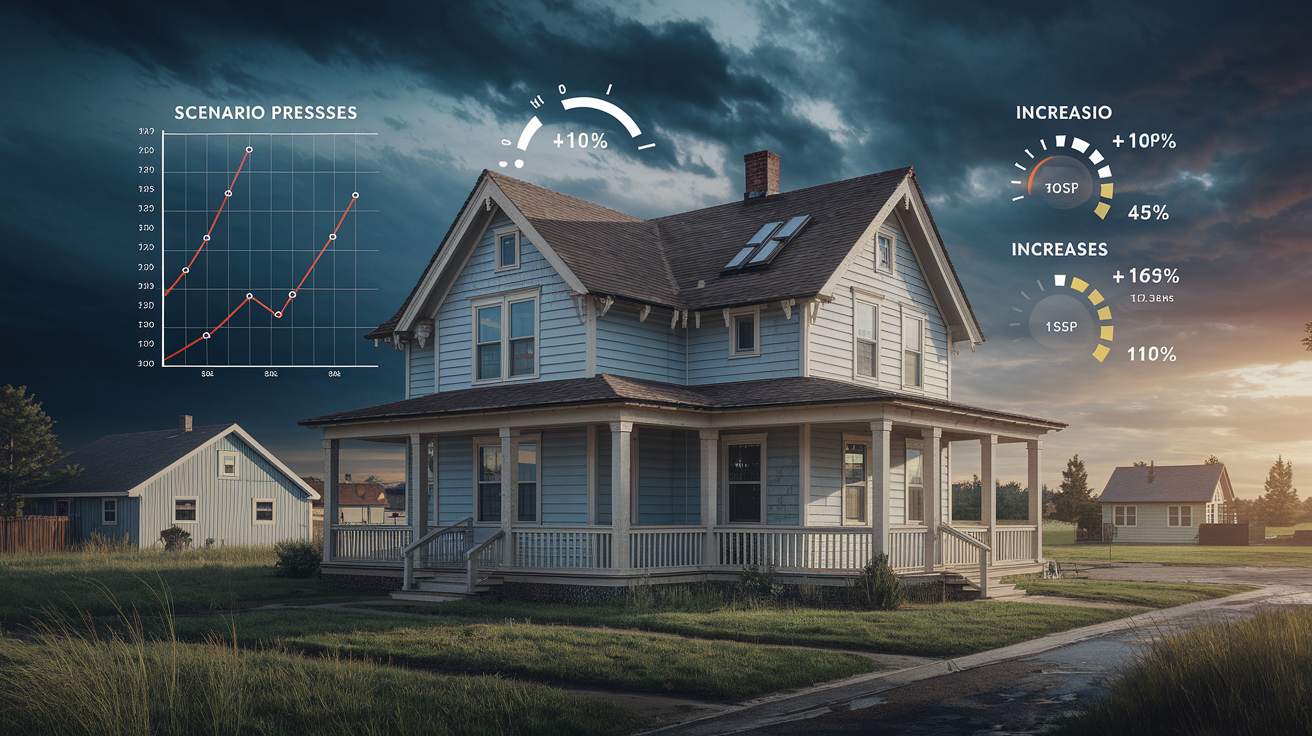
Pressure testing distressed rehab deals means rerunning your underwriting with pessimistic assumptions to see if the deal still clears your minimum return thresholds. Add 10–15% to renovation costs to account for hidden damage or scope creep. Double the construction timeline to reflect permit delays, contractor issues, or weather. Reduce ARV by 5–10% to simulate a market softening or appraisal coming in low. If the deal still works, you’ve built in enough margin. If it breaks, you’re gambling.
Walk away from deals that only work under perfect conditions. If a single bad assumption (one extra month of carry, one surprise $8,000 foundation repair, one $15,000 ARV miss) turns your profit into a loss, the risk isn’t worth it. Distressed properties already carry more unknowns than stabilized assets. Stress testing separates deals with real margin from deals that look good on paper but collapse in execution.
Common deal killers surface during stress testing and due diligence. An ARV that collapses when you apply conservative comp filters. Structural damage that’s too expensive to fix within your budget. Zoning restrictions that prevent your intended use or require costly variances. Title issues like unpaid liens, easements, or clouded ownership that delay closing or kill the deal entirely. Permit requirements that triple your soft costs or extend timelines by six months.
Common deal killers:
ARV collapse when conservative comps are applied or appraisal comes in 10%+ below broker estimates. Unfixable structural damage like foundation failure, severe settling, or load bearing wall issues that exceed budget. Zoning restrictions preventing renovation scope, ADU conversion, or short term rental use. Title defects including unresolved liens, estate issues, or missing easement documentation. Permit denials or requirements that add $20,000+ in fees, engineering reports, or impact studies.
Legal, Title, and Compliance Checks for Distressed Underwriting

Title must be clear of liens and encumbrances before you close because unresolved claims transfer to you as the new owner. That means unpaid property taxes, mechanics liens from contractors on prior work, mortgage liens from previous financing, and judgment liens from lawsuits all become your problem. A title search during due diligence identifies these issues so you can negotiate payoffs, demand seller resolution, or walk if the cloud can’t be cleared.
Permit requirements and zoning directly influence rehab timeline and feasibility because unpermitted work creates legal and financing risks. If the property has unpermitted additions, converted garages, or structural changes done without approval, you may need to bring it up to code, remove the work, or apply for retroactive permits. Zoning restrictions can block your renovation scope entirely if the property is nonconforming or if your intended use (like a duplex conversion or short term rental) isn’t allowed.
Critical compliance checks:
Full title search confirming no outstanding liens, judgments, or unresolved ownership disputes. Verification that prior renovation work was permitted and signed off by local building departments. Zoning confirmation that your renovation scope and intended use are allowed as of right or achievable with minor variances. Code violation search through municipal records to identify unpaid fines, open violations, or pending enforcement actions.
Using Underwriting Spreadsheets and Templates to Simplify Distressed Deal Evaluation

Back of the envelope tests filter bad deals early so you don’t waste time building detailed models on properties that will never pencil. Subtract rough renovation costs (use $25–$40 per square foot as a starting point) and 35% of ARV for all other costs (acquisition, carry, transaction, profit). If the remaining number is below the asking price, move on. If it’s above, dig deeper with a full spreadsheet.
A full underwriting model organizes all your assumptions, calculations, and outputs in one place so you can test scenarios quickly and compare deals side by side. Input tabs capture purchase price, ARV comps, renovation line items, financing terms, and holding period assumptions. Analysis tabs calculate NOI, DSCR, profit margin, and cash on cash return. Stress test tabs let you toggle pessimistic variables and see how the deal performs under pressure.
Essential spreadsheet tabs:
Inputs: property address, purchase price, ARV, renovation budget, financing terms, timeline assumptions. Analysis Outputs: total project cost, profit margin, NOI, DSCR, cash flow projections, return metrics. Stress Tests: sensitivity tables showing how profit or DSCR changes when you adjust costs, ARV, or timeline.
Final Words
Run the quick screen: condition, realistic repair estimate, ARV from true comps, financing limits, and a profit or cash-flow test. That early pass tells you if a deal deserves the deeper work.
You now have the steps for condition checks, scoped rehab budgets, ARV math, all-in costs, financing impacts, stress tests, title checks, and spreadsheet workflows.
Pick a deal, follow the checklist, and practice underwriting distressed rehab deals step by step. You’ll get clearer answers and fewer surprises.
FAQ
Q: What are the 5 C’s of underwriting?
A: The 5 C’s of underwriting are character, capacity, capital, collateral, and conditions. They assess borrower reliability, repayment ability, reserves, property as security, and the loan or market context.
Q: What are the steps in the underwriting process?
A: The underwriting process steps are initial application and document verification, income and expense analysis, property valuation/appraisal, risk scoring and conditions, loan decision, and closing/funding.
Q: What is the 70% rule for brrrr?
A: The 70% rule for BRRRR says purchase price plus rehab costs should typically not exceed 70% of ARV. Equivalently, Max Purchase = 70% of ARV − estimated rehab, preserving profit and costs.
Q: How to finance a distressed property?
A: To finance a distressed property use hard-money or private loans, rehab-specific programs, bridge financing, or cash. Pick based on speed, LTV limits, interest cost, and your exit plan (flip, refinance, or hold).