

Think any contractor who shows up with a ladder is good enough for a BRRRR rehab?
Holding costs, missed refi windows, and tenant-less months will eat your profit fast; a contractor who finishes in three weeks instead of eight can save you thousands.
This post walks you through choosing contractors who actually run fast rehabs, how to check start availability, verify recent similar jobs, confirm stable crews and subs, and lock timeline commitments in writing.
If you want to cut weeks off your schedule and protect your deal math, this is the place to start.
Fast-Track Contractor Selection for BRRRR Rehab Success

Holding costs destroy your numbers. Every week a BRRRR property sits vacant chips away at what you thought you’d make. Mortgage, insurance, taxes, utilities. That’s anywhere from $500 to $2,500 a month depending on how you financed it and where you bought. When your whole strategy depends on rehabbing fast, getting a tenant in, and pulling your money back out through a refi, speed isn’t some nice bonus. It’s survival math. A contractor who wraps up a light rehab in 3 weeks instead of 8 just saved you $1,000 to $5,000 in holding costs. And that’s not even counting the cash flow you missed while the place sat empty. Picking the right contractor is one of the biggest levers you can pull in a BRRRR deal.
Fast contractors aren’t just people who work quicker. They’re more organized. They’ve got steady crews. They manage subs without everything turning into a circus. They know how to line up the trades so the plumber isn’t sitting around waiting for the electrician, and drywall doesn’t stall out because someone missed the inspection window. They carry insurance, they answer the phone, and they’ve done this recently enough that they remember how it goes. A contractor who can knock out a cosmetic rehab in 2 to 3 weeks, a light rehab in 3 to 6 weeks, or a full gut in 8 to 16 weeks has real systems. They’re not figuring it out on your property.
To screen candidates fast, focus on recent work and current availability. If they can’t start in 7 to 21 days, they’re probably overloaded. If they can’t name three similar jobs they finished in the past 24 months, they’re either new or rusty. Ask for references, actually call them, and if you can, go walk a finished job or two. Ask about crew size and who they use for subs. Find out how many jobs they’re running right now. A contractor juggling eight projects with a two person crew is a scheduling nightmare you don’t want any part of.
What to check right away:
- Current capacity and start availability. You want someone who can begin in 7 to 21 days. Longer than that usually means you’re not a priority.
- Crew size and subcontractor reliability. Ask for the names of subs they work with regularly. Stable relationships mean fewer delays.
- Documented past speed on similar rehabs. Get real examples with actual start and finish dates, not vague promises.
- At least three verifiable investor references. Call them. Ask about on-time completion and whether the final cost matched the bid.
- Proven BRRRR or rental rehab familiarity. Contractors who get investor timelines and rental grade finishes think differently than the ones who build custom homes.
- Clear timeline commitments in writing. If they won’t put milestone dates on paper, they don’t believe they can hit them.
Vetting Processes for BRRRR-Focused Contractors

Skipping due diligence costs you more than just money. It costs time. A contractor who disappears halfway through or brings uninsured subs onto your property can stall everything for weeks. Worse, unpaid subs can slap liens on the place and kill your refinance. Vetting isn’t optional, and it doesn’t take forever if you know what you’re checking. You just need to confirm the contractor is legit, solvent, insured, and accountable before you sign anything or hand over a deposit.
Start with paperwork. Get a copy of their active contractor license with the expiration date. Certificate of insurance showing at least $1,000,000 in general liability plus workers’ comp. Their EIN or business registration. A list of the subs they’re planning to use. Check the license status online through your state’s licensing board. Run a lien search on their name to see if suppliers or subs have sued them. Multiple recent liens? Walk. Ask for references from at least three recent investor clients. Not homeowners. Investor rehabs move faster and the expectations are different. Call those references and get specific. Did they finish on time? Did the final cost match the bid? How’d they handle problems? Then visit one or two finished projects if you can. Ten minutes on site teaches you more than three phone calls.
Pre-qualification checklist:
- Minimum 3 years in business with verifiable registration or EIN.
- At least 5 similar rehab projects finished in the past 24 months. Get addresses and dates.
- Active contractor license that matches the scope of work.
- Current certificate of insurance: $1,000,000+ liability, active workers’ comp, you listed as additional insured if possible.
- Written list of subcontractors with contact info and trade specialties.
- At least 3 recent investor references willing to talk.
- Clean lien history. No pattern of unpaid subs or suppliers filing claims.
Interviewing Contractors for Fast BRRRR Rehab Timelines

The interview separates contractors who actually understand speed from the ones who just say they do. Don’t go on gut feel or charm. Ask direct questions that reveal capacity, process, and accountability. A solid contractor will answer quickly and specifically. A weak one will dodge, talk in generalities, or promise everything without explaining how. You’re trying to figure out if this person can start promptly, finish on schedule, and communicate clearly the whole way through.
Timeline Capacity Questions
Start with how many active projects they’re managing right now. If it’s more than four or five and they’re running a small crew, that’s trouble. Then ask when they can start. Ideal window is 7 to 21 days. Anything past a month usually means they’re overcommitted or they don’t prioritize smaller investor jobs. Next, ask for average turnaround times by scope. “What’s your typical timeline for a cosmetic rehab, a light rehab, and a full gut?” For context, realistic numbers are 7 to 21 days for cosmetic stuff like paint and flooring, 21 to 45 days for light rehabs with kitchens or baths, and 60 to 120 days for full gut jobs. If their estimates are way faster, ask how. Bigger crews? Weekend work? Priority relationships with subs? If they’re slower, find out why and decide if the delay is worth it.
Quality & Oversight Questions
Ask who will be on site daily and who your single point of contact is. You want a named project manager or lead, not a different person every week. Then ask for a backup contact in case the primary person isn’t reachable. Find out how they manage subs. Do they use the same ones on every job, or do they shop around? Stable sub relationships usually mean faster coordination and fewer no-shows. Ask if they provide a written warranty on workmanship and for how long. One year is standard. If they say no or seem vague, that’s a problem. Finally, ask them to walk you through a recent project where something went wrong and how they fixed it. The answer tells you a lot about how they handle pressure.
Comparing Contractor Bids and Avoiding Unrealistic Pricing

Never rely on a single bid. Get at least three, ideally five, and make sure each one is detailed and itemized. A good bid breaks out costs by trade and by room. Demo, framing, plumbing, electrical, drywall, paint, flooring, appliances. If a bid just says “full rehab: $30,000,” it’s useless for comparison and risky to accept. Itemized bids let you spot where one contractor is expensive and another is cheap. They also give you leverage to negotiate or ask questions. Require that all bids stay valid for 30 days so you’ve got time to compare without contractors jacking up prices halfway through your decision.
Pricing signals matter. Contractor markup on labor and materials usually falls between 10 and 25 percent depending on project complexity and your market. If one bid comes in 30 percent or more below the others, treat it like a red flag. That’s not a deal. It’s usually a sign the contractor missed scope, plans to cut corners, or will hit you with change orders later. On the other hand, the highest bid isn’t automatically the best quality. Compare line by line. For rough benchmarks, cosmetic “lipstick” rehabs often run around $10 per square foot for paint, flooring, and fixtures. Heavy remodels involving kitchens, baths, and structural work can hit $20 per square foot or more. Use these as sanity checks, not gospel.
| Type of Bid | Pros | Cons |
|---|---|---|
| Line-item bid | Transparent; easy to compare across contractors; clear scope per trade; simplifies change order pricing. | Takes longer to prepare; requires detailed walkthrough; contractor may pad line items if unsure of scope. |
| Fixed-price | Predictable total cost; contractor owns risk of overruns; simpler contract structure for investor. | Contractor may inflate price to cover unknowns; harder to negotiate adjustments; less transparency on labor vs material split. |
| Time and materials | Flexible for uncertain scope; contractor paid for actual work; can be faster to start. | Unpredictable final cost; requires close oversight; risk of inflated hours; not ideal for tight BRRRR budgets. |
Crafting Contracts that Protect BRRRR Speed and Quality

A verbal agreement isn’t a contract. A vague one page proposal isn’t much better. Your contract needs enough detail that both sides know exactly what’s expected, when it’s due, and what happens if things go wrong. The more specific you are up front, the fewer disputes you’ll have later. A strong contract protects your timeline, your budget, and your ability to refinance on schedule.
Start with a detailed scope of work attached as an exhibit. The scope should list every task by room and trade. What’s included and, just as important, what’s not. Include the total contract price with a line item breakdown if possible. Specify the start date, milestone dates for each major phase, and the final completion date. Tie your payment schedule to those milestones so the contractor only gets paid after you’ve inspected and approved each phase. Include a written process for change orders. Any change to scope or price has to be documented in writing and signed by both parties before work begins. Require that the contractor pulls all necessary permits and gives you copies. Make sure they get lien waivers from every sub and supplier at each payment. Include a warranty term for workmanship, typically one year. Add an indemnification clause so the contractor is responsible for injuries or damages caused by their crew. Finally, include a dispute resolution process and a termination clause that lets you end the contract if the contractor fails to perform.
Must have contract clauses:
- Detailed scope of work as signed exhibit. Room by room task list prevents scope creep and “I thought that was included” fights.
- Milestone schedule with specific dates. Tie each payment to inspected completion of demo, rough in, drywall, final paint, punch list, etc.
- Payment terms and retainage percentage. Standard structure: 10 to 30 percent deposit, progress draws at milestones, 5 to 10 percent held until final sign off.
- Change order requirement. All changes must be written, priced, and signed before work starts. Verbal agreements don’t count.
- Lien waiver procedure. Contractor must provide conditional waivers at each draw and an unconditional final waiver before getting the last payment.
For speed protection, consider adding a liquidated damages clause. This sets a daily penalty if the contractor misses the agreed completion date. Common range is $100 to $500 per day, or 0.2 to 1.0 percent of the contract value per day. The penalty compensates you for extra holding costs and gives the contractor a financial reason to stay on schedule. You can also include an early completion bonus as a carrot. Pay an extra $100 to $500 per day, or 1 to 3 percent of the contract total, if they finish ahead of schedule. Balance the bonus so it’s motivating but doesn’t eat your margin. Both clauses work best when the timeline was realistic to begin with.
Payment Structures that Incentivize Fast and High-Quality Work
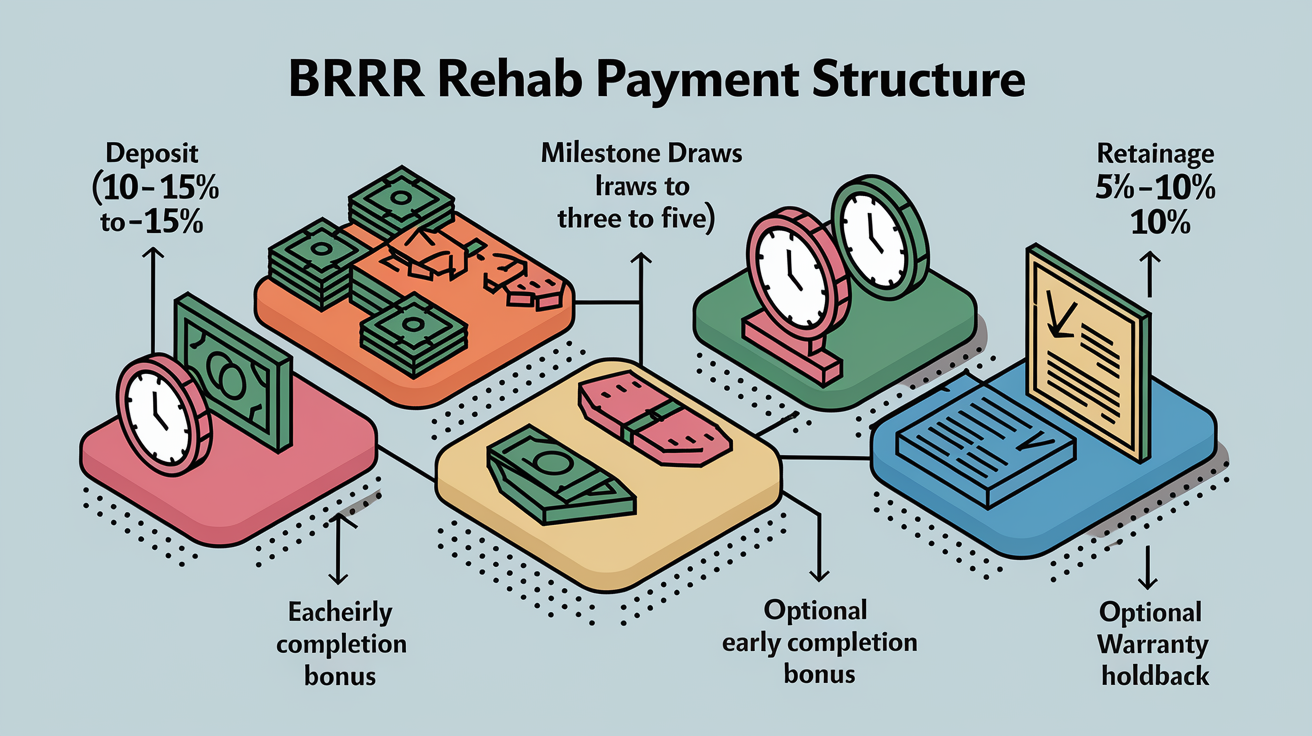
How you pay a contractor shapes how they behave. Pay too much up front and you lose leverage. Pay too little until the end and the contractor may pull their crew to another job that’s paying faster. The right structure balances cash flow for the contractor with protection and urgency for you. Milestone based payments tied to inspected deliverables are the standard for investor rehabs. They work because both sides have skin in the game at every stage.
A typical payment schedule starts with a 10 to 15 percent deposit when the contract is signed. That gives the contractor cash to order materials and mobilize the crew. Then you make progress payments, usually three to five draws depending on project size, at major milestones like demo complete, rough in complete and inspected, drywall hung, final paint and finishes, and punch list. Each draw should require your inspection and sign off, plus a signed lien waiver from the contractor and any subs who worked on that phase. Hold back 5 to 10 percent as retainage until the final punch list is complete, all permits are closed, and you’ve gotten an unconditional lien waiver. Some investors hold a small portion even longer, until 30 days post completion or the one year warranty check, to make sure the contractor comes back if minor issues pop up.
Five step payment structure:
- Deposit on signing. 10 to 15 percent. Covers initial material orders and mobilization. Never pay 50 percent or more up front.
- Milestone draws. Three to five payments tied to inspected phases. Each payment requires your approval and signed lien waivers before release.
- Retainage until punch list. Hold 5 to 10 percent until all final items are complete and permits are closed. This is your primary leverage for finishing details.
- Early completion bonus. Optional. Fixed dollar amount or percentage if contractor finishes ahead of deadline. Keeps crew prioritized on your job.
- Warranty holdback. Optional. Retain a small portion (1 to 2 percent) until 30 day or one year warranty check to ensure contractor returns for minor fixes.
The single most effective speed incentive is paying promptly when milestones are hit. Contractors talk. The ones who deliver fast work gravitate toward investors who inspect quickly and release payments on time. If you nickel and dime every draw or delay payment for no reason, you’ll lose access to the best contractors. If you pay on schedule and provide steady repeat work, you’ll move to the front of their queue.
Managing Contractors During High-Speed BRRRR Rehabs

Hiring the right contractor is half the job. Managing them well is the other half. Even a great contractor will drift off schedule if no one’s watching. Your job isn’t to micromanage every nail, but to stay close enough that small problems get fixed before they become big ones. Weekly check ins, photo updates, and a shared schedule are the minimum standard for any rehab where speed matters.
Set a standing weekly walkthrough at the same day and time every week. Show up on time with a list of open items from the previous week. Walk every room, check progress against the schedule, and document any issues right there. Take your own photos. Between walkthroughs, require the contractor to upload progress photos to a shared cloud folder at least three times per week during active work phases. These photos create a visual timeline and give you early warning if something’s off. Use a simple shared schedule. A Gantt chart if you’re comfortable with it, or just a spreadsheet with task names, responsible parties, start dates, and durations. Update it every week so both of you know what’s supposed to happen next. Address problems the same day they’re identified. Waiting a week to bring up a mistake or missed deadline just compounds the delay.
Schedule & Documentation Requirements
Insist on clear milestone checkpoints with named responsible parties. For example: “Demo complete by March 15, John’s crew; rough plumbing complete by March 22, ABC Plumbing; electrical rough in complete by March 24, Smith Electric.” This removes ambiguity and makes it easy to see when someone’s behind. Schedule key inspections in advance. After demo, after rough in, after drywall, and final. That way you’re not scrambling to get an inspector out when the contractor’s ready to move forward. Each inspection is a natural quality control gate. If something’s wrong, you catch it before it’s covered up. Once the main work is done, walk the property with the contractor and create a punch list of minor items that need fixing or finishing. Set a hard deadline for punch list completion, typically 7 to 14 days, and tie the final retainage payment to it. Make the punch list specific. “Fix gap under guest bath door” is better than “finish guest bath.”
Quality Control, Inspections, and Final Punch Lists

Speed and quality aren’t opposites, but they do create tension. A contractor under time pressure may skip steps, use cheaper materials, or leave details unfinished. Your quality control process is what keeps the work investor grade without adding unnecessary delays. The key is to inspect at the right moments and hold the line on standards that matter. Code compliance, durability, and finish quality that meets your rental market.
Require material submittals for major systems before installation. That means the contractor shows you the exact model and spec for the HVAC unit, windows, water heater, appliances, and any other long life components. Confirm that everything comes with a manufacturer warranty and meets local code. Schedule inspections at four natural checkpoints: after demo and before framing, after rough in and before drywall, after drywall and before paint, and final walkthrough. These inspections let you catch structural issues, code violations, and finish problems while they’re still easy to fix. If you’re refinancing soon after rehab, some lenders or appraisers may require third party inspection reports for major systems. Budget a few hundred dollars for a licensed inspector if that’s the case. It’s cheaper than a failed appraisal.
Four step quality checkpoint process:
- Material approval before purchase. Contractor submits model numbers and specs for HVAC, appliances, windows, and major finishes. You confirm they meet rental grade durability and code.
- Post demo inspection. Walk the property after tear out to confirm structural condition, identify hidden issues, and approve any scope changes before framing begins.
- Rough in inspection. Verify plumbing, electrical, and HVAC rough in passes code and is installed per plan before drywall covers it. This is your last chance to catch installation errors.
- Final walkthrough and punch list. Walk every room, test every fixture, check paint and trim, document any defects, and set a 7 to 14 day deadline for completion.
Red Flags and Avoiding Contractor Failures in BRRRR Projects
Not every contractor who talks a good game can deliver. Some are inexperienced, some are dishonest, and some are just too disorganized to finish on time. Spotting red flags early saves you weeks of frustration and thousands in holding costs. If you see multiple warning signs during vetting or the first week of work, act fast. It’s easier to fire a contractor after one week than after six.
Six red flags that should stop you from hiring or prompt immediate termination:
- Requests for 50 percent or more up front. Standard deposit is 10 to 15 percent. Large up front demands often signal cash flow problems or intent to disappear.
- Reluctance to provide proof of insurance or license. If they dodge or delay sending a certificate of insurance or license copy, they probably don’t have one.
- Bids 30 percent or more below competitors without clear explanation. Low bids usually mean missing scope, low quality materials, or planned change orders later.
- Inability to start within four weeks. Long delays suggest overcommitment. Fast BRRRR timelines require contractors with near term availability.
- Unpaid subcontractors or suppliers creating lien risk. If subs call you asking for payment or you find recent liens filed against the contractor, terminate and pay subs directly if legally required.
- Consistent poor communication. Missed calls, ignored emails, vague answers, or no project schedule. Communication problems always predict worse problems later.
If a contractor consistently misses milestones without a recovery plan, delivers work that fails inspection, or shows signs of financial trouble, don’t wait for things to improve. Use the termination clause in your contract, document all work completed and payments made, and hire a replacement. The cost of switching mid project is almost always lower than the cost of letting a failing contractor drag your timeline out for months.
Building a Reliable Contractor Network for Repeat BRRRR Projects

The first BRRRR is hard because you’re building your team from scratch. The fifth one is easier because you’ve got a bench of contractors who know your standards, your timelines, and your payment habits. A strong contractor network is one of the most valuable things you can build in a BRRRR business. It cuts vetting time, speeds up bidding, locks in pricing, and gives you scheduling priority when you’re ready to move on the next deal.
Start by maintaining a list of 5 to 10 vetted contractors across key trades. At least two general contractors, plus specialists in plumbing, electrical, HVAC, roofing, flooring, drywall, and paint. Keep backups for each trade so you’re not stuck if your first choice is booked. Recruit through local real estate investor meetups, referrals from other flippers, recommendations from suppliers at the pro desk, and by asking contractors on active job sites if they take on new clients. When you find a new candidate, test them with a smaller project before committing a full rehab. A bathroom refresh or exterior paint job will show you their speed, quality, and communication style without risking a six figure renovation. Track performance over time and give repeat work to contractors who consistently deliver.
Contractor Performance KPIs
Track on time completion rate, change order percentage, cost variance, and punch list item count for every contractor on every project. On time completion rate is simple: did they hit the agreed deadline? Aim for 80 percent or better. Change order percentage measures how often scope expands. Calculate it as change order dollars divided by original contract value. Low change order rates (under 10 percent) signal accurate bidding and good communication. Cost variance is actual final cost versus bid. You want contractors who finish within 5 percent of the original bid. Punch list item count tells you how much cleanup and rework is needed at the end. Fewer than ten items per project is solid. Review these KPIs quarterly and adjust your contractor rotation accordingly. Pay contractors promptly when they perform, provide steady work, and refer them to other investors. The best contractors will prioritize your projects because they know you’re a reliable client.
Final Words
Start by prioritizing contractors who can start in 7–21 days, have 3+ years in business, and 5+ recent similar rehabs. Speed matters because holding costs add up fast.
Vet licenses, insurance, and references. Interview for capacity and a single on-site contact, compare 3–5 line-item bids, and lock milestone-driven contracts with retainage and liquidated damages. Manage with regular photo logs and quick punch-list turnarounds. Watch red flags and fire early.
Choosing contractors for fast BRRRR rehabs takes work, but done right it keeps timelines short and outcomes steady and predictable.
FAQ
Q: What not to tell your contractor?
A: What not to tell your contractor is your absolute maximum budget, that you’ll accept the lowest bid, weak hard-deadlines, or personal inexperience—these invite markups, scope creep, or rushed shortcuts.
Q: What are red flags when hiring a contractor?
A: Red flags when hiring a contractor are bids 20–30% below market, refusal to show license or insurance, requests for 50%+ upfront, poor communication, no verifiable references, or inability to start within 7–21 days.
Q: How to choose between two contractors?
A: How to choose between two contractors is to compare verified references, similar rehab experience (3+ years, recent projects), start capacity, crew size, detailed line‑item bids, insurance, and warranty—pick the one with a reliable timeline and clear scope.
Q: Is it cheaper to hire a handyman or contractor?
A: Whether hiring a handyman or contractor is cheaper depends on scope: handymen cost less for small cosmetic tasks, while licensed contractors cost more but handle permits, complex work, and insurance, often saving money on rehabs.