
Think you can rent a room and call it a side hustle?
Think again.
House hacking mixes living and renting, so zoning rules, landlord-tenant laws, and building codes all apply at once.
A single missed rule can mean fines, forced removal of tenants, or being ordered to stop renting.
This post shows the key legal checkpoints, like occupancy limits, rental permits, and safety codes, and explains how to turn them into a practical lease that protects you and your housemates.
Read on if you want to host tenants without legal surprises.
Core Legal Foundations for House Hacking Compliance
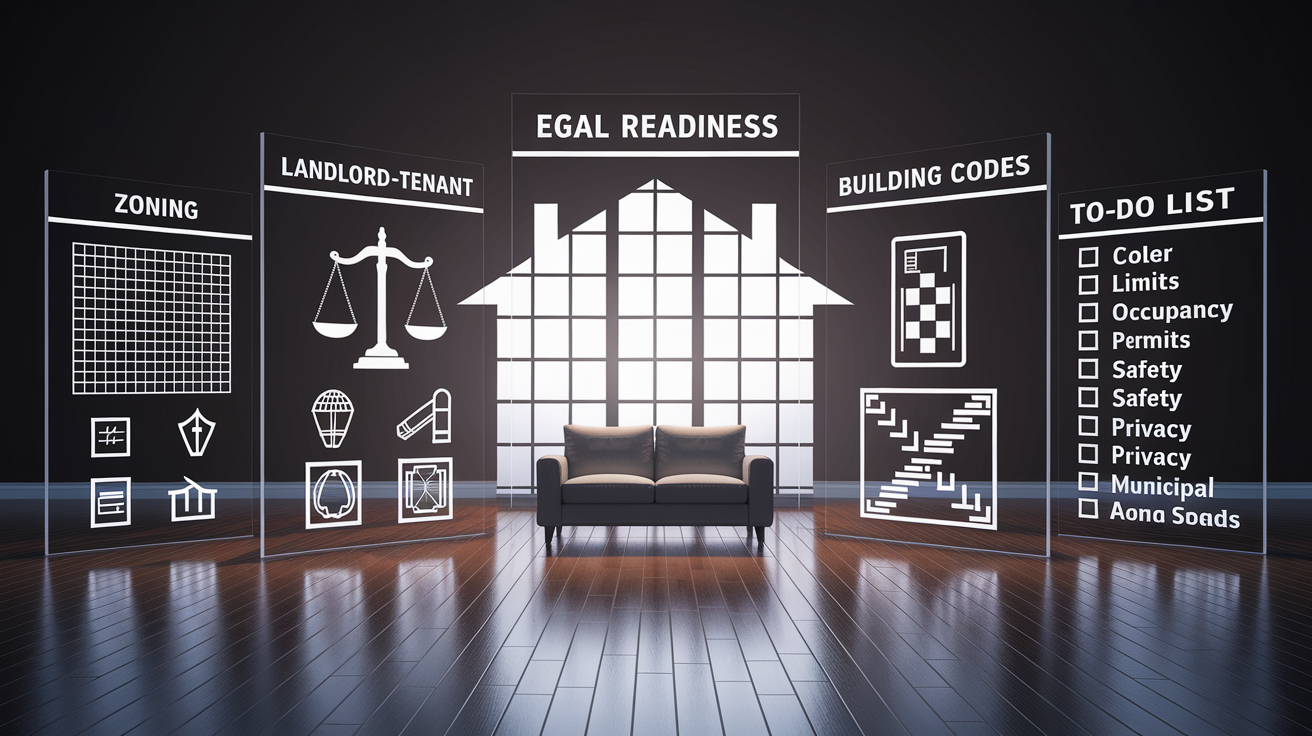
House hacking sits right at the intersection of personal living and property rental, which triggers three different sets of legal rules that all apply at once. Zoning laws decide whether you can even have tenants. Landlord-tenant laws govern rent collection, deposit returns, and evictions. Local building codes set minimum safety standards for any rented space. Living in the building doesn’t make any of these disappear, and missing just one can shut down your house hacking plan before the first tenant unpacks.
Each legal category covers different ground and comes from different sources. Zoning gets controlled by your city or county planning department. It regulates how many unrelated people can live in a home, whether ADUs are allowed, and how land can be used. Landlord-tenant statutes are state or local laws that spell out your duties as a landlord and your tenant’s rights, no matter how close you live to each other. Building codes and safety ordinances mandate things like smoke detectors, egress windows, and electrical standards. Lease agreements turn these legal requirements into enforceable contracts. All of these systems run in parallel. Compliance means checking every box.
Later sections walk through zoning restrictions, explore municipal codes that limit occupancy or require permits, break down safety inspections and licensing, and explain how to structure legally sound lease agreements. For now, run a quick legal readiness screen before you list a room or start renovating a basement:
- Occupancy limits: Does your city cap the number of unrelated adults who can share a dwelling?
- Rental permits: Do you need a business license, rental license, or certificate of occupancy to rent space in your home?
- Safety codes: Are smoke detectors, carbon monoxide alarms, egress windows, and electrical circuits up to code in the rented area?
- Privacy laws: What notice period is required before you can enter a tenant’s private space?
- Municipal codes: Does your jurisdiction treat room rentals as boarding houses or regulate ADUs separately from the main home?
Lease Agreement Structures for House Hacking Arrangements

Every house hacking arrangement needs a written lease. Even when you’re renting a spare bedroom to someone you know. A written agreement defines the financial terms, clarifies which spaces are shared and which are private, outlines maintenance responsibilities, and establishes ground rules for guests, noise, and house access. Without a signed document, you don’t have an enforceable way to collect late rent, prevent unauthorized occupants, or remove a problem tenant without slogging through a much longer eviction process. Verbal agreements sound friendly until the first dispute. Then they get expensive.
Shared-space clauses matter in house hacking leases because tenants and owners occupy the same property. The lease should spell out which areas belong exclusively to the tenant, which are shared common areas, how utilities get split or included in rent, and what quiet enjoyment actually means when the landlord lives ten feet away. A room rental lease might state “Tenant has exclusive use of the second-floor bedroom and bathroom. Kitchen, living room, laundry, and driveway are shared common areas. Utilities are included in rent. Landlord will provide 24-hour notice before entering tenant’s bedroom except in emergencies.” That clarity prevents the slow erosion of boundaries that kills house hacking arrangements.
Renewal and termination terms work a little differently when the landlord lives on-site. Lots of house hackers prefer month-to-month leases or short initial terms with automatic renewal, giving both parties flexibility if the living situation doesn’t work. Termination notice requirements still apply. You can’t just ask someone to leave next week. But shorter notice periods are sometimes allowed under local law for owner-occupied properties. California requires 30 days’ notice to terminate a month-to-month tenancy, but some jurisdictions drop that to 15 days when the landlord shares living space. Check your state’s rules, then write the notice period into the lease.
Don’t fall into verbal agreement traps. Put everything in writing, even informal arrangements with friends or family. If you agree to reduce rent in exchange for yard work, write it into the lease as a rent credit. If the tenant can use your garage, specify which bay and whether overnight guest parking is allowed. If utilities spike during winter, explain whether the tenant pays overage or you absorb it. When disputes show up, judges and mediators rely on written documents, not memories of hallway conversations. A lease protects both parties and keeps the landlord-tenant relationship professional, even when you share a refrigerator.
| Lease Type | Key Clauses | Special Considerations |
|---|---|---|
| Room Rental in Shared Home | Exclusive bedroom and bathroom access; shared kitchen, living room, laundry; utilities included or split; guest policy; quiet hours; landlord entry notice; parking assignment | Define common area etiquette; clarify storage limits; address overnight guests; specify cleaning responsibilities for shared spaces |
| Accessory Dwelling Unit (ADU) | Separate entrance and utilities; maintenance responsibilities for appliances and HVAC; yard use and parking; trash service; landlord access for repairs | ADU may have separate utility meters; clarify snow removal or lawn care duties; ensure ADU complies with local zoning before signing lease |
| Duplex or Triplex Unit | Exclusive unit with private entrance; tenant responsible for unit interior; landlord handles exterior, roof, foundation; security deposit; rent escalation clause; renewal terms | Specify whether tenant or landlord mows shared lawn; clarify driveway snow removal; define noise rules for shared walls; ensure lease mirrors standard landlord-tenant law since units are fully separate |
Local Ordinances and Municipal Codes that Impact House Hacking

Cities and counties enforce a patchwork of rules that directly control whether house hacking is legal in your neighborhood, how many tenants you can host, and what physical changes you can make to accommodate them. Zoning ordinances are the first stop. A lot of residential zones limit occupancy to family members or cap the number of unrelated adults who can share a dwelling, often at two or three people. If you’re planning to rent three bedrooms to three unrelated tenants while you occupy the fourth, that arrangement might violate the “unrelated occupants limit” in single-family zones. Even though the property is owner-occupied. Some jurisdictions carve out exceptions for owner-occupied houses. Others don’t.
Parking regulations, noise ordinances, and rental property standards all apply to house hacking. Municipal codes often require one off-street parking space per bedroom or per occupant. If you rent out two rooms and only have a two-car driveway, street parking for tenants might trigger complaints or fines. Noise rules typically set quiet hours, usually 10 p.m. to 7 a.m., and violations can result in citations whether the noise comes from you or your tenant. Some cities also classify room rentals as boarding houses if more than a certain number of unrelated people share cooking facilities, which can trigger additional licensing and inspection requirements that don’t apply to standard single-family homes.
ADU and basement apartment regulations vary wildly by location. A city may allow detached ADUs but prohibit basement conversions, or vice versa. Zoning codes specify minimum square footage, ceiling height, egress window size, and whether the ADU must share utilities with the main house or have separate meters. Short-term rental bans are also common. Plenty of municipalities restrict stays under 30 days to prevent Airbnb-style operations, and those bans apply to house hackers just as strictly as absentee landlords.
Typical local code restrictions that shape or block house hacking plans:
- Occupancy maximums based on unrelated adults per dwelling, often two to four depending on the zone.
- Off-street parking requirements that mandate one space per bedroom or per occupant, limiting the number of tenants you can legally host.
- Short-term rental bans prohibiting leases shorter than 30 consecutive days in residential zones.
- ADU zoning limits that specify size, setback, height, and whether detached or attached ADUs are permitted.
- Noise ordinances establishing quiet hours and sound limits that apply to tenant activity.
- Property condition standards requiring exterior maintenance, trash enclosures, and lawn care regardless of whether you live on-site.
Rental Permits, Licensing, and Safety Code Compliance for House Hackers

Lots of cities require a rental license or certificate of occupancy before you can legally rent any portion of your home. Even a single bedroom. The licensing process usually involves submitting an application, paying a fee, and passing an inspection that checks electrical systems, plumbing, smoke detectors, carbon monoxide alarms, and egress routes. Some jurisdictions exempt owner-occupied properties from rental licensing. Others apply the same rules to all landlords. Minneapolis, for example, requires a rental license for every dwelling unit offered for rent, including rooms in owner-occupied homes, and mandates inspections every three years. Renting without a license can result in fines, forced lease termination, and an order to cease renting until you come into compliance.
Safety devices and egress requirements aren’t negotiable. Every bedroom used by a tenant must have a working smoke detector, either hardwired or battery-powered depending on local code. Carbon monoxide detectors are required on every floor where fossil fuel appliances or attached garages are present. Basement bedrooms and any sleeping room must have an egress window or door that opens directly to the outside, with minimum dimensions typically 24 inches tall, 20 inches wide, and a sill height no more than 44 inches above the floor. If your basement bedroom has a small casement window that doesn’t meet egress size, you can’t legally rent that room as sleeping space until you install a code-compliant window.
Electrical and plumbing standards also apply. Rental units need adequate outlets, GFCI protection in bathrooms and kitchens, grounded circuits, and no exposed wiring. Plumbing must provide hot and cold running water, functional drainage, and a working toilet and sink. Heating systems must maintain a minimum temperature, often 68 degrees, during cold months. Some codes specify ventilation requirements for bathrooms and kitchens. If you’re converting a garage or attic into a rental unit, those spaces must meet the same habitability standards as any other dwelling. Which often means adding insulation, climate control, and proper ventilation before a tenant moves in.
Consequences for renting without proper authorization vary but tend to get serious quickly. An unlicensed rental discovered during a code complaint or neighbor report can trigger a stop-work order, fines starting at a few hundred dollars and increasing daily, and a mandate to remove the tenant. In some cities, tenants in unlicensed units can withhold rent or sue for rent abatement. Even if you’re living on-site and following most landlord-tenant laws, operating without required permits or passing safety inspections undermines your legal standing and turns a small compliance gap into a real problem.
HOA Rules, CC&Rs, and Private Community Restrictions Affecting House Hacking

Homeowners associations and recorded covenants, conditions, and restrictions can flat-out prohibit house hacking, even when local zoning and landlord-tenant laws allow it. HOA rules are private contracts that bind property owners, and they often include rental caps, guest restrictions, or outright bans on leasing individual rooms or ADUs. Some HOAs limit the percentage of units in the community that can be rented at any given time. A rule designed to maintain owner-occupancy rates for FHA or conventional financing eligibility. If the rental cap is already met, you can’t rent your spare bedroom or ADU until another owner stops renting and opens a slot.
CC&Rs may also restrict the type of rental arrangements you can create. A common rule forbids subletting or prohibits leasing portions of a home while the owner remains in residence, which effectively bans room rentals and shared-living arrangements. Other associations ban short-term rentals entirely, defining any lease under six months or a year as prohibited. Even when long-term room rentals are technically allowed, CC&Rs might impose guest limits, parking restrictions, or quiet hours that make house hacking impractical. Violating HOA rules can result in fines, liens on your property, or legal action to force compliance and cover the association’s attorney fees.
Before purchasing a property in an HOA community with house hacking plans, read the governing documents carefully and ask the HOA board directly whether your intended use is permitted. Some associations are flexible and grant variances for owner-occupied rentals, especially if you’re renting to a family member or long-term tenant. Others enforce rules strictly and won’t make exceptions. If the HOA prohibits your plan, you have three choices: buy a different property, comply with the restriction and abandon house hacking, or request a rule change, which requires convincing the board and sometimes a majority of homeowners.
Typical HOA restrictions that limit house hacking:
- Rental caps that limit the percentage of units in the community available for lease, blocking new rentals once the cap is reached.
- Guest limits that restrict overnight visitors or prohibit non-family members from staying more than a certain number of days per month.
- Short-term rental prohibitions banning leases under 30, 90, or 180 days, eliminating Airbnb-style use and sometimes preventing flexible month-to-month arrangements.
Tenant Screening, Fair Housing Obligations, and Legal Application Requirements

Tenant screening must follow the federal Fair Housing Act and state fair housing laws, even when the landlord lives in the same building. The Fair Housing Act prohibits discrimination based on race, color, national origin, religion, sex, familial status, and disability. That means you can’t reject an applicant because of their ethnicity, refuse to rent to someone with children, or decline a tenant because they need a service animal. A lot of states add protected classes like sexual orientation, gender identity, source of income, or veteran status. House hacking doesn’t create an exemption from these rules, and violations can result in complaints to HUD, state civil rights agencies, or private lawsuits with damages and attorney fees.
A legally compliant rental application gathers the information you need to evaluate financial stability and rental history without asking prohibited questions. Standard applications request full name, current address, employment details, gross monthly income, prior landlord contact information, and references. You can ask for Social Security numbers to run credit and background checks, but you must get written consent first. Questions about marital status, religion, national origin, or whether an applicant plans to have children are illegal. Questions about criminal history are allowed under federal law but restricted in some states and cities. California and Seattle, for example, limit when and how landlords can consider arrest or conviction records.
Background and credit checks should cover eviction history, credit score, criminal records, and prior landlord references. Eviction records show whether the applicant has been legally removed from a rental for non-payment or lease violations. Credit reports reveal payment history, outstanding debts, and overall financial responsibility. Criminal background checks are legal in most places but must be applied consistently and can’t be used to discriminate against protected classes. Prior landlord references confirm rent payment history, lease compliance, property care, and whether the landlord would rent to the applicant again. Document your screening criteria in writing and apply them uniformly to every applicant to avoid claims of selective enforcement.
Fair housing compliance checklist for tenant screening:
- Use the same application and criteria for all applicants regardless of protected class status.
- Avoid questions about race, religion, familial status, disability, or national origin on applications or during showings.
- Obtain written consent before running credit or background checks and provide adverse action notices if you deny based on report findings.
- Apply criminal history, income, and credit score standards consistently and document your decision-making process.
- Provide reasonable accommodations for applicants with disabilities, such as allowing service animals even if your lease prohibits pets or modifying application procedures for those who need assistance.
Fair Housing Nuances for Owner-Occupied Rentals
Federal fair housing law includes a limited exemption for owner-occupied buildings with four or fewer units, often called the “Mrs. Murphy exemption.” If you live in the property and rent out three or fewer additional units, you’re technically exempt from some Fair Housing Act provisions when selecting tenants. But this exemption is narrow and doesn’t apply to advertising. You still can’t publish ads that express illegal preferences, like “no children” or “Christian roommate preferred,” and plenty of states don’t recognize the exemption at all. State and local fair housing laws often apply regardless of owner occupancy, and even where the exemption exists, it’s safer to follow fair housing rules fully to avoid lawsuits, reputational damage, and the risk of misapplying a complex legal carve-out.
Security Deposit Rules, Rent Terms, and Legal Payment Standards in House Hacking

Security deposit limits, return timelines, and allowable deductions are controlled by state and sometimes local law. Most states cap deposits at one or two months’ rent, though some allow more. California limits deposits to two months’ rent for unfurnished units, one month for furnished. New York requires landlords to hold deposits in interest-bearing accounts and pay accrued interest to tenants. Return timelines range from 14 to 60 days after move-out, depending on the state, and landlords must provide an itemized statement of deductions for damages beyond normal wear and tear. If you miss the deadline or fail to provide documentation, you may forfeit the right to withhold any of the deposit and face penalties.
Rent payment terms must be clearly stated in the lease. Specify the amount, due date, acceptable payment methods, where to send payment, and grace periods if any. Late fees are allowed in most states but often capped at a percentage of monthly rent or a flat dollar amount, and they can’t be charged until after the grace period expires. Washington state limits late fees to the greater of 20 dollars or 20 percent of rent, and fees can’t be assessed until rent is at least five days late. Charging excessive late fees or imposing them immediately on the due date can violate state law and make the fee unenforceable.
Rent increases must follow state notice requirements, which typically range from 30 to 90 days depending on the size of the increase and the length of tenancy. Some cities with rent control or tenant protection ordinances limit how much and how often you can raise rent. Even in house hacking arrangements, you can’t simply tell a tenant next week’s rent is higher. Give proper written notice, document the increase, and make sure it complies with any local caps or procedural rules.
| Payment Term | Legal Requirement | Common Mistake |
|---|---|---|
| Security Deposit | Capped at one to two months’ rent in most states; must be returned within 14 to 60 days with itemized deductions; interest may be required | Withholding deposit for normal wear and tear like faded paint or carpet wear; missing the return deadline; failing to provide a deduction statement |
| Late Fees | Allowed only after grace period; often capped at 5 to 10 percent of rent or a flat dollar limit; must be stated in lease | Charging late fees immediately on the due date; imposing fees higher than state caps; adding fees not disclosed in the lease |
| Rent Increases | Require 30 to 90 days’ written notice depending on state and increase size; some cities cap annual increases; month-to-month tenancies easier to raise than fixed-term leases | Announcing increase verbally or with insufficient notice; raising rent mid-lease without a clause allowing it; exceeding local rent control limits |
| Accepted Payment Methods | Must be specified in lease; landlords can require specific methods like check, electronic transfer, or money order; some states restrict cash-only policies | Changing accepted methods mid-lease without tenant consent; refusing reasonable electronic payment options; not documenting cash payments with receipts |
Eviction Procedures, Dispute Resolution, and Tenant Rights in Shared Housing

Evicting a tenant from a house hacking property follows the same legal process as evicting from any other rental, regardless of whether you live in the next room or the next unit. You can’t simply change the locks, remove belongings, or threaten a tenant into leaving. Self-help evictions are illegal in every state and can result in lawsuits for wrongful eviction, damages, and attorney fees. The formal process starts with written notice, usually a pay-or-quit notice for non-payment of rent or a cure-or-quit notice for lease violations, giving the tenant a short window to fix the problem or vacate. If the tenant doesn’t comply, you file an unlawful detainer lawsuit in court, attend a hearing, and obtain a judgment before a sheriff or marshal can physically remove the tenant.
Timelines for eviction vary wildly. In some states, the process can be done in three to four weeks if the tenant doesn’t contest. In others, especially jurisdictions with strong tenant protections, evictions can take two to six months. Rent control cities and states with just-cause eviction laws add procedural requirements and valid reasons you must prove in court. During the eviction, the tenant retains the right to quiet enjoyment of the property and privacy protections. You can’t shut off utilities, enter the tenant’s space without notice, or harass them into leaving. Doing so gives the tenant grounds to countersue and delays or derails your eviction case.
Disputes that don’t rise to eviction level can often be resolved through informal negotiation, mediation, or small claims court. Mediation is a low-cost process where a neutral third party helps you and the tenant reach a compromise, often available through local housing agencies or community dispute resolution centers. Small claims court handles damage disputes, unpaid rent, and security deposit conflicts up to a dollar limit, usually 5,000 to 10,000 dollars depending on the state. Lots of landlord-tenant disagreements in house hacking arrangements stem from boundary issues, like noise, guests, or shared space conflicts, and can be settled with clear communication and a lease amendment before they blow up.
The legal risk of trying to remove a tenant informally is serious. If you change locks, shut off heat or water, or move a tenant’s belongings to the curb, the tenant can file for wrongful eviction and recover damages that often exceed the rent owed. Courts award actual damages for costs like hotel stays and moving expenses, and in plenty of states, they add statutory penalties and attorney fees. Even if the tenant genuinely violated the lease, skipping the legal eviction process forfeits your right to remove them and exposes you to liability. House hacking creates emotional pressure to resolve conflicts quickly because you share the same roof, but taking shortcuts around eviction law turns a manageable legal process into an expensive mistake.
Insurance, Liability Protection, and Risk Mitigation for House Hackers

Homeowner’s insurance policies typically don’t cover rental activity, even part-time room rentals. Once you collect rent, insurers classify part of your home as a business operation, and standard policies exclude claims related to tenant injuries, property damage caused by tenants, or loss of rental income. You need to either add a rental endorsement to your existing homeowner’s policy or upgrade to a landlord or dwelling fire policy that covers rental risk. Endorsements usually cost a few hundred dollars per year and extend liability coverage to rented areas. Full landlord policies cost more but provide broader protection, including loss of rent coverage if the property becomes uninhabitable.
Liability coverage protects you when someone gets injured on your property. If a tenant slips on ice, a guest falls down stairs, or a repair error causes harm, liability insurance pays medical bills, legal fees, and settlements up to your policy limit. Minimum recommended coverage is 300,000 to 500,000 dollars per occurrence, but 1,000,000 dollars is safer if you rent multiple rooms or units. Personal umbrella policies add another 1,000,000 to 5,000,000 dollars in coverage above your base policy and cost 200 to 400 dollars per year. For house hackers, umbrella insurance is a low-cost way to cover catastrophic claims that exceed standard policy limits.
Forming an LLC to hold rental property can provide liability protection by separating personal assets from rental activity, but it’s more complex for owner-occupied properties. Most residential mortgages include a due-on-sale clause that allows the lender to demand full repayment if you transfer the property to an LLC. Some lenders grant permission. Others don’t. Even if you form an LLC, you still need proper insurance, because the LLC shield disappears if you personally commit negligence or fail to maintain the property. LLCs make more sense for larger multi-family properties or multiple rental units, not for renting a bedroom in your primary residence.
Common coverage gaps house hackers overlook:
- No rental endorsement on homeowner’s policy, leaving tenant-related claims entirely uncovered and voiding coverage for incidents in shared areas.
- Insufficient liability limits when renting to multiple tenants, risking personal asset exposure in serious injury cases.
- No loss of rent coverage, meaning if fire or water damage makes the rental uninhabitable, the landlord loses income for months without insurance reimbursement.
Tax Reporting, Deductions, and Homestead Considerations for House Hackers

Rental income from house hacking must be reported to the IRS on Schedule E, even if you live in the property. You report gross rent collected, then subtract allowable expenses to calculate net rental income or loss, which flows to your Form 1040. Expenses must be divided between personal use and rental use based on square footage, number of rooms, or another reasonable allocation method. If you rent one bedroom in a four-bedroom house, roughly 25 percent of mortgage interest, property taxes, insurance, utilities, and maintenance can be deducted as rental expenses. The remaining 75 percent is personal and handled through standard homeowner deductions if you itemize.
Common deductible categories include repairs, maintenance, utilities, insurance premiums, property management fees, advertising, and depreciation. Repairs that keep the property in working condition, like fixing a leaky faucet or replacing a broken window, are fully deductible in the year incurred. Capital improvements that add value or extend the property’s life, like a new roof or HVAC system, must be depreciated over 27.5 years. Depreciation allows you to deduct a portion of the property’s value each year, but only the rental portion. If 25 percent of your home is rented, you depreciate 25 percent of the building’s cost basis, not the land.
Homestead exemptions can be affected by rental use. A lot of states offer property tax reductions for primary residences, but those exemptions sometimes require the owner to occupy the entire home or limit the percentage that can be rented. Texas, for example, allows a homestead exemption but may reduce or eliminate it if more than a certain portion of the home is used for business or rental purposes. Check your county assessor’s rules before assuming you can house hack and keep the full exemption. Losing the homestead exemption increases property taxes and eats into the financial benefit of rental income.
Business use of home rules apply if you rent out space and also use part of your home for rental-related administrative work, like a home office where you manage leases, screen tenants, and handle maintenance scheduling. The home office deduction is separate from rental expense allocation and has its own requirements. You must use the space regularly and exclusively for business. Most house hackers don’t qualify because rental management is incidental and doesn’t require a dedicated office. If you do qualify, you can deduct a percentage of mortgage interest, utilities, and depreciation attributable to the office space on Schedule C, in addition to rental deductions on Schedule E.
Common deductible categories for house hackers:
- Repairs and maintenance, proportional to rental space, for items like plumbing fixes, appliance repairs, painting, and pest control.
- Utilities including electricity, gas, water, trash, and internet if provided to tenants or used in common areas, allocated by rental percentage.
- Insurance premiums for landlord or rental endorsements, property insurance, and liability coverage related to rental activity.
- Depreciation of the building’s cost basis over 27.5 years, calculated only for the portion of the home used as rental space.
Final Words
Start now: confirm zoning, landlord-tenant basics, habitability codes, and whether HOA rules or permits apply. Get a written lease that splits utilities, sets notice rules, and protects privacy. Check fair housing and screening so you avoid costly missteps.
Schedule local inspections, lock in insurance endorsements, and separate personal vs rental expenses for taxes.
Keep a simple checklist for house hacking legal considerations lease agreements and local ordinances. Do the homework now and you’ll run a safer, steadier rental.
FAQ
Q: What legal checkpoints must I confirm before renting space in my home?
A: The essential legal checkpoints are checking zoning, landlord-tenant laws, written lease requirements, and habitability/safety codes. Confirm permits, occupancy limits, and local privacy rules before you advertise or accept rent.
Q: Do zoning laws allow ADUs or room rentals on my property?
A: Whether zoning allows ADUs or room rentals depends on your municipal code; check local zoning maps, ADU rules, and boarding-house definitions because allowances vary block by block and city by city.
Q: What must a written lease for a room or ADU include?
A: A written lease should state rent amount and due date, security deposit terms, maintenance responsibilities, private versus shared spaces, utility splits, guest rules, and termination or renewal notice requirements.
Q: How do renewal and notice rules change when I live on-site?
A: Renewal and notice rules still follow landlord-tenant law even if you live on-site; the main difference is practical communication, but legal notice periods and written renewals remain required in most jurisdictions.
Q: What municipal codes commonly affect house hacking?
A: Municipal codes that matter include occupancy maximums, off-street parking rules, noise ordinances, short-term rental bans, ADU zoning limits, and property condition or safety standards enforced by inspections.
Q: Do I need a rental permit or inspection before renting rooms?
A: You may need a rental license or inspection; many cities require certificates of occupancy, safety checks, and permits before renting any portion of a home—check local department rules early.
Q: Can my HOA stop me from house hacking?
A: Your HOA can restrict or forbid room rentals, ADUs, and short-term stays through CC&Rs; HOA rules override owner preferences and violations can trigger fines or legal action.
Q: What screening rules and fair housing obligations apply when I rent rooms?
A: Fair housing rules apply even in owner-occupied rentals; screen consistently using employment, credit, and rental history checks, and provide reasonable disability accommodations while avoiding discriminatory criteria.
Q: Are there fair housing exemptions for owner-occupied rentals?
A: Limited exemptions exist for shared living situations, but advertising and selection still must not discriminate; always follow federal rules and check state or local nuances before assuming an exemption.
Q: What security deposit and rent payment legal rules must I follow?
A: Security deposit rules set maximums, handling, and return timelines; rent payments need clear due dates, allowed late fees, and proper written notices for increases—local law sets specifics.
Q: How do eviction procedures work for shared housing and what are the risks of informal removal?
A: Eviction procedures follow formal legal timelines regardless of owner occupancy; informal removal risks unlawful eviction claims, fines, and longer legal battles—use proper notice and court processes.
Q: What insurance and business-entity steps should I take to limit liability?
A: Add landlord endorsements and adequate liability insurance, confirm tenant coverage gaps, and consider an LLC only after checking mortgage and insurance impacts to balance protection with lender rules.
Q: How must I report rental income and what tax deductions apply?
A: Report rental income on your tax return; you can deduct repairs, maintenance, insurance, property taxes, and depreciation proportionate to the rental portion—track personal versus rental expenses carefully.