

Think you need an insider or fancy software to find distressed homes? You don’t.
Start today with public records, MLS (multiple listing service) foreclosure filters, bank REO (bank owned) lists, tax delinquent rolls, HUD and agency portals, and auction calendars.
These are the exact channels pros use to find inventory before the crowd.
This post gives seven immediate sources, a quick 10-minute screening routine, and simple steps to check them weekly so you see deals first and decide fast.
Immediate Ways to Locate Distressed Property Opportunities Fast

If you need to start finding distressed properties today, skip the theory and go straight to the sources. MLS foreclosure filters, county legal notices, and bank REO lists will get you into real inventory within an hour. These are the same tools professional investors use to build pipelines before properties hit the broader market.
Most distressed homes move through predictable channels. You can access most of them for free or under a hundred bucks a month. You don’t need special software or insider connections to start. County records, online auction platforms, and government property portals are all public. The only barrier is knowing where to look and checking those sources consistently.
Your immediate action list should cover every major distressed property category. Start with these seven channels and check at least three of them this week:
• MLS foreclosure and short sale filters (requires agent access or IDX subscription)
• County legal notices and pre foreclosure public filings (free at county recorder or online)
• Tax delinquent property lists published by county tax assessors
• Bank REO departments and asset management pages (direct from major lenders)
• Government owned home portals including HUD, Fannie Mae, and Freddie Mac listings
• Online auction sites like Auction.com, Hubzu, and Xome
• Sheriff sale calendars and courthouse auction schedules
Each channel updates on its own schedule. Auctions post weekly or monthly. Tax lists refresh quarterly. MLS listings appear daily. If you only check once, you’ll miss most of the inventory. Set a rhythm and repeat it.
Core Types of Distressed Properties Buyers Should Understand
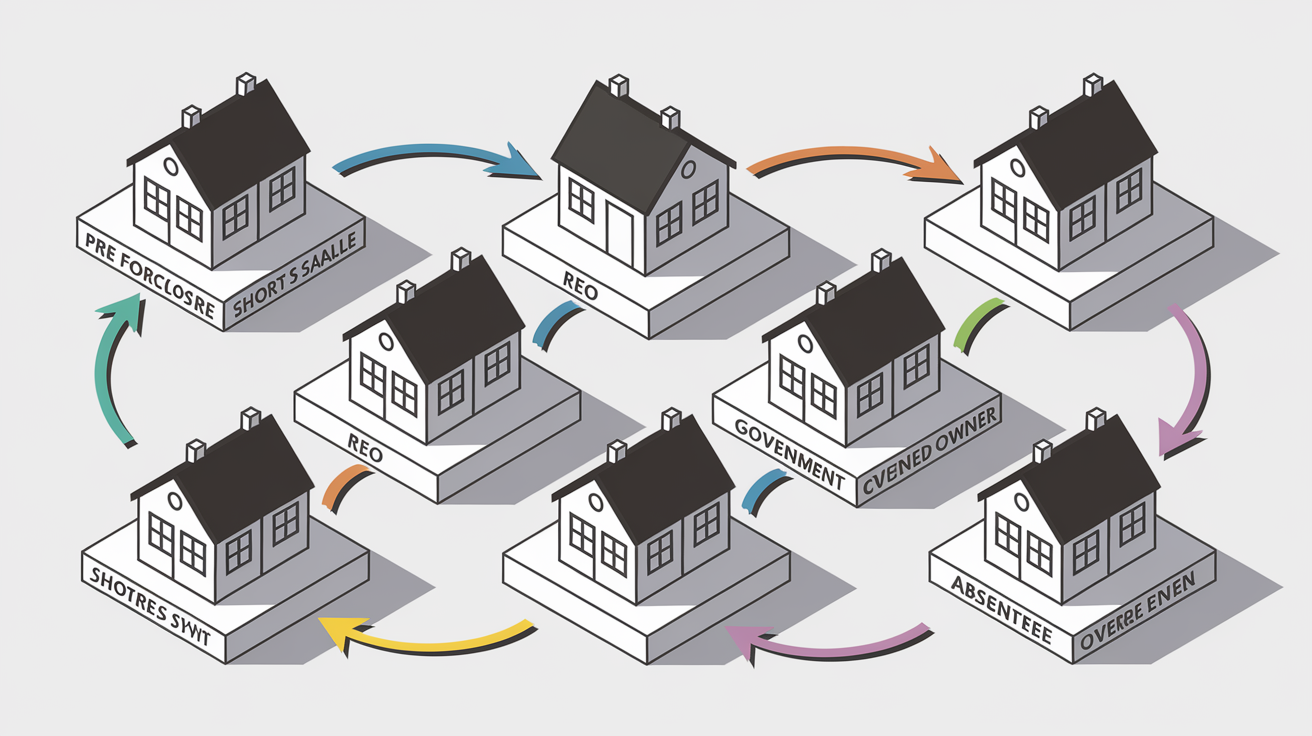
Distressed properties fall into a few main categories, and each one comes with a different seller motivation and timeline. Pre foreclosure homes are owned by people who’ve fallen behind on payments or taxes but haven’t lost the property yet. Short sales require lender approval because the sale price won’t cover the mortgage balance. REO or bank owned properties have already been foreclosed and repossessed. Probate estates belong to someone who’s passed away, and the executor is selling through the court. HUD and government owned homes come from FHA insured loans that defaulted. Absentee owner properties are held by out of state landlords who may be tired of the carrying costs.
Understanding the category tells you how motivated the seller is and where to find the listing. A homeowner facing foreclosure next month is far more motivated than a bank holding an REO for six months. A probate heir living across the country may take a lower offer to close fast. Government agencies price to move inventory, not to maximize profit.
Here’s where each type shows up and what drives the sale:
• Pre foreclosure: lis pendens filings, Notice of Default, county legal publications. Seller wants to preserve credit or avoid eviction.
• Short sale: MLS listings marked “short sale” or “lender approval required”. Seller is underwater and can’t cover the payoff.
• REO / bank owned: MLS bank owned filters, lender asset lists. Bank wants to recover loan balance and stop paying maintenance.
• Probate: probate court dockets, county registrar. Executor must liquidate estate, often for multiple heirs.
• Government owned: HUD Home Store, Fannie Mae HomePath, Freddie Mac HomeSteps. Agency recovered collateral and reprices monthly.
• Absentee owner: county tax records showing different mailing address. Owner may be paying double mortgages or neglecting repairs from a distance.
Using MLS and Agent Strategies to Spot Distressed Homes Early

The MLS is the fastest way to see distressed homes the moment they’re listed. Most listing services let agents filter by foreclosure status, bank ownership, short sale flags, and “as is” condition. Zillow and other consumer portals also offer a foreclosure filter, but those listings usually appear after they’ve already been on the MLS for days or weeks. If you’re working with an agent, ask them to set up an auto alert for new foreclosure, REO, and short sale listings in your target neighborhoods.
REO properties show up in the MLS after the bank has repossessed the home and assigned it to a listing agent. Short sales appear while the homeowner still holds title, but the listing will note “lender approval required” or “subject to third party approval.” Pre foreclosure homes sometimes get listed as standard sales by owners trying to sell before the auction date. Look for phrases like “motivated seller,” “needs TLC,” or “cash only” in the remarks. They’re often code for distress.
Agents with foreclosure experience know which banks move fast and which ones sit on counteroffers for weeks. They also know how to read days on market and price drop history to spot inventory that’s about to get more flexible. If a bank owned listing has been active for 60 days and just took a second price cut, that’s a signal.
| Filter Type | What It Identifies | Typical Discount Range |
|---|---|---|
| Foreclosure / REO | Bank owned homes already repossessed | 10 to 25% below comparable sales |
| Short Sale | Owner occupied, lender must approve sale | 5 to 15% below market, subject to bank approval timeline |
| As Is / Cash Only | Properties needing repairs, often distressed condition | 15 to 40% below ARV, depending on repair scope |
| Pre Foreclosure | Owners in default but still holding title | Varies widely. Some list at market, others discount to close fast |
How to Find Distressed Properties Through Public Records and Legal Notices

County courthouses and recorder offices publish every foreclosure filing, tax lien, probate case, and legal notice required by state law. These documents are public, and most counties now post them online for free or a small search fee. A lis pendens filing tells you a lender has started foreclosure. A Notice of Default is the formal trigger in many nonjudicial states. Tax delinquent lists show owners who haven’t paid property taxes and may face auction. Probate filings name executors and heirs who will soon sell an inherited home.
Foreclosure timelines vary by state. Judicial foreclosures can take 12 months or more in places like New York or Florida. Nonjudicial states like Texas or California can complete the process in 60 to 120 days. That means a lis pendens filed today might represent a six month window to contact the owner. Or it might mean the auction is already scheduled. Check your county’s process and track filings weekly.
Legal notices also appear in local newspapers or dedicated legal publications. Some counties require foreclosure notices to run for three consecutive weeks. If you subscribe to those publications or monitor the county’s online legal notice board, you’ll see upcoming auctions, sheriff sales, and court ordered liquidations before they reach the general public.
Here are the six most valuable public record documents for finding pre market distressed properties:
• Lis pendens: official notice that foreclosure litigation has begun. Indicates owner is in default and property may go to auction.
• Notice of Default (NOD): nonjudicial equivalent signaling the start of foreclosure. Deadline for owner to cure debt is typically 90 to 120 days.
• Tax delinquency lists: published by county tax collectors. Properties may be auctioned if taxes remain unpaid.
• Probate filings: court documents naming executor and heirs. Property must be sold to settle the estate.
• Divorce and bankruptcy dockets: court cases requiring asset liquidation. Properties often sold quickly to divide proceeds or satisfy creditors.
• Sheriff sale postings: final auction schedule with date, time, opening bid, and property address. Last chance to contact owner before sale.
Auctions, Sheriff Sales, and Government Foreclosure Platforms

Courthouse auctions and online foreclosure platforms sell properties directly to the highest bidder, often at steep discounts. Sheriff sales happen on courthouse steps or in designated county offices, usually on a fixed day each week or month. You’ll need to bring a cashier’s check or verified funds for the deposit, typically 5 to 20 percent of your bid, and you’ll have 24 to 72 hours to deliver the full purchase price. Some states allow the original owner a redemption period of 30 to 180 days, during which they can reclaim the property by paying off the debt. If that happens, you get your money back, but you’ve lost time and opportunity cost.
HUD homes come from FHA insured loans that defaulted. The Department of Housing and Urban Development repossesses the property and lists it on HUD Home Store. Fannie Mae and Freddie Mac operate similar portals for their foreclosed inventory. These platforms update daily, and properties are sold through standard real estate contracts with licensed agents. Online auction sites like Auction.com, Hubzu, and Xome require registration and often charge a buyer’s premium on top of your winning bid. Read the terms before you bid. Some auctions are absolute with no reserve. Others have minimum bids set by the lender.
Here’s the basic auction process:
- Research the property using the legal description and address. Many auctions prohibit interior inspections.
- Check title records for liens, judgments, or secondary mortgages that may survive the foreclosure.
- Register with the auctioneer or platform and confirm deposit and payment requirements.
- Attend the auction (in person or online) and bid within your maximum price. Factor in buyer premiums and closing costs.
- If you win, deliver the deposit immediately and arrange full payment within the deadline, often 24 to 72 hours.
| Channel | Typical Requirements | Key Risks |
|---|---|---|
| Sheriff / Courthouse Sale | 5 to 20% deposit, full payment in 24 to 72 hours, cashier’s check or wire | No inspection, title may have liens, redemption period in some states |
| Online Auction (Auction.com, Hubzu) | Platform registration, buyer’s premium 5 to 10%, earnest deposit, approved financing or cash | Buyer premium adds cost, strict timelines, as is sale with limited recourse |
| HUD Home Store | Licensed agent to submit offer, FHA financing allowed, standard purchase contract | Properties sold as is, competitive bidding, may require repair escrow |
| Fannie Mae / Freddie Mac Portals | Agent submitted offer, HomePath or HomeSteps financing options, standard contract | As is condition, competition from investors, first look periods for owner occupants |
Driving for Dollars and Field Scouting for Vacant or Abandoned Homes

Driving through neighborhoods and noting distressed properties is one of the oldest lead generation methods in real estate investing. You’re looking for visible signs that a house is vacant, neglected, or heading toward foreclosure. This approach averages about one solid lead per 100 to 500 homes depending on the market and neighborhood condition. It’s slow, but it’s free. And you’ll find properties that aren’t listed anywhere yet.
Focus on zip codes or census tracts with higher foreclosure rates or older housing stock. Drive the same routes every few weeks and watch for changes. A lawn that was mowed last month but is waist high today signals a recent vacancy. Boarded windows, piles of mail, and code violation stickers are all green lights. Take photos from the street and note the address. Then cross reference the address in county records to find the owner’s name and mailing address.
If the owner’s mailing address is different from the property address, they’re absentee and may be more motivated. Look up their phone number using skip tracing tools or public directories, then send a letter or make a call. Always stay on public property when taking photos. Don’t trespass, knock on doors of occupied homes without permission, or remove mail from mailboxes.
Watch for these six visual indicators of distress:
• Overgrown yard, dead landscaping, or lawn more than six inches high
• Mail piled up in the mailbox or scattered on the porch
• Boarded or broken windows, missing screens, or damaged doors
• Municipal code violation notices taped to the door or posted in the yard
• Utilities disconnected (no exterior lighting at night, no HVAC condenser running in summer)
• For sale or auction signs that have been up for months, faded or damaged
Direct Mail, Cold Calling, and Skip Tracing Distressed Owners

Direct mail campaigns target property owners who fit a distressed profile but haven’t listed their homes yet. You buy or build a list of owners who are behind on taxes, facing foreclosure, living out of state, or inheriting property through probate. Then you send a series of postcards or letters offering to buy. Printing and postage typically run 50 cents to two dollars per piece. Response rates hover around 0.5 to 2 percent, which means you’ll usually get one lead for every 100 to 200 mailers. Most investors plan three to six touches because people don’t respond to the first letter.
Skip tracing is the process of finding current phone numbers and addresses for owners who’ve moved or are hard to contact. You start with public records that show the owner’s name, then use paid databases or skip tracing services to pull phone numbers, email addresses, and alternate mailing addresses. Once you have contact information, you can cold call or send targeted mail. Cold calling works faster than mail, but it requires more skill and thicker skin. Expect a lot of hang ups and a few serious conversations.
Make sure your outreach complies with federal and state telemarketing and solicitation laws. The Telephone Consumer Protection Act and state do not call lists regulate cold calling. Direct mail is less restricted, but your message should be respectful and not misleading. Lead with value and a fair offer, not high pressure tactics.
Here are the core elements of an effective distressed owner outreach strategy:
• Buy or build a targeted list. Tax delinquent owners, absentee landlords, pre foreclosure filings, probate estates, or divorce cases.
• Design a simple postcard or letter. One clear message, “I buy houses, cash, as is,” plus your name and phone number.
• Plan a multi touch sequence. Send the first mailer, wait two weeks, send a second, wait two weeks, send a third. Response rates climb with repetition.
• Use skip tracing to locate phone numbers for high priority leads (recent foreclosure filings, properties with equity).
• Script your cold calls. Introduce yourself, state your purpose, ask if they’d consider selling, listen more than you talk.
• Track your numbers. Leads per 100 mailers, cost per lead, conversion rate from lead to signed contract.
• Follow up fast. If someone responds, call or visit within 24 hours while they’re still thinking about it.
Finding Distressed Deals Through Wholesalers and Local Investor Networks

Wholesalers are investors who find off market distressed properties, get them under contract, and then assign that contract to another buyer for a fee. The assignment fee typically ranges from five thousand to twenty thousand dollars depending on the deal size and equity spread. Wholesalers do the marketing, negotiation, and initial due diligence, which saves you time. But you still need to verify the numbers, check title, and estimate repairs yourself because the wholesaler’s profit depends on the gap between their contract price and what you’re willing to pay.
Local investor networks, real estate investment associations (REIAs), and meetups are good places to meet active wholesalers and other investors who share deals. Attend regularly, exchange contact information, and make it clear what kind of property you’re looking for. Some wholesalers send weekly email blasts with new deals. Others post inventory in private Facebook groups or text chains.
Vetting Wholesaler Deals
Before you commit to a wholesaler’s deal, pull your own comparable sales to confirm the after repair value. Ask for photos, repair estimates, and any inspection reports they’ve done. Review the purchase contract to understand the assignment terms and timeline. Check the title yourself or hire a title company to run a preliminary report. If the property has liens, judgments, or clouded title, the wholesaler may not have disclosed them. Also confirm that the seller has actually agreed to the contract and knows it’s being assigned. A few wholesalers market properties they don’t have under contract, which wastes your time and theirs.
How to Evaluate Condition, Repairs, and ARV on Distressed Homes

Before you make an offer on any distressed property, you need three numbers. After repair value, total repair cost, and maximum purchase price. The 70 percent rule is the quick formula most investors start with. Take the ARV, multiply by 0.70, then subtract estimated repairs. That’s your max price. For example, if the ARV is three hundred thousand dollars, 70 percent is two hundred ten thousand. Subtract forty thousand in repairs, and your max offer is one hundred seventy thousand. That leaves room for profit, holding costs, closing costs, and surprises.
ARV comes from comparable sales. Pull three to five sold properties within half a mile to one mile, closed in the last 90 to 180 days, similar square footage, bed and bath count, and condition. Adjust for differences in lot size, upgrades, and location. If comps are selling for 280 to 320 thousand and your subject property will match them after rehab, use the midpoint or conservative end of that range as your ARV.
Repair costs vary by scope and market. A light cosmetic rehab (paint, carpet, fixtures, landscaping) typically runs fifteen to forty dollars per square foot. A full rehab with new systems, kitchen, baths, and structural work can run forty to one hundred dollars or more per square foot. Always get contractor bids if you can access the property. If you can’t inspect the interior, add a 10 to 30 percent contingency to your repair estimate and assume the worst for big ticket items like HVAC, roof, and foundation.
| Rehab Level | Cost per Sq Ft | Typical Scope |
|---|---|---|
| Light Cosmetic | $15 to $40 | Paint, flooring, fixtures, landscaping, minor repairs. Systems functional |
| Moderate Rehab | $40 to $70 | Updated kitchen and bath, new flooring throughout, some mechanical work, exterior refresh |
| Full Gut Rehab | $70 to $100+ | New electrical, plumbing, HVAC, roof, windows, complete interior finishes, possible structural repair |
Title, Legal, and Risk Considerations in Distressed Property Purchases

Distressed properties come with more title and legal risk than standard sales. Tax liens, mechanic’s liens, and judgment liens can all survive a foreclosure or attach to the property after the sale. If you buy at auction and discover a senior lien that wasn’t disclosed, you may have to pay it or lose the property. Some states give the original owner a redemption period, during which they can reclaim the home by paying off the debt. Redemption windows typically range from 30 to 180 days. If the owner redeems, you get your purchase price back, but you’ve tied up capital and lost time.
Most distressed sales are “as is,” which means the seller won’t make repairs or offer credits. You accept the property in its current condition and assume responsibility for code violations, environmental hazards, and undisclosed defects. Homes built before 1978 may contain lead paint. Properties with old oil tanks, asbestos siding, or mold need specialist inspections and remediation budgets.
Always order a title search and, if possible, title insurance before closing. If the property has unknown occupants (squatters or holdover tenants) you may face an eviction process that adds weeks or months to your timeline. Check local eviction timelines and factor them into your holding cost budget.
Five common title and legal issues to investigate before buying a distressed property:
• Outstanding tax liens: check county tax records. Unpaid property taxes create a senior lien that survives most foreclosures.
• Mechanic’s liens: contractors or suppliers who weren’t paid may have filed liens. Search county recorder filings.
• Judgment liens: creditors with court judgments can attach liens to real estate. Show up in title searches.
• HOA or condo dues: unpaid assessments may create a lien or trigger foreclosure independent of the mortgage.
• Unknown occupants: squatters or tenants without leases require formal eviction. Budget 30 to 120+ days depending on state law.
Final Words
In the action, this post gave a fast checklist of places to look and the main categories of distressed homes.
We covered MLS filters, county records, auctions, driving for dollars, direct outreach, and wholesalers.
You also got a quick rehab math frame (ARV and repair ranges) and a rundown of title and legal risks to check before closing.
If you want a practical start, pick one channel, make a simple list, and test it. You can learn how to find distressed properties for sale without guessing, and that’s a win.
FAQ
Q: How to find distressed real estate deals?
A: To find distressed real estate deals, start with MLS foreclosure filters, county legal notices, bank REO lists, tax‑delinquent records, HUD sites, auctions, and driving-for-dollars; prioritize comps and quick outreach.
Q: What is the 3-3-3 rule in real estate?
A: The 3-3-3 rule in real estate is a quick screening guideline: check three comps, get three repair estimates, and hold three months of reserves to judge a distressed deal’s feasibility.
Q: How to buy a distressed property?
A: To buy a distressed property, identify leads, run a quick screen (ARV, repairs, title), line up cash or financing, negotiate an as‑is price, then inspect and clear title before closing.
Q: How do I find distressed properties on Zillow?
A: To find distressed properties on Zillow, use the foreclosure filter, search terms like “pre‑foreclosure” or “bank‑owned,” save searches, and watch for price drops and as‑is or auction tags.