

Want to close quickly on a distressed house without feeling like you’re exploiting someone?
When owners face foreclosure, liens, probate, or major repairs, they often value speed and certainty more than top dollar.
This intro shows how to lead with empathy, verify real motivation fast, and offer structured options that solve the seller’s problems while protecting your return.
You’ll get clear steps to qualify deals, use simple scripts, and back offers with transparent math so negotiations end fast and fair.
Read on to learn the practical framework for true win-win outcomes.
Core Negotiation Steps for Motivated Distressed Home Sellers

Distressed sellers are homeowners dealing with urgent life situations that compress their timelines and flip their priorities away from top dollar toward speed, certainty, and relief. We’re talking foreclosure notices, tax liens, bankruptcy filings, inherited properties stuck in probate, divorce settlements, job relocations, or just the crushing weight of repairs on a vacant house. For these sellers, a cash buyer who can close in 7 to 14 days and take the property as is often delivers more actual value than waiting months for a conventional buyer who might demand repairs, negotiate concessions, or blow up the deal when financing falls through. Understanding this mindset is where every successful negotiation starts.
Transparency, empathy, and option-based offers consistently beat single-price ultimatums when you’re negotiating with distressed homeowners. Sellers in crisis need to feel heard, not cornered. When you walk a seller through repair estimates, holding costs, and market comps, you’re not just defending your number. You’re showing respect for their intelligence and building trust. Presenting multiple deal structures (cash, seller financing, subject-to existing mortgage, or rent-back arrangements) gives sellers a sense of control and lets them pick the solution that fits their immediate needs. This collaborative approach shortens negotiation cycles and increases acceptance rates.
Here’s the complete framework:
- Initial contact and rapport building – Introduce yourself, confirm ownership, and ask open-ended questions about timeline and motivation.
- Validate distress level – Check foreclosure dates, lien amounts, probate deadlines, bankruptcy chapter, or vacancy status to prioritize urgency.
- Ask discovery questions – Use empathetic probes like “What would make this process easy for you?” and “What happens if this doesn’t sell in the next 30 days?”
- Identify pain points – Uncover non-price needs such as avoiding showings, moving quickly, or staying in the home temporarily.
- Frame your offer with options – Present 2 to 3 deal structures (all-cash, seller finance, leaseback) so the seller feels agency.
- Handle objections with math and empathy – When sellers push back, show transparent breakdowns of repair costs, holding costs, and comps. Never argue, educate.
- Present a written offer and next steps – Formalize the agreement in plain language, set a closing date, and confirm the timeline to maintain momentum.
This workflow balances investor profit with ethical responsibility. It respects the seller’s urgency, acknowledges their stress, and delivers solutions that remove burdens rather than exploit vulnerabilities. When executed correctly, both parties walk away feeling the deal was fair.
Identifying Seller Motivation Before Negotiation Begins

Seller motivation determines everything. The tone of your conversation, the structure of your offer, how quickly the deal closes. A homeowner three days from foreclosure has radically different priorities than someone casually testing the market. Understanding motivation signals before you make an offer lets you tailor your approach, avoid wasting time on low-probability deals, and present solutions that directly address the seller’s specific pain points. The goal is to qualify motivation fast and accurately.
Real motivation shows up in measurable, verifiable indicators:
Foreclosure clock running. A foreclosure sale date within 7 to 30 days creates maximum urgency. Sellers will accept below-market offers to avoid losing equity and credit damage.
Vacant home burning cash. Empty properties drain owners through taxes, insurance, utilities, and HOA fees with zero rental income. Sellers often prioritize speed to stop monthly losses.
Inheritance deadlines and estate settlements. Probate courts, sibling disputes, and tax deadlines push heirs to liquidate quickly, even at discounted prices.
Documented relocation or job transfer letters. A signed job offer in another state or military orders create hard move-by dates that eliminate negotiation power for the seller.
Repair overwhelm with proof. When sellers provide contractor estimates showing $40,000 in foundation work or roof replacement, they’re signaling they lack capital or willingness to fix the property.
Early qualification avoids chasing deals that will never close. If a seller hesitates when you ask “What’s your timeline?” or can’t explain why they need to sell now, you’re likely talking to someone testing the market, not a motivated distressed seller. Focus your energy on homeowners with concrete deadlines, documented financial pressure, or clear evidence they can’t manage the property. Those are the conversations that convert into signed contracts.
Communication Techniques for Negotiating With Distressed Sellers

The best distressed seller negotiations feel like problem-solving conversations, not sales pitches. Your job is to listen more than you talk, uncover what the seller truly needs, and position yourself as the solution to their specific burden. Aim for an 80/20 talk ratio. The seller should be speaking roughly 80 percent of the time while you ask strategic questions and respond with empathy. This approach reveals hidden motivations, builds trust, and lowers resistance to your eventual offer.
Mirroring and labeling are two of the most effective psychological tools in distressed seller negotiations. Mirroring means repeating the last few words the seller said, which encourages them to elaborate and shows you’re paying attention. If a seller says, “I just can’t handle the repairs anymore,” you respond, “Can’t handle the repairs?” and then pause. Labeling means naming the emotion you’re observing: “It sounds like the timeline is the biggest stressor for you.” When you label emotions accurately, sellers feel understood, their defensiveness drops, and they become more willing to share details that help you structure a winning offer. Both techniques are simple, low-risk, and immediately applicable on your next call.
Calibrated questions guide the conversation without applying pressure. Instead of asking yes/no questions, use open-ended prompts that require thoughtful answers: “What would make this process easy for you?”, “How would you feel if we could close by next Friday?”, or “What’s keeping you up at night about this situation?” These questions surface non-price priorities (timeline flexibility, avoiding showings, staying in the home temporarily) that you can use to add value without raising your purchase price. Start every initial conversation with rapport-building basics like “How do you pronounce your name?” and “Can you tell me a little about the property and why you’re considering selling?” to set a collaborative tone before diving into numbers.
Emotional Labeling Basics
Emotional labeling works by acknowledging what the seller is feeling without judgment or argument. When you say, “It seems like the repairs are overwhelming,” or “It sounds like you’re worried about the foreclosure timeline,” you’re validating the seller’s experience and creating psychological safety. This reduces defensiveness and opens the door to honest conversation about solutions. The key is to keep labels tentative (“It seems…”, “It sounds like…”) rather than absolute (“You are…”), which gives the seller space to correct you if you’re wrong. Practice labeling emotions on every call until it becomes second nature.
Scripting and Dialogue for Negotiating Distressed Home Purchases

Scripts increase confidence, especially for newer investors who feel nervous or unprepared during high-stakes conversations. A well-tested script gives you a roadmap for the call, ensures you ask the right questions in the right order, and prevents you from forgetting critical information. Scripts aren’t meant to sound robotic. They’re frameworks you adapt to each seller’s unique situation. The more you practice, the more natural they become, until you’re using them without conscious thought.
Silence and price ranges are two advanced tactics that enhance buyer power without creating adversarial tension. After you make an offer, pause and count to five in your head. That silence feels uncomfortable, but it forces the seller to fill the void, often by negotiating against themselves or revealing new information. Price ranges soften the negotiation by presenting a band instead of a single number: “Based on the condition and the market, I’m looking at a range of $180,000 to $210,000 depending on a few factors.” Ranges make you sound flexible and analytical rather than rigid and transactional.
Here are six practical scripts you can use immediately:
First contact – “Hi, I’m [Your Name]. I work with buyers who can close quickly and buy homes as is. I’m calling about your property at 123 Main Street. Are you the owner? What’s your timeline to sell?”
Price anchoring – “Based on what I’m seeing with the condition and the market, I want to make sure any offer I put together is realistic for both of us. What kind of number were you hoping to get?”
Repair explanation – “I appreciate you sharing that number. To get there, I’d need the numbers to work after repairs and holding costs. Let me show you how I’m looking at this so we’re on the same page.”
Empathy framing – “Our goal is to remove this burden quickly. We handle the repairs, closing costs, and paperwork so you can move on with your life.”
Urgency discovery – “What happens if this property doesn’t sell in the next 30, 60, or 90 days?”
Follow-up – “I know this is a big decision. I want to check in and see if anything has changed or if you have any questions about the offer we discussed.”
| Scenario | Script Line | Purpose |
|---|---|---|
| Opening call | “I buy houses in your area and can close fast. Do you want the simplest option to get this off your hands?” | Frame the conversation as problem-solving, not sales |
| Seller states high price | “I understand wanting top dollar. Given repairs and market comps, here’s a transparent breakdown of why this offer is fair.” | Shift from opinion to data without dismissing seller’s hope |
| Discovering pain points | “What would an ideal outcome look like for you?” | Uncover non-price motivations like timeline, certainty, or relief |
| After making offer | [Silence for 5 seconds] | Let seller process and respond without pressure |
Offer Structuring Options for Distressed Seller Negotiations
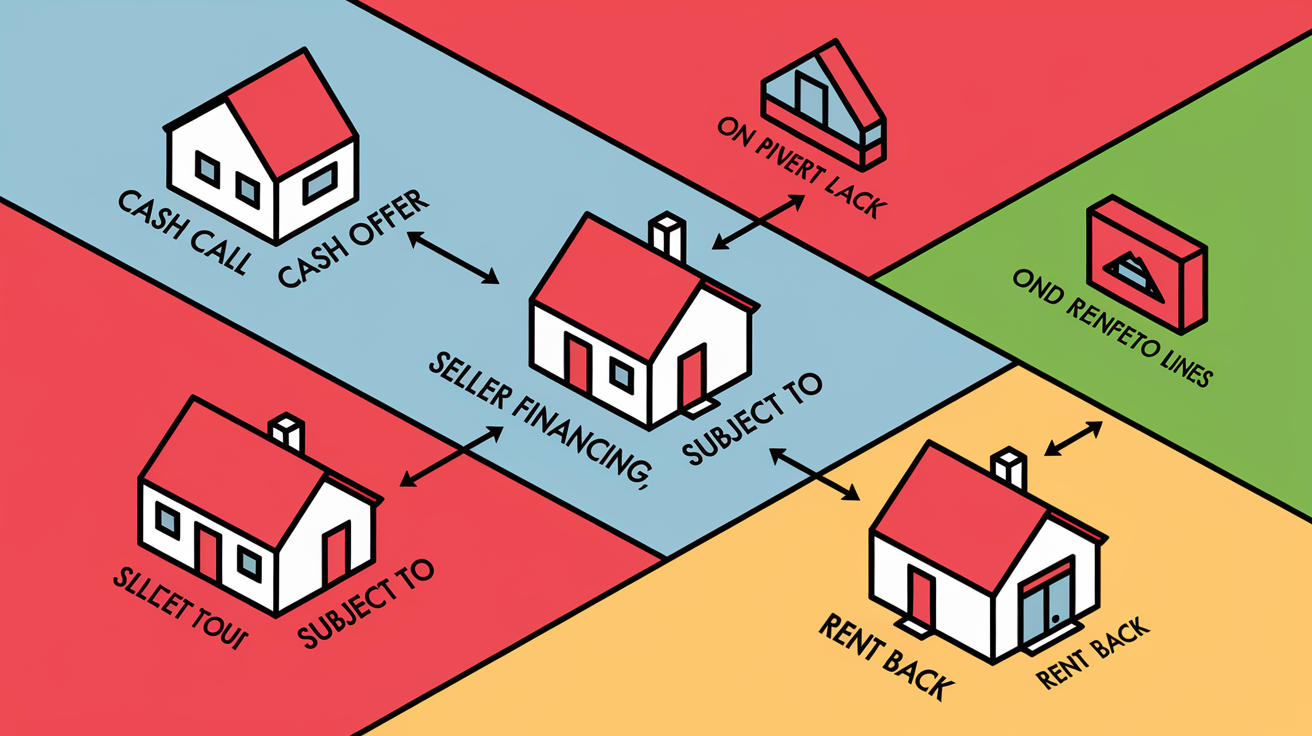
All-cash, as-is offers are the gold standard for distressed seller negotiations because they eliminate financing contingencies, appraisal risks, and repair demands. When you advertise a 7 to 14 day closing capability, you’re solving the seller’s timeline problem directly. Cash offers also let you cover closing costs, pay off outstanding liens, and hand the seller a net check at closing without deductions for realtor commissions or buyer credits. This simplicity is often worth more to a distressed seller than an extra $5,000 or $10,000 on the purchase price.
Subject-to existing financing means taking over the seller’s mortgage payments while the loan remains in their name. This strategy works well when the seller has a low interest rate or needs to avoid foreclosure immediately, but it carries legal and title risks for both parties. The lender can call the loan due if they discover the transfer, and the seller remains liable if you stop making payments. Always involve a real estate attorney when structuring subject-to deals, and make sure the seller understands the risks and benefits in plain language before proceeding.
Seller financing gives sellers a monthly income stream instead of a lump sum payout, which can appeal to retirees or estate executors who want passive income. A typical structure might include a 5 to 7 percent interest rate, a 3 to 5 year balloon payment, and monthly installments based on a 20 or 30 year amortization schedule. Rent-back arrangements let sellers stay in the home as tenants for 30 to 90 days after closing, which solves moving logistics and gives them breathing room to find new housing. Wholesale assignment routes let you lock up a property under contract and assign that contract to another investor for a fee of $3,000 to $20,000, depending on the spread between your contract price and the end buyer’s offer.
Here are four creative deal structures to present:
Cash with flexible close date. Offer to close in 7 days or 60 days, seller’s choice, to accommodate their timeline.
Seller financing with no money down. Buyer pays monthly installments directly to seller. No bank involved.
Subject-to with cash-to-seller at close. Take over payments and give seller $10,000 to $30,000 in immediate cash for equity relief.
Rent-back with discounted rent. Close quickly, let seller stay 30 to 90 days at below-market rent or rent-free as part of the deal terms.
Price Calculation and Repair-Based Negotiation for Distressed Homes

After-repair value (ARV) is the cornerstone of every distressed home offer calculation. ARV is what the property will be worth after all repairs and updates are complete, based on comparable sales of similar renovated homes in the neighborhood. To estimate ARV, pull recent sales (last 90 days) of properties with the same bed/bath count, square footage, and condition within a half-mile radius. Adjust for differences in lot size, garage, or finishes, then calculate a conservative average. Conservative matters because overestimating ARV by even 10 percent can turn a profitable deal into a loss.
Estimating repair costs requires a combination of contractor quotes, per-square-foot benchmarks, and property walkthroughs. For quick screening, use rough guidelines: cosmetic updates (paint, flooring, fixtures) run $15 to $25 per square foot. Moderate rehabs (kitchen, bath, HVAC) cost $30 to $50 per square foot. Heavy rehabs (foundation, roof, layout changes) can exceed $60 per square foot. Always add a 10 to 20 percent contingency buffer for surprises like hidden mold, outdated electrical panels, or permit issues. When negotiating, walk the seller through these costs line by line so they understand why your offer is lower than their hoped-for number.
The 70 percent rule is a wholesale investor’s quick-screen formula: your maximum offer should be 70 percent of ARV minus repair costs. This leaves room for holding costs, selling costs, and profit margin. Here are three numeric examples:
- Wholesale flip scenario – ARV = $200,000 | Repairs = $40,000 | Target offer = (0.70 × $200,000) − $40,000 = $140,000 − $40,000 = $100,000
- Rehab investor deal – ARV = $160,000 | Repairs = $25,000 | Target wholesale price = (0.70 × $160,000) − $25,000 = $112,000 − $25,000 = $87,000 | Assign to rehabber at $95,000 → assignment fee = $8,000
- Fast-close premium – ARV = $180,000 | Repairs = $30,000 | Base offer = $96,000 | Add $3,000 premium for 7-day close → final offer = $99,000
Use these calculations as starting points, not rigid formulas. Local market conditions, competition, and seller urgency all influence final pricing. The key is to present transparent math during negotiation so the seller sees you’re being fair, not lowballing.
Objection Handling Strategies for Motivated Distressed Sellers

The “I need more time” objection usually signals uncertainty about the offer, not a genuine need for more days. When you hear this, respond with respect and curiosity: “I completely understand. This is a big decision. What specifically would you like to think over? I want to make sure I’ve answered everything before we leave.” This often reveals the real concern (price, timeline, trust) that you can address immediately. If timing truly is the issue, offer a 30 to 90 day rent-back or delayed closing date. Often, adding flexibility is worth more to the seller than adding cash to your offer.
“I owe too much on the mortgage” is common with underwater properties or sellers facing foreclosure. Start by asking exactly how much they owe (mortgage balance plus liens, taxes, and fees). If the debt exceeds your maximum offer, explain that a short sale with the lender might be the best path, or explore subject-to financing where you take over payments and give the seller cash for moving expenses. If the gap is small (under $10,000), consider covering the difference as part of your closing costs to make the deal work. Transparency about net proceeds using a simple one-page worksheet builds trust and shows you’re trying to solve their problem, not just profit from their distress.
Creating urgency without pressure means framing deadlines as facts, not threats. If the seller faces foreclosure in 14 days, you’re not creating urgency, you’re reflecting reality. Say, “Based on the foreclosure date, we’d need to close by [date] to stop the sale. Is that timeline workable for you?” When sellers claim they can get more money by listing with a realtor, contrast value instead of arguing: “You’re right that listing might get a higher gross price. After the 6 percent commission, potential repair credits, 60 to 90 day timeline, and financing fall-through risk, here’s what you’d net. With our offer, you net [amount] in 10 days with zero repairs or showings. Which scenario gives you more certainty?”
Here are five common objections and clear responses:
“Your offer is too low.” “I hear you. You want the most money. Let me show you a transparent breakdown of repair costs, holding costs, and comps so you see how I got to this number.”
“I can get more on the open market.” “You might. After commissions, repairs, time, and financing risk, here’s what you’d actually net. Our offer gives you certainty and speed.”
“My neighbor says it’s worth more.” “I respect that. Here are three comparable sales from the last 90 days. Let’s look at them together.”
“I need to talk to my spouse/attorney.” “Absolutely. When can we reconnect? I want to make sure all your questions are answered.”
“This feels rushed.” “I understand. Would a 30-day close or a rent-back option give you the time you need?”
Legal, Ethical, and Transactional Safeguards in Distressed Seller Negotiations

Ethics in distressed seller negotiations start with a simple test: if your grandmother were in this situation, would you feel good about how you’re treating her? Vulnerable sellers deserve full disclosure, clear explanations, and solutions that genuinely help them. Never use fear tactics, mislead about market value, hide material defects you discover, or pressure sellers into decisions they don’t understand. Your reputation and your ability to sleep at night depend on doing deals that are fair to both sides. Win-win isn’t a cliché. It’s a business model.
Legal compliance and documentation safeguards protect you from liability and ensure clean title transfer. Always perform title and lien searches before closing to uncover hidden encumbrances like mechanic’s liens, tax liens, or second mortgages. Verify the seller’s authority to sell by confirming they’re the legal owner, executor of an estate with probate authority, or holder of a valid power of attorney. When structuring creative deals like subject-to or seller financing, involve a real estate attorney to draft compliant agreements and explain risks to the seller in writing. If you’re cold-calling or mailing, comply with Do Not Call registries and local solicitation laws to avoid fines.
Here are four legal must-do items for every distressed seller negotiation:
Order a title search before closing. Uncover all liens, judgments, and ownership issues early so you can address them or walk away.
Confirm seller authority. Request proof of ownership, probate letters, or power of attorney documents if dealing with estates or representatives.
Use written agreements for all terms. Verbal promises are unenforceable and create confusion. Put timelines, price, and concessions in writing.
Involve an attorney for nonstandard deals. Subject-to, seller financing, and lease-options carry legal risks. Pay for professional review upfront to avoid expensive problems later.
Case Studies: Real-World Negotiations With Distressed Homeowners
Real numbers make abstract strategies concrete. These three case studies show how the negotiation frameworks, pricing formulas, and creative structures come together in actual deals. Each example includes ARV, repair estimates, offer logic, and final outcome.
Case 1: Foreclosure rescue with fast-close premium. A homeowner received a foreclosure notice with a sale date 10 days out. ARV = $185,000 | Repairs = $28,000 (cosmetic: paint, flooring, landscaping) | Standard formula offer = (0.70 × $185,000) − $28,000 = $129,500 − $28,000 = $101,500. The investor added a $4,000 fast-close premium to secure the deal and close in 7 days, bringing the final offer to $105,500. The seller accepted because it paid off the mortgage ($98,000), covered closing costs ($3,500), and gave them $4,000 cash to move. The investor wholesaled the contract to a rehabber for $115,000, netting a $9,500 assignment fee.
Case 2: Inherited property with seller financing. Three siblings inherited a home from their parents but couldn’t agree on repairs or selling strategy. ARV = $220,000 | Repairs = $35,000 (roof, HVAC, kitchen cabinets). The investor offered two options: (A) $120,000 all-cash close in 14 days, or (B) $140,000 with seller financing at 6 percent interest, 5-year balloon, and $20,000 down. The siblings chose option B because it gave them monthly income and a higher total payout. The investor rehabbed the property, rented it for $1,800/month, and refinanced after two years to pay off the balloon. The seller financing structure solved the family’s disagreement and gave the investor time to build equity.
Case 3: Subject-to with rent-back for relocation seller. A military family received transfer orders with 45 days to move across the country. ARV = $195,000 | Repairs = $18,000 (minor cosmetic). Mortgage balance = $145,000 at 3.5 percent interest. The investor offered to take over the existing mortgage payments (subject-to), give the seller $10,000 cash at closing for moving expenses, and allow a 60-day rent-back at $1,200/month (below market). The family accepted because it solved their timeline problem, gave them cash for the move, and let them stay in the home while they found housing near the new base. The investor later sold the property for $192,000 after light updates, netting $29,000 after holding costs and transaction fees.
Final Words
In the action, you ran through the full workflow: reading motivation, building rapport, using scripts, structuring offers, doing the math, handling objections, and protecting the deal legally.
Use the quick 7-step screen, ask the right discovery questions, show transparent numbers, and offer clear options — not pressure — so you turn urgency into certainty.
If you keep practicing the steps and respect seller needs, negotiating with motivated sellers of distressed houses becomes repeatable and fair. You’ll close better deals and sleep easier.
FAQ
Q: What are common agent red flags?
A: Common agent red flags are poor communication, missing license or references, pressure to list at an inflated price, vague comps, frequent missed appointments, and refusal to provide a written plan—verify license and recent sales.
Q: What devalues a house the most?
A: The factors that devalue a house the most are major structural or water damage, severe deferred maintenance, bad location (noise, flood zone), and large unpaid liens or code violations.
Q: What is the 3-3-3 rule in real estate?
A: The 3-3-3 rule in real estate isn’t universal; it’s shorthand used differently—common meanings include a 3-step pricing test over 3 weeks, or a quick qualification: three questions in three minutes.
Q: How to find motivated sellers of distressed properties?
A: To find motivated sellers of distressed properties, search public records (foreclosure, probate, tax liens), drive neighborhoods, pull MLS long-DOM listings, use direct mail, and network with attorneys, estate executors, and wholesalers.