
Think house hacking is a free ticket to tax breaks?
It’s partly true, but the IRS treats your home as two things: personal and rental.
That split decides which costs you can write off, where they belong on your return, and whether profits face extra tax.
This post walks through the core rules: how to allocate space, which rental expenses are deductible, depreciation basics, and passive-loss limits like the $25,000 exception.
Read on for simple examples and a quick checklist to protect your deductions.
Core Tax Treatment of a House Hack (Mixed-Use Property Rules)
The IRS looks at your house hack as two separate things. Part personal residence, part rental business. That split controls which deductions you get and where they land on your return. Live in a duplex and rent the other side? Occupy one bedroom of a single-family house and rent the rest? You’re running what the tax code calls mixed-use property.
Report your rental income and expenses on Schedule E (Form 1040). That’s where rental operations belong. Your personal mortgage interest and property taxes stay on Schedule A if you itemize, but only the slice tied to your living space. The rental share goes to Schedule E as a business deduction. This division runs through every shared expense. Insurance, utilities, repairs, HOA dues.
Providing substantial services to your tenants can change the game. Daily cleaning, meals, concierge-style assistance? The IRS may reclassify your activity from passive rental (Schedule E) to active business (Schedule C). Schedule C income can trigger self-employment tax. Most house hackers stick to basic landlord duties and keep everything on Schedule E.
Allocation is simple math. Take a 1,500-square-foot house where you rent 500 square feet to a roommate. Your rental percentage is 500 ÷ 1,500 = 33.3%. Apply that 33.3% to every shared cost. If annual mortgage interest is $6,000, the rental deduction on Schedule E is $2,000 (33.3% of $6,000). The remaining $4,000 is your personal portion, potentially itemizable on Schedule A.
What matters most with mixed-use classification:
- Only the rental portion of your expenses is deductible on Schedule E. Personal use generates no rental deduction.
- Mortgage interest and property taxes get split between rental (Schedule E) and personal (Schedule A) based on your allocation percentage.
- Depreciation applies only to the building value allocated to the rental portion. You can’t depreciate your own living space or any land.
- Providing substantial tenant services can move your income from Schedule E to Schedule C and potentially subject net profit to self-employment tax.
- Rental losses are generally passive. You may not be able to use them against W-2 income unless you qualify for the $25,000 active-participation exception.
- When you sell, the rental portion may face different capital-gains treatment and depreciation recapture. Your personal residence may qualify for the Section 121 exclusion.
Allocating Expenses in a House Hack for Maximum Tax Accuracy
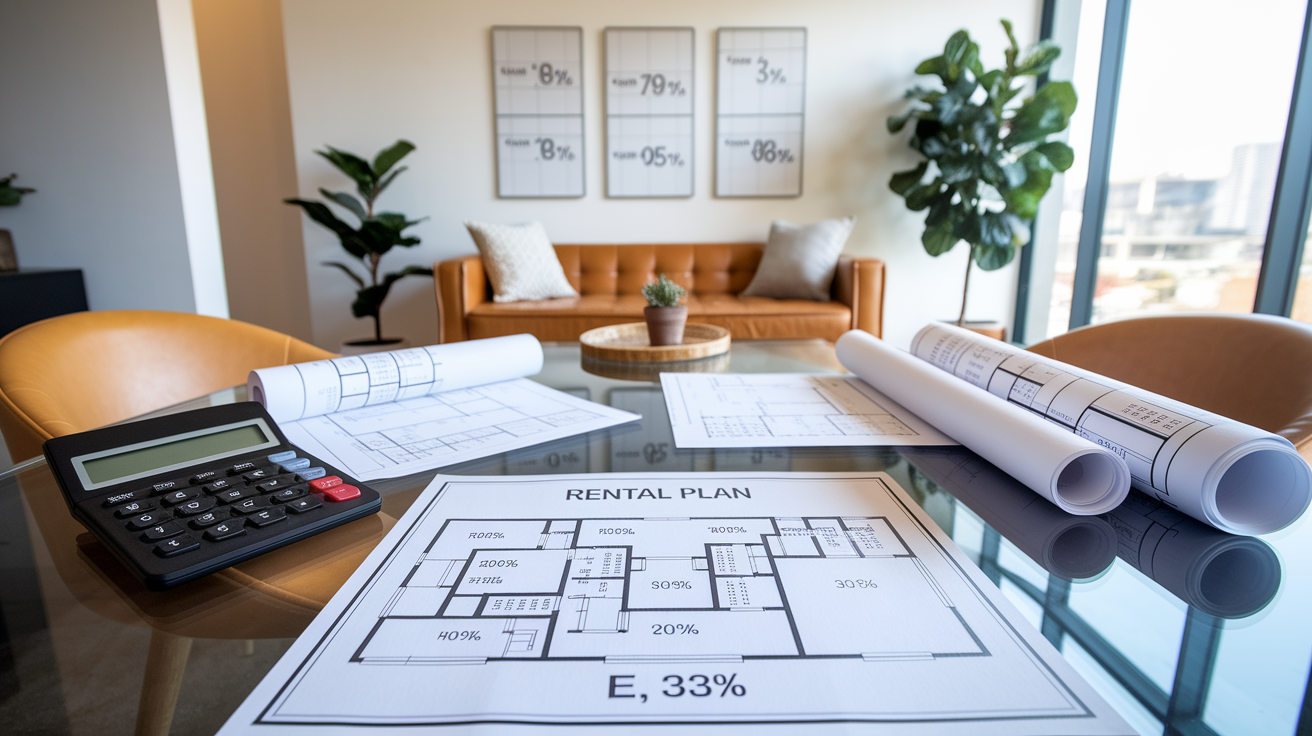
You need one consistent method to split costs between your rental business and your home. The two most common are square footage and bedroom count. Pick the one that gives you the highest rental percentage and document it every year with floor plans, measurements, or unit counts.
Square footage works well for duplexes and multifamily properties. Measure each unit or bedroom and calculate rental space divided by total space. Bedroom count is simpler when you’re renting rooms in a single-family house. Count bedrooms, assume equal sharing of common areas. Four-bedroom house, you occupy one bedroom? That’s 75% rental. Three units in a triplex, you live in one? That’s 67% rental.
Five steps for a compliant allocation:
- Measure or confirm square footage of rental areas and total property (use floor plans, county records, or a tape measure).
- Count units or bedrooms if using that method. Document which method you elected.
- Calculate rental percentage: rental square feet ÷ total square feet (or rental units ÷ total units).
- Apply that percentage to every shared expense: mortgage interest, property taxes, insurance, utilities, repairs, HOA.
- Save your calculations, floor plan, and supporting documents with your tax records each year.
Here’s a concrete example. You buy a four-unit building for $600,000 and live in one unit. Total square footage is 4,000 (four 1,000-square-foot units). Your rental portion is 3,000 ÷ 4,000 = 75%. Annual property insurance costs $2,400. Rental deduction on Schedule E: $2,400 × 75% = $1,800. Your personal share: $600. If you paid $8,000 in mortgage interest, rental deduction is $8,000 × 75% = $6,000. Personal portion is $2,000, potentially deductible on Schedule A if you itemize.
Deductible House Hack Expenses and How to Classify Them

Your rental portion of the property qualifies for the same deductions any landlord gets. Shared costs get deducted at your rental percentage. Mortgage interest, property taxes, insurance, utilities you pay on behalf of tenants. Direct rental expenses like advertising for tenants or a repair specific to the rental unit are 100% deductible.
Utilities present a clear rule. If you pay water, gas, electric, or trash for the entire property and tenants don’t reimburse you separately, deduct the rental percentage. If tenants pay their own utilities, you deduct nothing. If you pay and then bill back, include the reimbursement in rental income and deduct the full cost.
Distinguish repairs from improvements. Repairs maintain the property in working condition. Fixing a broken window, patching a roof leak, replacing a water heater. Those are deductible in the year you pay them, allocated to the rental portion. Improvements add value or extend useful life. New roof, room addition, HVAC system replacement. Those must be capitalized and depreciated over their recovery period.
Common deductible rental expenses for the rental portion:
- Mortgage interest (rental share)
- Property taxes (rental share)
- Hazard and liability insurance (rental share)
- Utilities paid by owner and not separately metered (rental share)
- HOA or condo fees (rental share)
- Repairs and maintenance (rental share for shared items, 100% for rental-unit-specific work)
- Advertising and tenant screening costs (100% rental)
- Property management fees or leasing commissions (100% rental)
- Legal and professional fees related to rental activity (100% rental)
- Supplies and small tools for rental maintenance (100% rental)
Repair vs. improvement example. Replacing a broken toilet flapper is a repair. Deduct the rental share immediately. Replacing the entire toilet because you’re upgrading fixtures is an improvement. Capitalize and depreciate the rental-allocated cost. The IRS watches this line closely, so keep receipts and notes explaining what you did and why.
House Hack Depreciation Rules and Building Basis Calculations

Depreciation is your largest non-cash deduction. Residential rental property uses a 27.5-year MACRS straight-line schedule. You can only depreciate the building. Land never wears out, so it gets zero depreciation.
Start with your total purchase price plus acquisition costs: title fees, recording fees, attorney fees, inspection costs, and any other closing expenses that add to your cost basis. Subtract the land value. Use your county assessor’s allocation or a professional appraisal to split building and land. Then multiply the building value by your rental percentage. That’s your depreciable basis for the rental portion.
Your personal living area can’t be depreciated while you occupy it. If you later convert your unit to a rental, you can start depreciating that portion at its adjusted basis when placed in service.
Step-by-Step Depreciation Example
You purchase a property for $300,000. Closing costs and acquisition fees total $10,000, bringing your total basis to $310,000. County assessor records show the land represents 20% of the property value. Land value: $310,000 × 20% = $62,000. Building value: $310,000 − $62,000 = $248,000.
You live in one unit of a duplex, so your rental percentage is 50%. Depreciable basis (rental portion of building): $248,000 × 50% = $124,000. Divide by 27.5 years: $124,000 ÷ 27.5 ≈ $4,509 annual depreciation. Claim that deduction every year on Form 4562 and carry it to Schedule E.
| Component | Amount | Depreciation Treatment |
|---|---|---|
| Total Purchase + Closing Costs | $310,000 | Not depreciated directly |
| Land Value (20%) | $62,000 | Never depreciated |
| Building Value | $248,000 | Only the rental share is depreciated |
| Rental Portion of Building (50%) | $124,000 | $124,000 ÷ 27.5 = $4,509/year |
If you move out later and rent your former unit, recalculate. Your rental percentage jumps to 100%, and you begin depreciating the remaining building portion using its adjusted basis at the new in-service date.
Passive Activity Rules and How They Limit or Expand House Hack Tax Benefits

Rental income is passive by default. Passive losses can only offset passive income. You can’t use a rental loss to reduce your W-2 wages unless you qualify for an exception. The most common exception for house hackers is the $25,000 active-participation special allowance.
You qualify for the $25,000 allowance if you own at least 10% of the property, you actively participate in management decisions (approving tenants, setting rents, choosing contractors), and your modified adjusted gross income (MAGI) is $100,000 or less. The full $25,000 is available below $100,000 MAGI. It phases out by 50 cents for every dollar of MAGI above $100,000 and disappears entirely at $150,000.
If your rental shows a loss after depreciation and expenses, the active-participation allowance lets you deduct up to $25,000 of that loss against your salary, bonus, or other non-passive income. Losses beyond the allowance carry forward indefinitely and offset future passive income or gain when you sell.
How the $25,000 active-participation allowance works:
- You must own ≥10% of the property and make management decisions. Tenant approval, repairs, contractor selection.
- Full $25,000 deduction allowed when MAGI ≤ $100,000.
- Allowance reduces by $0.50 for each $1 of MAGI over $100,000.
- Completely phased out when MAGI reaches $150,000.
- Suspended losses carry forward to offset future passive income or are released when you sell the property.
MAGI phaseout example. Your MAGI is $125,000. You’re $25,000 above the $100,000 threshold. Your allowance is reduced by $25,000 × 50% = $12,500. You can deduct up to $12,500 of rental loss against active income. If your rental loss is $8,000, you use all $8,000. If your rental loss is $15,000, you deduct $12,500 this year and carry forward $2,500.
Material participation is a higher bar. Spending more than 500 hours or more than anyone else on the rental activity. Most house hackers don’t meet that test. Real estate professional status requires 750+ hours in real property trades and more time in real estate than any other work. If you qualify, rental losses are non-passive and fully deductible. Most W-2 house hackers rely on the $25,000 allowance instead.
Capital Gains, Exclusion Rules, and Depreciation Recapture When Selling a House Hack
When you sell, the IRS splits your property into rental and personal pieces. Your personal residence may qualify for the Section 121 capital-gains exclusion: $250,000 for single filers, $500,000 for married filing jointly. To qualify, you must have owned and used the home as your primary residence for at least two of the five years before the sale.
The exclusion only covers gain attributable to personal use. Rental use and any nonqualified use after January 1, 2009, reduce the exclusion proportionally. If you house-hacked for three years (living in 50% of the property) and then rented the entire property for two years before selling, your nonqualified-use period affects how much exclusion you get.
Depreciation recapture is unavoidable. Every dollar of depreciation you claimed (or should have claimed) on the rental portion is recaptured as unrecaptured Section 1250 gain, taxed at a maximum rate of 25%. This happens even if the rest of your gain qualifies for the Section 121 exclusion.
Four steps to calculate taxable gain and recapture:
- Determine total gain: sale price minus adjusted basis (original basis plus improvements, minus depreciation taken).
- Allocate gain between personal and rental portions based on use history and square footage.
- Apply Section 121 exclusion to the personal-use gain if you meet the ownership and use tests (nonqualified use may reduce the exclusion).
- Report depreciation recapture separately: total depreciation claimed on the rental portion is taxed at up to 25%, regardless of exclusion eligibility.
Example with numbers. You bought a duplex for $400,000 ($80,000 land, $320,000 building). You lived in one unit (50% personal) for four years, claimed $23,273 total depreciation ($160,000 rental building ÷ 27.5 × 4 years), and sold for $500,000. Adjusted basis: $400,000 − $23,273 = $376,727. Total gain: $500,000 − $376,727 = $123,273.
Assume 50% of the gain ($61,637) is personal and 50% rental. If you’re single and meet the use test, you exclude up to $250,000 of personal gain. Your $61,637 is fully excluded. The $61,637 rental gain is taxable, plus $23,273 depreciation recapture at 25%. Your total federal tax hit: roughly $15,409 rental gain (long-term capital gains rate) + $5,818 recapture (25% × $23,273).
Converting from rental to primary or vice versa changes your allocation going forward but doesn’t create a new asset or reset basis. Track every change and keep records for the entire ownership period.
Short-Term Rental and Airbnb Tax Rules for House Hackers

Renting your extra space on Airbnb or other short-term platforms can shift your tax treatment. The IRS distinguishes between traditional long-term rentals and short-term arrangements, especially when the average rental period is seven days or less, or when you provide substantial services.
Substantial services include daily cleaning, regular linen changes, meals, or concierge-like assistance. Occasional turnover cleaning between guests usually doesn’t count. But if you’re cleaning daily, doing laundry mid-stay, or offering breakfast, the IRS may treat your income as business income on Schedule C instead of rental income on Schedule E. Schedule C income is subject to self-employment tax (15.3% on net profit), which can significantly increase your tax bill.
Tax differences between long-term and short-term rental treatment:
- Long-term rentals (Schedule E) are passive. Losses are subject to passive-activity limits and the $25,000 allowance.
- Short-term rentals with substantial services (Schedule C) generate active business income subject to self-employment tax on net profit.
- Short-term rentals without substantial services remain on Schedule E but may be tested differently under material-participation rules.
- If you provide daily cleaning or meals, your income moves to Schedule C, and you can no longer use the passive $25,000 loss allowance.
- Expenses remain deductible, but you must account for self-employment tax and may need to make quarterly estimated payments.
Most house hackers who Airbnb a spare room or basement without daily maid service report on Schedule E. Keep cleaning and services minimal, charge by the night or week, and document that tenants have independent access and control. If your service level resembles a hotel, expect Schedule C treatment and the self-employment tax that comes with it.
Record-Keeping Systems to Protect Deductions in a House Hack
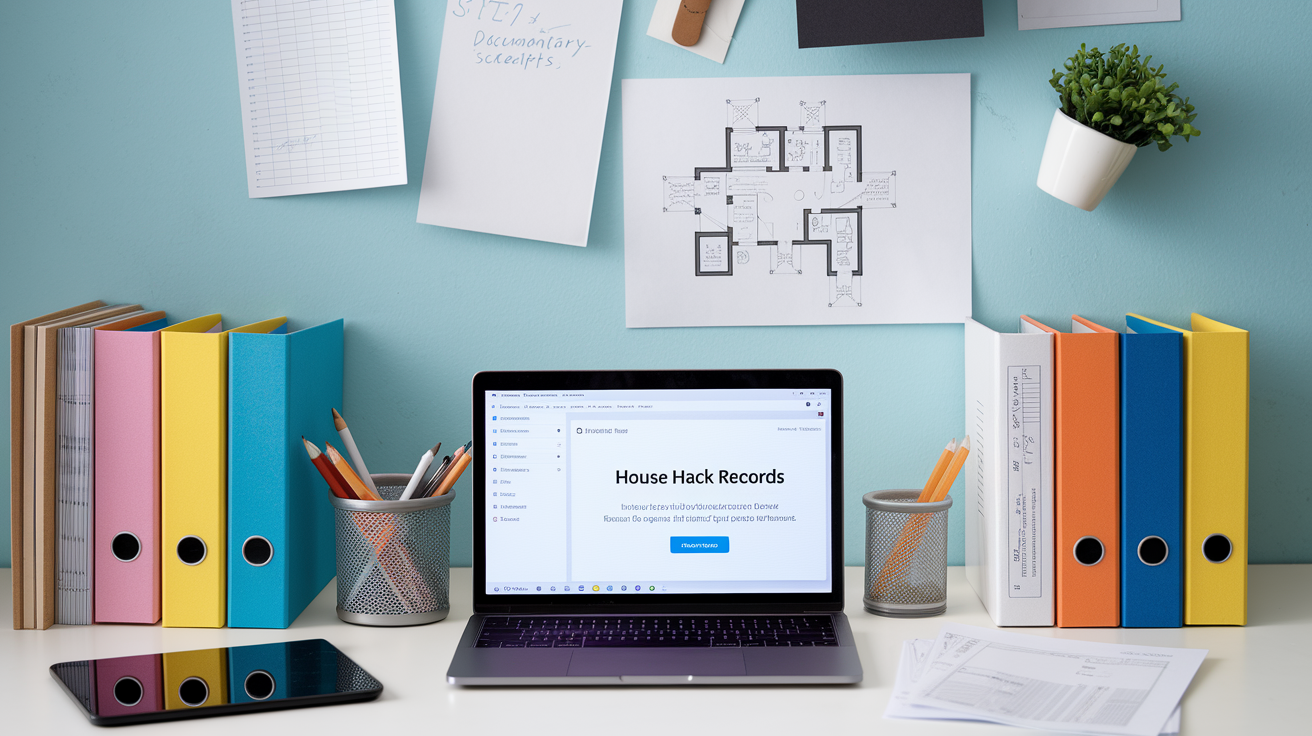
The IRS general statute of limitations is three years from the date you file your return, but examiners routinely ask for property records covering the entire ownership period. Best practice: keep acquisition documents, depreciation schedules, and capital-improvement receipts for as long as you own the property plus seven years after sale.
Separate your rental activity from personal finances. Open a dedicated bank account for rental income and expenses. Use accounting software or a simple spreadsheet to categorize every transaction by expense type and allocate shared costs monthly. When April comes, you’ll have a clean record instead of a shoebox full of mixed receipts.
Essential documents to maintain:
- Closing statement (HUD-1 or settlement statement) showing purchase price, acquisition costs, and property-tax credits.
- County assessor records or appraisal documenting land vs. building allocation.
- Floor plans or measurements supporting your square-footage or unit-count allocation method.
- Lease agreements, rent ledgers, and deposit records for every tenant.
- Receipts and invoices for repairs, maintenance, utilities, insurance, property taxes, and all other expenses.
- Photos of the property before improvements, during repairs, and after major work (supports repair vs. improvement classification).
- Annual depreciation worksheets and Form 4562 for each tax year.
Save digital copies in cloud storage with year-based folders. Paper receipts fade. Scan them. If the IRS questions your allocation or depreciation, you want to produce a floor plan, a spreadsheet, and the receipts within hours, not weeks.
Common House Hack Tax Errors and How to Avoid IRS Issues

Misallocating personal and rental percentages is the number-one audit risk. If you claim 80% rental on a duplex where both units are identical, the IRS will ask why. Measure carefully, document your method, and apply it consistently every year. Switching methods year to year without explanation raises red flags.
Depreciating land is a clear mistake. Land never wears out. If you don’t split building and land at purchase, you’ll overclaim depreciation and face adjustments plus interest when the error surfaces at sale. Always use assessor records or an appraisal to separate the two.
Mixing personal and rental funds in one bank account creates chaos during an audit. The IRS will disallow expenses you can’t prove were rental-related. A separate checking account costs nothing and saves hours of reconstruction if you’re ever examined.
Five best practices to prevent IRS issues:
- Document your allocation method with a written memo, floor plan, or unit breakdown every year. Attach it to your tax file.
- Split building and land using county assessor percentages or a qualified appraisal at purchase. Never depreciate the land portion.
- Use a dedicated rental bank account and accounting software to track every income and expense transaction.
- Classify repairs vs. improvements correctly: repairs deduct now, improvements capitalize and depreciate. When in doubt, ask your CPA before filing.
- Track depreciation precisely in a schedule that carries forward year to year, reducing your basis and preparing for recapture at sale.
Exceeding personal-use limits can flip your property into vacation-home rules, where rental deductions are limited if personal use exceeds the greater of 14 days or 10% of total rental days. Most year-round house hackers stay well under those thresholds, but if you Airbnb sporadically and use the space yourself frequently, watch the day count.
Report all rental income. Even cash payments count. The IRS matches 1099 forms from payment processors, and underreporting income is the fastest way to trigger a correspondence audit.
Practical Tax-Saving Strategies Specific to House Hackers

Choose the allocation method that maximizes your rental percentage, then document it. If bedroom count gives you 75% rental and square footage gives you 67%, elect the bedroom method and write down your reasoning. The IRS allows you to pick. Just be consistent and honest.
Time repairs and maintenance to bunch deductions in high-income years. If you’re closing on the property in December, wait until January to paint and fix unless the work is required before tenants move in. Deductible expenses in a year when your marginal rate is higher save more tax.
Separate your rental finances completely. One checking account for rent deposits and expenses, one credit card for rental purchases. At year-end, export transactions and categorize. This fifteen-minute-per-month habit eliminates weekend-long receipt hunts in March.
Cost segregation studies can accelerate depreciation by reclassifying building components. Appliances, carpets, cabinets into shorter recovery periods (5, 7, or 15 years instead of 27.5). The upfront cost of a study (often $5,000 to $15,000) makes sense when your building basis exceeds $200,000 to $500,000 and you want larger early deductions. For a $300,000 duplex with $150,000 rental building basis, cost segregation may not pencil. For a $600,000 fourplex with $400,000 rental building basis, it might.
Track every dollar of depreciation in a running schedule. When you sell, your basis is reduced by all depreciation allowed or allowable. If you forget to claim $3,000 one year, the IRS still reduces your basis by $3,000 and recaptures it, so you lose the deduction and pay recapture tax anyway. Claim it every year or file an amended return to catch up.
Actionable tactics for house hackers:
- Measure square footage or count bedrooms and units. Calculate both methods and document the one that yields the higher rental percentage.
- Separate rental and personal bank accounts and use simple bookkeeping software (or a spreadsheet) updated monthly.
- Bunch deductible repairs in high-income tax years when your marginal rate is highest.
- Consider cost segregation only when rental building basis is substantial (generally $200,000+ rental portion) and you want accelerated depreciation.
- Track cumulative depreciation in a basis worksheet that adjusts for improvements and prepares you for recapture on sale.
- Keep acquisition documents, floor plans, and receipts for the life of the property plus seven years post-sale.
- Review passive-loss carryforwards annually. If your income drops below $100,000 MAGI, you may unlock suspended losses.
- Consult a CPA before the first filing to confirm basis, allocation, and depreciation calculations. Mistakes in year one compound every year after.
A 1031 exchange allows you to defer capital gains by reinvesting sale proceeds into another investment property. But the 1031 only applies to the rental portion of your house hack. The personal-residence piece doesn’t qualify for like-kind exchange treatment. If you house-hacked a duplex (50% personal, 50% rental) and want to 1031 the rental half into a new property, you’ll need to carefully allocate proceeds and work with a qualified intermediary and tax advisor. The personal portion is handled separately, potentially using the Section 121 exclusion if you meet the use tests. This split-treatment complexity is why many house hackers simply sell, take the exclusion on personal gain, pay recapture on rental depreciation, and move on rather than attempt a partial 1031.
Final Words
In the action, we walked through how a house hack is treated as a mixed-use property, how to allocate expenses, which deductions to claim, depreciation basics, passive loss limits, sale and recapture rules, short-term rental traps, record keeping, common errors, and practical tax-saving tactics.
If you take one step now, document your allocation, track receipts, and run the numbers. This wrap-up on house hacking tax implications and deductions explained gives a clear framework so you can make lower-risk choices and keep more of your returns.
FAQ
Q: How does the IRS treat a house hack for taxes?
A: The IRS treats a house hack as a mixed-use property: rental income is reported on Schedule E, personal mortgage interest and taxes may go on Schedule A, and expenses are allocated by rental percentage.
Q: When do I use Schedule E versus Schedule C for a house hack?
A: You use Schedule E for normal rental activity; you use Schedule C if you provide substantial services (meals, daily cleaning) or run it like a business, which can trigger self-employment tax.
Q: How should I allocate expenses between personal and rental use?
A: Allocate expenses by a consistent method—square footage, bedroom count, or unit count—document measurements, then apply the rental percentage to mortgage interest, insurance, utilities, taxes, and repairs.
Q: What are the most common deductible expenses for a house hack?
A: Common deductible house hack expenses include mortgage interest, property taxes, insurance, tenant-area utilities, repairs, maintenance, advertising, management fees, tenant screening, and legal or professional fees.
Q: How do I handle repairs versus improvements for tax purposes?
A: Repairs are deductible immediately; improvements must be capitalized and depreciated. Classify work by whether it restores property versus adds lasting value, and keep receipts and descriptions.
Q: How does depreciation work for a house hack and how do I calculate the basis?
A: Depreciation uses a 27.5-year schedule for the building only. Calculate basis by subtracting land value from purchase plus acquisition costs, then apply your rental percentage for the depreciable basis.
Q: Can you show a quick depreciation example?
A: Using a $300,000 purchase with 20% land ($60,000), building $240,000, and 33.3% rental share: depreciable basis $80,000; annual MACRS depreciation ≈ $2,909.
Q: How do passive activity rules affect house hack losses?
A: Passive-loss rules can limit deductible losses; active participation allows up to $25,000 offset if AGI ≤ $100,000, phasing out to $150,000. Any disallowed losses carry forward.
Q: How is the Section 121 home sale exclusion applied to a house hack?
A: Section 121 can exclude $250k/$500k if you lived in the home 2 of the last 5 years; periods of rental or nonqualified use reduce the exclusion proportionally.
Q: What happens with depreciation recapture when I sell a house hack?
A: Depreciation recapture taxes prior depreciation at up to 25%; include the recaptured amount when calculating taxable gain and adjust basis for rental-use periods.
Q: When does a short-term rental trigger Schedule C or self-employment tax?
A: Short stays under seven days or providing substantial services can move the activity to Schedule C and potentially subject you to self-employment tax rather than typical rental treatment.
Q: What records should I keep to support house hack deductions?
A: Keep leases, rent ledgers, receipts, invoices, photos, allocation worksheets, bank statements, and mileage logs. Retain records at least three to seven years and use separate accounts when possible.
Q: What common tax mistakes do house hackers make and how can I avoid them?
A: Common mistakes are misallocating personal vs rental use, depreciating land, misclassifying services, mixing accounts, and mislabeling repairs. Avoid them with measurements, separate accounts, and clear receipts.
Q: What practical tax-saving tactics work for house hackers?
A: Practical tactics include choosing the best allocation method, timing deductible repairs, using separate accounts, tracking depreciation, considering cost segregation when basis is large, and planning sales with Section 121 or 1031 limits.