

Think you need a pile of cash to buy rental real estate? Think again.
FHA loans let first-time buyers buy a duplex, triplex, or fourplex with as little as 3.5% down, as long as you live in one unit.
But FHA has rules, including credit thresholds, occupancy timing, property standards, county loan limits, and a 75% rental income credit, and those details make or break a deal.
This post walks through the qualifying criteria and a step-by-step strategy so you can screen deals fast, manage risks, and know what to expect at closing.
Using an FHA Loan for House Hacking: Core Requirements Explained

FHA loans work great for house hacking. They’re probably the easiest way into multi-unit real estate if you don’t have a big pile of cash sitting around. With FHA, you can buy a duplex, triplex, or fourplex with just 3.5% down, as long as you’re willing to live in one of the units. That’s why so many first-time investors use this route to slash their housing costs and start building equity.
The concept is straightforward. You buy a property with up to four units, move into one, and rent out the rest. The rent from those other units can cover part of your mortgage, or maybe all of it. You might end up living for free while tenants pay down your loan. But FHA won’t let you just hand over keys and disappear. You’ve got to move in within 60 days of closing and stay there for at least a year. After that year’s up, you can move out, keep it as a rental, and do it again if you want to scale.
FHA also caps how much you can borrow based on where you’re buying. County loan limits vary. In most areas, you can finance a fourplex up to around $1,008,300 as of 2026, but that number shifts depending on location. Check your local limit before you start looking.
Here’s what you need to qualify:
- Down payment: 3.5% if your credit score is 580 or higher. 10% if you’re between 500 and 579.
- Credit score: At least 580 for the lower down payment. Below 500 usually won’t fly.
- Unit count: FHA covers 1 to 4 units. For house hacking, you want 2 to 4 so you’ve got rental income.
- Occupancy timing: Move in within 60 days and live there as your primary residence for at least 12 months.
- Loan limits: Can’t borrow more than the FHA limit for your county and unit count. Verify local caps first.
FHA Borrower Eligibility Criteria for Multi‑Unit Properties

FHA underwriting is more flexible than conventional loans, but there are still clear benchmarks. If your credit score is 580 or better, you get the 3.5% down payment deal. Between 500 and 579, you can still get approved, but you’ll need 10% down. Below 500 is usually a dead end. Lenders also look at your history. Recent foreclosures, bankruptcies, or delinquencies come with waiting periods, and you’ll need to prove you’ve rebuilt credit.
Income and employment get the standard two-year lookback. Lenders want W-2s and tax returns for the past two years, plus recent pay stubs. Self-employed? They’ll average your income from the last two years of returns. Employment gaps or job hopping can raise eyebrows, so be ready to explain.
Debt-to-income ratio matters. FHA usually caps your front-end DTI (housing payment divided by gross monthly income) around 31%, and back-end DTI (all debts divided by income) at 43%. But if you’ve got compensating factors like cash reserves, a bigger down payment, or a strong credit score, that back-end limit can stretch to about 50%. If you’re counting rental income from the other units to qualify, that gets factored into your DTI. FHA counts only 75% of projected rental income, though, not the full amount.
FHA Property Requirements for 2–4 Unit Buildings

FHA won’t finance just any building. The property has to meet HUD’s Minimum Property Standards. That’s code for safe, structurally sound, and livable. You need working HVAC, functional plumbing and electrical, a solid roof, no peeling lead paint, and no major health hazards. Cosmetic stuff doesn’t matter. Ugly kitchens and beat-up carpet are fine. But structural problems, sketchy wiring, or a crumbling foundation can tank your appraisal. If the appraiser flags serious issues, you’ll either negotiate repairs with the seller or use an FHA 203(k) Renovation Loan to roll repair costs into the mortgage.
For 3- and 4-unit properties, FHA runs a self-sufficiency test during underwriting. The appraiser puts together a rent schedule showing what each unit could realistically rent for based on local comps. If the total projected rental income from all units meets or exceeds your full PITI (principal, interest, taxes, insurance), the property passes the test. That can help you qualify even if your personal income alone wouldn’t cover the payment. If the rents fall short, you’ll need to show that your income plus 75% of the rental income together satisfy FHA’s DTI limits.
Multi-unit properties do better with separate utilities when possible. FHA doesn’t strictly require separate meters for gas, electric, and water, but separate systems make tenant billing cleaner and reduce your headaches. Appraisers and underwriters like properties with clear unit boundaries, separate entrances, and individual utility controls. Here’s what FHA checks on the property side:
- The appraisal has to confirm the property meets HUD Minimum Property Standards for safety and structure.
- For 3–4 unit buildings, projected rents from all units should meet or exceed PITI to pass the self-sufficiency test.
- Utilities should ideally be separately metered or at least clearly divided by unit.
- No major code violations, hazardous conditions, or deferred maintenance that creates safety risks.
How FHA Allows Rental Income to Support Loan Approval

One of the best parts of using FHA for house hacking is counting rental income toward your qualification. Lenders let you use 75% of the projected monthly rent from the units you won’t be living in. That 75% haircut accounts for vacancy and maintenance. So if an appraiser says one unit should rent for $1,200 per month, the lender credits you with $900 of qualifying income.
The rental income figure comes from the appraisal’s market rent schedule, not from what you think you can get or what you saw on Craigslist. The appraiser reviews recent rent comps in your area and assigns a fair market rent to each unit. If units are already occupied and you have signed leases, the lender may use actual lease amounts, but they’ll still compare those to the appraiser’s schedule. If your tenant is paying above market rent, the lender uses the lower number.
Adding that rental income to your gross monthly income can make or break your approval. If your base salary puts your back-end DTI at 48% but FHA’s limit is 43%, crediting $1,800 in rental income (75% of $2,400 in projected rents) might drop your DTI to 40% and get the loan approved. Just remember, rental income helps you qualify, but it doesn’t replace the need for stable personal income and cash reserves. Lenders still want to see that you can cover the mortgage if a unit sits vacant or a tenant disappears.
FHA Loan Application Workflow for House Hackers

The FHA process for a multi-unit house hack follows the same basic steps as any FHA purchase, with a few extra documentation layers because of the rental income and property complexity.
Get pre-approved with an FHA lender. Submit two years of W-2s or tax returns, recent pay stubs, bank statements showing your down payment funds, and a credit report. Tell the lender upfront you’re buying a 2–4 unit property for house hacking so they can discuss rental income qualification and DTI calculations.
Find a property that meets FHA standards. Work with an agent who understands multi-family properties and FHA appraisal requirements. Make sure the property doesn’t have obvious red flags like major structural damage, code violations, or safety hazards that would fail the appraisal.
Make an offer and open escrow. Include an FHA financing contingency in your contract so you can back out if the property doesn’t appraise or fails to meet FHA livability standards.
Order the FHA appraisal. The lender arranges this. The appraiser inspects the property, verifies it meets Minimum Property Standards, and prepares a market rent schedule for the units. This usually takes 7–10 days but can stretch longer in busy markets.
Submit the appraisal and rental income documentation to underwriting. If units are currently rented, provide signed leases. If they’re vacant, the underwriter uses the appraiser’s rent schedule to calculate 75% of projected income for qualification.
Clear underwriting conditions. The underwriter might ask for more documentation. Updated pay stubs, proof of funds for reserves, explanations of recent deposits, or contractor estimates if the appraisal flagged minor repairs. Respond quickly.
Close on the property. Review your Closing Disclosure at least three days before closing to confirm loan terms, interest rate, down payment, and total cash to close. Bring a cashier’s check or arrange a wire transfer for your down payment and closing costs, sign the paperwork, and get your keys.
Expect 30 to 45 days from accepted offer to closing. FHA appraisals and underwriting can add a few extra days compared to conventional loans, especially if the property needs minor repairs or the underwriter needs clarification on rental income documentation. Stay in close contact with your lender and agent.
Cost Breakdown Example for an FHA House Hack Purchase
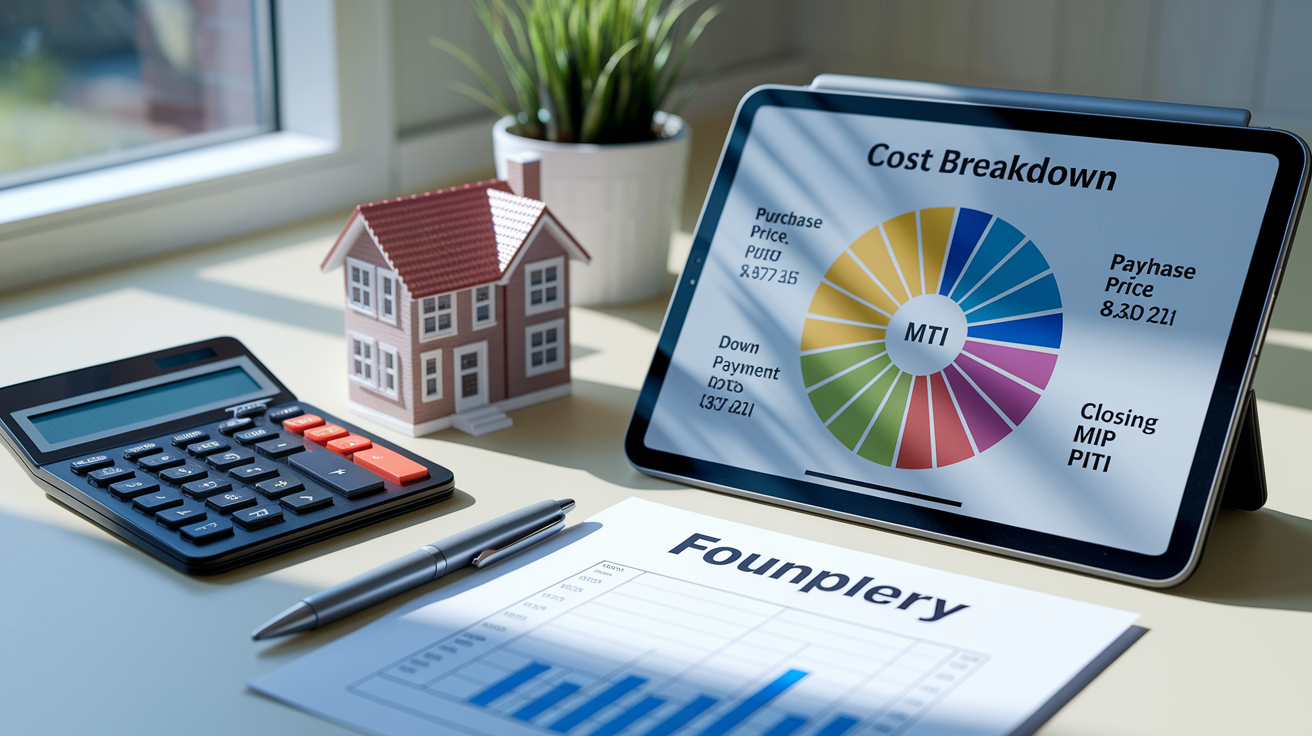
Let’s walk through the real numbers on a fourplex purchase so you can see what you’re actually spending upfront and every month. These figures are illustrative but grounded in typical 2026 FHA costs and interest rates.
Say you’re buying a $380,000 fourplex in a mid-sized market. You plan to live in one unit and rent out the other three. With a credit score of 620 and 3.5% down, here’s what the costs look like:
| Cost Category | Example Amount | Notes |
|---|---|---|
| Purchase Price | $380,000 | Fourplex in average market |
| Down Payment (3.5%) | $13,300 | Due at closing |
| Base Loan Amount | $366,700 | Purchase price minus down payment |
| Upfront MIP (1.75%) | $6,417 | Rolled into loan; total financed = $373,117 |
| Closing Costs (est. 2.5%) | $9,500 | Title, escrow, lender fees, prepaid taxes/insurance |
| Total Cash Needed | ~$22,800 | Down payment + closing costs |
Your monthly payment on the $373,117 financed amount at 7.25% interest would be roughly $2,546 in principal and interest. Add about $171 per month for annual MIP (approximately 0.55% of the loan balance), $400 for property taxes, $150 for homeowners insurance, and you’re looking at a total PITI of around $3,267 per month. If you rent the other three units at $1,000 each, that’s $3,000 in gross monthly rent, leaving you with a net housing cost of around $267 before accounting for maintenance, vacancy, or utilities. If one unit goes vacant or you set aside $200 a month for repairs, your actual cost creeps back up, but you’re still living in a fourplex for a fraction of what you’d pay to rent an apartment.
Common Pitfalls and How to Avoid Them When House Hacking with FHA

A lot of deals fall apart because buyers assume rental income projections will hold up without doing the homework. If the appraiser’s rent schedule comes in lower than your pro forma, your qualifying income drops, your DTI climbs, and you might not get approved. Always verify local rent comps yourself before you make an offer. Pull actual listings for similar units in the same neighborhood, talk to property managers, and build conservative rent estimates. If your numbers depend on every unit renting at top-of-market rates with zero vacancy, you’re setting yourself up for a denial or a cash-flow disaster.
Property condition surprises kill deals. FHA appraisals are stricter than conventional, and items that wouldn’t flag on a conventional deal can trigger repair requirements. Peeling exterior paint, a cracked window, missing handrails, or an older roof with visible wear can all cause problems. If the seller won’t fix those items and you don’t have the cash or the ability to use a 203(k) loan, your deal dies. Before you go under contract, walk the property carefully or bring a contractor for a pre-inspection. If you see deferred maintenance, factor repair costs into your offer or ask for a seller credit at closing.
Occupancy and appraisal timing catch people off guard. You’ve got to move in within 60 days of closing. Miss that window without lender approval, and you’re violating your loan agreement. Plan your move before you close. On the appraisal side, if the property doesn’t meet the self-sufficiency test for a 3- or 4-unit building and your personal DTI is already tight, the underwriter may deny the loan even if your credit score is fine. Run your own DTI calculation before you apply, including 75% of projected rents, and make sure you’re comfortably under 43% or have compensating factors that justify a higher ratio.
Final Words
Start by checking the basics: FHA lets you buy 1–4 unit properties with 3.5% down if you move into one unit within 60 days.
This post explained borrower rules (credit, DTI, down payment), property standards (appraisal, separate utilities, self‑sufficiency), how rental income is counted (about 75%), the application steps, a cost example, and common pitfalls.
Run a quick screen against house hacking with FHA loans requirements—owner‑occupancy timing, down payment, unit count, and loan limits—then line up a lender and an inspector. Do the checks, plan for repairs, and you’ll be ready to move.
FAQ
Q: What will disqualify a house from an FHA loan?
A: A house will be disqualified from an FHA loan if it fails HUD minimum property standards — unsafe structure, major health or safety hazards, missing essential utilities, or an appraisal finding it uninhabitable or not marketable.
Q: Is house hacking still a good idea?
A: House hacking is still a good idea when local rents cover a meaningful portion of mortgage and you can manage tenants. It cuts living costs and builds equity, but depends on market and your risk tolerance.
Q: What is the 75 rule for FHA loans?
A: The 75 rule for FHA loans means lenders count 75% of projected rental income from additional units toward your qualifying income, letting you offset vacancy and expenses when calculating debt‑to‑income ratios.
Q: What is an example of house hacking?
A: An example of house hacking is buying a duplex, living in one unit, and renting the other so the rent covers part or all of your mortgage, lowering your monthly housing expense while building equity.